
Comparison and Study of the Text of the Additional Psalms in the Manuscripts of the Book of Centuries and the Qumran Manuscript 11QPsa
DOI:
https://doi.org/10.21271/zjhs.30.3.11Keywords:
Psalms, Elia al-Anbari, Syriac, Hebrew, QumranAbstract
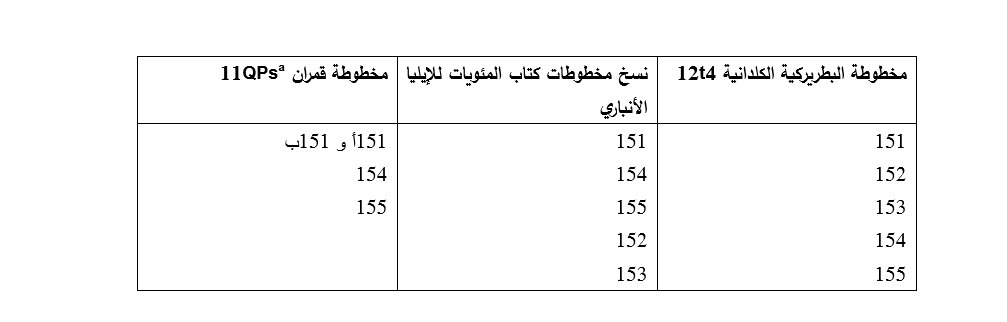
The Book of Centenaries by Elia al-Anbari has attracted the attention of some scholars since the last century, following the discovery of the Qumran manuscripts near the Dead Sea. One of the Qumran Hebrew manuscripts, numbered 11QPsa, contains some psalms previously known only from Syriac manuscripts, such as the Syriac Liturgical Codex 12t4 and the Book of Centenaries by Elia al-Anbari, which includes these additional psalms. The additional psalms were compared with several Syriac manuscripts containing the additional psalms, located in various libraries and museums, to reveal the differences between the texts. However, the Syriac manuscripts in Iraq were not available to scholars. This study is a continuation of the work of previous researchers. Its results show that the texts of the Psalms in the Syriac manuscripts of Elijah al-Anbari found in Iraq are consistent with the texts previously studied by researcher W. Baar in 1972. However, some of the manuscripts of Elijah al-Anbari's Centenaries found in Iraq do not contain the texts of the five additional psalms. When comparing Manuscript 12t4 with the Anbari manuscripts, there are clear differences between them in terms of the order of the psalms, their introductions, and some of the vocabulary used. Furthermore, when comparing the Syriac manuscripts together with the Qumran Hebrew manuscript 11QPsa, it becomes clear that there is a convergence, but there are some important differences between them, most notably the Qumran manuscript in Psalm 151 and Psalms 154-155. This suggests the possibility of different sources for both 11QPsa and the Syriac manuscripts, which each relied on to write the Psalms.
References
- الفغالي، بولس (1997)، "خمسة مزامير لم تكتب في لائحة المزامير" مجلة المشرق 1، ص 41-56.
- الكتاب المقدّس- الترجمة الكاثوليكيّة. دار المشرق، بيروت، 2012.
- Addai Scher, “Notice sur les manuscrits syriaques et arabes conserves a l’archeveche chaldeen de Diarbeker,” JA 10th ser., 10 (1907): 331–62, 385–431.
- Baars, W. (1972), ‘Apocryphal Psalms’, in The Old Testament in Syriac according to the Peshitta Version, part IV, fas. 6.
- Carbajosa, I. (2004), “11QPsa AND THE Hebrew Vorlage of the Peshitta Psalter.” AS 2 (1), pp. 3-24.
- Biblia Hebraica Stuttgartensia. A. Schenker, 1997.
- Eshel, H., & Eshel, E., 2000. “4Q448, Psalm 154 (Syriac), Sirach 48:20, and 4QpIsaa.” Journal of Biblical Literature, 119(4), pp. 645–659.
- Flint, P. W. (2000), “Variant Readings of the Dead Sea Psalms Scrolls, against the Massoretic Text and the Septuagint Psalter.” In: A. Aejmelaeus & U. Quast ed. Der Septuaginta-Psalter und seine Tochterübersetzungen. MSU XXIV; Göttingen: Vandenhoeck & Ruprecht, pp. 337-365.
- Juckel, A., (2011), “Eliya of al-Anbār (first half of the 10th cent.).” In: Brock, S. P. ed., The Gorgias Encyclopedic Dictionary of the Syriac Heritage, Piscataway, NJ: Gorgias Press, p. 142
- Mroczek, E. (2017), “The End of the Psalms in the Dead Sea Scrolls, Greek Codices, and Syriac Manuscripts.” In: Lied, L. and Lundhaug, H. ed. Snapshots of Evolving Traditions: Jewish and Christian Manuscript Culture, Textual Fluidity, and New Philology. Berlin, Boston: De Gruyter, pp. 297-322.
- Pajunen, M. (2011), “The Use of Different Aspects of the Deuteronomistic Ideology in Apocryphal Psalms.” In H. Weissenberg, J. Pakkala & M. Marttila (Ed.), Changes in Scripture: Rewriting and Interpreting Authoritative Traditions in the Second Temple Period. Berlin, New York: De Gruyter, pp. 347-368
- _____ (2021), “Psalms 151–155.” In: Oegema, Gerbern ed. Oxford Handbook of the Apocrypha. Oxford University Press, pp. 423–448
- Rahlfs, Alfred, and Robert Hanhart, eds. Biblia Graeca: Septuaginta. German Bible Society, 2013.
- Sanders, J. A. (1965), The Psalms Scroll of Qumran Cave 11 (11QPsa), Discoveries in the Judaean Desert 4. Oxford: Clarendon Press.
- Segal, M. (2002), “The Literary Development of Psalm 151: A New Look at the Septuagint Version.” Textus, 21(1), 139-158. https://doi.org/10.1163/2589255X-02101008
- Skehan, P. W. (1973), “A Liturgical Complex in 11QPsa.” CBQ 34, 195-205.
- _____ (1976), “Again, the Syriac Apocryphal Psalms.” The Catholic Biblical Quarterly 38(2), pp. 143–158. http://www.jstor.org/stable/43714169
- Strugnell, J. (1966), “Notes on the Text and Transmission of the Apocryphal Psalms 151, 154 (= Syr. II) and 155 (= Syr. III).” Harvard Theological Review, 59(3), pp. 257–281. doi:10.1017/S0017816000009767.
- Tov, E. (1992), Textual Criticism of the Hebrew Bible, Minneapolis, MN: Fortress Press.
- Van Rooy, H. F. (1993) “Psalm 155: One, Two or Three Texts?” Revue de Qumrân 61 (16), pp. 109–122.
- _____ (1995), “The Textual Traditions and Origin of The Syriac Apocryphal Psalm 152.” Journal of Northwest Semitic Languages 21 (2), pp. 93-104.
- _____ (1998), “The Marginal Notes to the Syriac Apocryphal Psalms in Manuscript 12T4.” Vetus Testamentum 48(4), 542–554.
- Yohanna, S.S. (2023), “Comparative Textual Criticism of the Peshitta of the Book of Psalms” Zanco Journal of Humanity Sciences, 27 )s6), pp. 75-92: Second Arba'ilu International Conference on Syriac and Sureth Studies (2nd AICSSS 2023). DOI: https://doi.org/10.21271/zjhs.27.s6.7
Downloads
Published
How to Cite
Issue
Section
License
Copyright (c) 2026 Luma Aphraim Khudher

This work is licensed under a Creative Commons Attribution 4.0 International License.