
Exploring the Use of Hesitators in Kurdish Learners of English Conversation
DOI:
https://doi.org/10.21271/zjhs.29.SpA.15Keywords:
Hesitators Types Frequency Kurdish ConversationAbstract
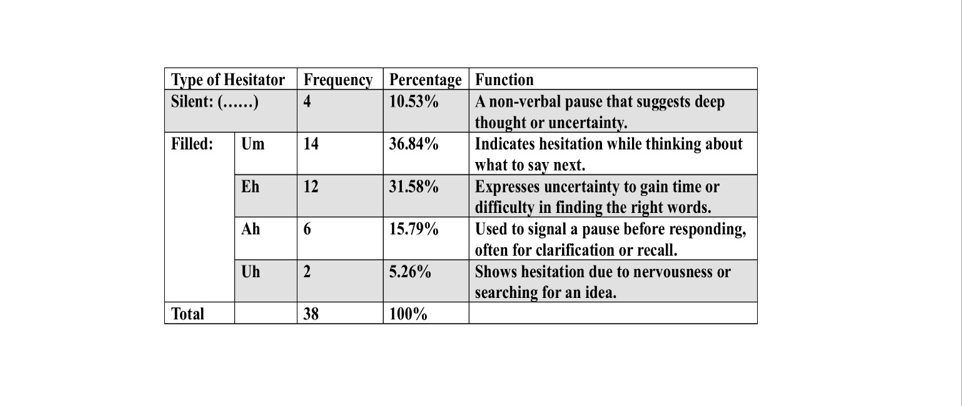
Speakers frequently utilize fillers to gain time while they generate thoughts. This behavior is known as the pause or hesitation phenomenon. The study aims to identify the most commonly used hesitators during spoken interactions. It will categorize hesitators into various groups, helping to identify which types are more prevalent and which present challenges for learners. Through the classification of hesitators, the study will highlight particular difficulties learners encounter with their language usage. Analysis showed that students used hesitators, such as silent hesitator and filled “uh”, “ah”, “eh and “um,” an average of 38 times per class, largely during complicated discussions. Hesitators acted as time-gaining devices, markers of uncertainty, and turn-taking facilitators. Their overuse occasionally stifled fluency, while their effective use aided communication. Teachers are called to increase awareness of the usage of hesitators, present alternative tools, and encourage their polysemous interpretation.
References
Biber, D., Leech, G. & Conrad, S., 2002. Longman Grammar of Spoken and Written English. Harlow: Pearson Education Limited.
- Boonsuk, Y., Ambele, E. A. & Buddharat, C., 2019. Position of hesitation markers in everyday, informal conversation in English. ABAC Journal, 39(3), pp. 129-140.
- Carrol, D. W., 2008. Psychology of language. 5th ed. New York: Thomson Wadsworth,.
- Cenoz, J., 1998. Pauses and communication strategies in second language speech.
- Clark, H. H. & Tree, J. E. F., 2002. Using 'uh' and 'um' in spontaneous speaking. Cognition, 84(1), p. 73–111.
- Das, R. K., 2023. Structure of spoken discourse and strategies for speaking well. International Journal for Research Trends and Innovation , 8(8), pp. 81-88.
- Gilquin, G., 2008. Hesitation markers among EFL learners: Pragmatic deficiency or difference?". Pragmatics and Corpus Linguistics: A Mutualistic Entente, Volume 2, pp. 119-149.
- Goffman, E., 1981. Forms of talk. First ed. Philadelphia : University of Pennsylvania Press.
- Goldman-Eisler, F., 1958. Speech production and the predictability of words in context. Quarterly journal of experimental psychology, 10(2), pp. 96-106.
- Leeuw, E. d., 2007. Hesitation Markers in English, German, and Dutch. Journal of Germanic Linguistics, 19(2), pp. 85-114.
- Maclay, H. & Osgood, C. E., 1959. Hesitation phenomena in spontaneous English speech. Word, 15(1), pp. 19-44.
- Schachter, S., Nicholas Christenfeld, Ravina, B. & Bilous, F., 1991. Speech disfluency and the structure of knowledge. Journal of Personality and Social Psychology, 60(3), pp. 362-367.
Downloads
Published
How to Cite
Issue
Section
License
Copyright (c) 2025 Farhang Ali Awdi, Anjuman Muhamad Sabir

This work is licensed under a Creative Commons Attribution 4.0 International License.