
استكشاف دور مكونات القيادة الاستراتيجية في تطوير المنظمات الذكية: أدلة من شركات الاتصالات في إقليم كردستان
DOI:
https://doi.org/10.21271/zjhs.29.SpC.51الكلمات المفتاحية:
Strategic Leadership, Digitalization, Smart Organizations, Telecommunication Companies, Kurdistan Regionالملخص
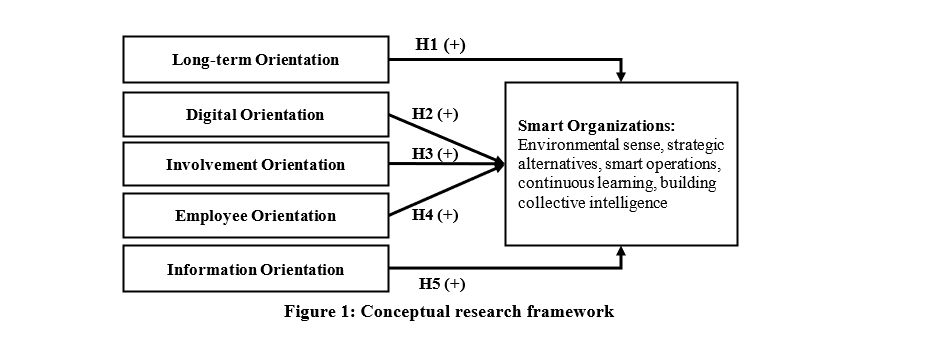
الهدف الرئيسي من هذا البحث هو استكشاف دور مكونات القيادة الاستراتيجية الرئيسية مثل التوجه طويل المدى والتوجه الرقمي والتوجه نحو المشاركة والتوجه نحو الموظفين والتوجه نحو المعلومات في تطوير المنظمات الذكية. بناءً على ذلك، تم توزيع استبيان منظم على الإداريين والفنيين في شركات الاتصالات في إقليم كردستان العراق، وهي آسياسيل وكورك تيليكوم وزين العراق، كجزء من تصميم ومنهج البحث، وتم الحصول على ما مجموعه 397 إجابة صحيحة. تم استخدام نمذجة المعادلات الهيكلية للمربعات الصغرى الجزئية (PLS-SEM) كأسلوب تحليل إحصائي لاختبار الفرضيات المقترحة. تثبت النتائج أن تطوير المنظمات الذكية يتأثر إيجابياً بجميع مكونات القيادة الاستراتيجية الرئيسية الخمسة. كان أهمها تأثير التوجه نحو الموظفين والتوجه الرقمي في شركات الاتصالات. كما أكدت الآثار الإيجابية والمهمة للتوجهات المعلوماتية والتوجه نحو المشاركة الدور الحيوي للقيادة القائمة على البيانات والمشاركة الفعالة في فعالية القادة. تُشير هذه النتائج إلى أنه لتعزيز الممارسات الذكية، والمرونة، والابتكار داخل المؤسسات، بما في ذلك شركات الاتصالات، ينبغي على القادة اعتماد نهج استراتيجي متعدد الجوانب. يُقدم البحث رؤى عملية لقادة شركات الاتصالات الراغبين في الاستثمار في التكنولوجيا الرقمية والممارسات كثيفة المعرفة في مرحلة الانتقال نحو نماذج تنظمات ذكية.
المراجع
- Abdullah, H.A., Hamad, A.A., & Abdulkarim, A.I. (2020). Detecting the dimensions of smart organizations: An analytical study from the perceptions of teaching staff at Samarra University. Journal of Administration and Economics, 126, 105-118.
- Adaileh, A.M., & Adaileh, N.A. (2021). The impact of strategic leadership practices on organizational learning capabilities in public universities in the southern region of Jordan. Journal of Legal, Ethical and Regulatory Issues, 24(6), 1-19.
- Adamczewski, P. (2016). ICT solutions in intelligent organizations as challenges in a knowledge economy. De Gruter Open, Journal of Management, 20(2), 198-209.
- Adamik, A. (2020). SMEs on the way to the SMART World of Industry 4.0. In Proceedings of the 25th Eurasia Business and Economics Society Conference, Series: Eurasian Studies in Business and Economics; Bilgin, M.H., Danis, H., Eds.; Springer: Cham, Switzerland, 2, 3-43.
- Al-Juboory, K.M., & Al-Samman, H.A. (2020). Strategic orientations and smart organizations: Removing silos and promoting integration. Journal of Business and Management, 22(3), 122-138.
- Alzoubi, H.M., Ahmed, U., & Amran, A. (2022). Strategic leadership and organizational performance: Mediating role of dynamic capabilities and organizational agility. Journal of Strategy and Management, 15(2), 179-198.
- Alzubia, M., & Khalid, M.B. (2022). The effect of strategic leadership on intellectual capital: The mediating role of knowledge sharing in Kuwait industrial companies. Management Science Letters, 12 (2022), 291-306.
- Avolio, B.J., Walumbwa, F.O., & Weber, T.J. (2009). Leadership: Current theories, research, and future directions. Annual Review of Psychology, 60, 421-449.
- Bharadwaj, A., El Sawy, O.A., Pavlou, P.A., & Venkatraman, N. (2013). Digital business strategy: Toward a next generation of insights. MIS Quarterly, 37(2), 471-482.
- Bhattacharyya, S.S., & Jha, S. (2018). Strategic Leadership Models and Theories: Indian Perspectives, Emerald Publishing Limited, Leeds, 195-204.
- Boal, K. B., & Hooijberg, R. (2001). Strategic leadership research: Moving on. The Leadership Quarterly, 11(4), 515-549.
- Chin, W.W., Marcolin, B.L., & Newsted, P.R. (2003). A Partial Least Squares PLS latent variable modeling approach for measuring interaction effects: Results from a Monte Carlo simulation study and an electronic-mail emotion/adoption study. Information Systems Research, 14(2), 189-217.
- Creswell, J.W., & Creswell, J.D. (2018). Research design: Qualitative, quantitative, and mixed methods approach. 5th Edition, SAGE Publications.
- Davenport, T.H., & Harris, J.G. (2017). Competing on analytics: The new science of winning. Harvard Business Review Press.
- Davenport, T.H., & Ronanki, R. (2018). Artificial intelligence for the real world. Harvard Business Review, 96(1), 108-116.
- Filos, E. (2006). Smart organizations in the digital age. In I. Mezgár (Ed.), Integration of ICT in Smart Organizations (pp. 1-38). Idea Group Publishing.
- Hadi, Q.A. (2013). Formulating the sustainable strategy of the company in building smart organizations: a study of the sample opinions of managers in Zain Iraq Telecom Company. Al-Ghari Journal of Economic and Administrative Sciences, 9(26), University of Kufa, Najaf, Iraq.
- Hair, J.F., Black, W.C., Babin, B.J., & Anderson, R.E. (2019). Multivariate data analysis (8th ed.). Cengage Learning.
- Hair, J.F., Hult, G.T.M., Ringle, C., & Sarstedt, M. (2021). A Primer on Partial Least Squares Structural Equation Modeling (PLS-SEM). 3rd Edition, SAGE Publications.
- Heifetz, R.A., Grashow, A., & Linsky, M. (2009). The practice of adaptive leadership: Tools and tactics for changing your organization and the world. Boston, MA: Harvard Business Review Press.
- Henseler, J., & Sarstedt, M. (2013). Goodness-of-fit indices for partial least squares (РLЅ), path modeling, Computational Statistics, 28, 565-580.
- Henseler, J., Hubona, G., & Ray, P. A. (2016). Using PLS path modeling in new technology research: Updated guidelines. Industrial Management & Data Systems, 116(1), 2–20.
- Henseler, J., Ringle, C.M., & Sinkovics, R.R. (2009). The Use of Partial Least Squares (PLS) Path Modeling in International Marketing. Advances in International Marketing (AIM), 20, 277-320.
- Hill, C.W., Schilling, M.A., & Jones, G.R. (2017). Strategic management, 12th ed. Boston: Cengage Learning.
- Ireland, R.D., & Hitt, M.A. (2005). Achieving and maintaining strategic competitiveness in the 21st century: The role of strategic leadership. Academy of Management Executive, 19(4), 63-77.
- Ismail, A.I., Mohamed, H.A.B., Sulaiman, M., Mohamad, M., & Yusuf, M.H. (2018). Strategic leadership and organizational performance: A review and research agenda. International Journal of Management Studies, 25(1), 113-133.
- Katzenbach, J.R., & Smith, D.K. (2005). The wisdom of teams: Creating the high-performance organization. Harper Business.
- Khaddam, A.A., Artima, H.J., & Badr, B. (2020). Human resources management strategies and their impact on smart organizations: The moderate role of employee empowerment: A field study on a group of pharmacies operating in the Capital of Amman. Global Journal of Economics and Business, 8(1), 117-148.
- KRG Ministry of Transportation and Communications. (2022). Annual Report on Digital Transformation and Telecom Infrastructure in the Kurdistan Region. Erbil: KRG Publications.
- Kumar, A., Anand, G., & Nandedkar, T. (2024). A smart leader in a VUCA world: Presenting key components of strategic leadership using the SLR method. Indonesian Management and Accounting Research, 23(1), 87-108.
- Makhmutov, S., Utepbergenov, Y., & Sabirova, L. (2016). Employee-oriented practices in innovative smart enterprises. International Journal of Economics and Financial Issues, 6(S7), 79-84.
- Malone, T.W., & Bernstein, M.S. (Eds.). (2015). Handbook of collective intelligence. MIT Press.
- Marchand, D.A., Kettinger, W.J., & Rollins, J.D. (2001). Information orientation: The link to business performance. Oxford University Press.
- Morrar, R., Arman, H., & Mousa, S. (2017). The Fourth Industrial Revolution (Industry 4.0): A social innovation perspective. Technology Innovation Management Review, 7(11), 12-20.
- Pisano, G.P. (2015). You need an innovative strategy. Harvard Business Review, 93(6), 44-54.
- Quong, T., &Walker, A. (2010). Seven principles of strategic leadership. ISEA, 38(1), 23-33.
- Rashid, W.N. (2025). The Role of Authentic Leadership on Organizational Identification through Quality of Work Life: An Exploratory Study of the Perspectives of a Sample of Employees in a Number of Private Hospitals in Sulaymaniyah City, in Kurdistan Region of Iraq. Zanco Journal of Human Sciences, 29(3); 163-194.
- Ringle, C., Wende, S., and Will, A. (2005). Smart-PLS 2.0.M3, Smart-PLS, Hamburg. Retrieved from http://www.smartpls.de.
- Robbins, S.P., & Judge, T.A. (2019). Organizational behavior. Upper Saddle River, NJ: Pearson.
- Russell, G. (2018). Strategic leadership in technology implementation: A case study of the director's role in the classroom (Unpublished PhD thesis), Northwestern Nazarene University - Department of Higher Education, USA.
- Saunders, M., Lewis, P., & Thornhill, A. (2019). Research Methods for Business Students. 8th Edition, Pearson Education.
- Sekaran, U., & Bougie, R. (2016). Research Methods for Business: A Skill-Building Approach. 7th Edition. Wiley.
- Singh, A., Lim, W.M., Jha, S., Kumar, S., & Ciasullo, M.V. (2023). The state of the art of strategic leadership. Journal of Business Research, 158, 1-21.
- Sonmez Cakir, F., & Adiguzel, Z. (2020). Analysis of leader effectiveness in organization and knowledge sharing behavior on employees and organization, SAGE Open, 10(1), 1-14.
- Tallon, P.P., Queiroz, M., Coltman, T., & Sharma, R. (2019). Information technology and the search for organizational agility: A systematic review. MIS Quarterly, 43(1), 1-28.
- Tao, F., Qi, Q., Liu, A., & Kusiak, A. (2018). Data-driven smart manufacturing. Journal of Manufacturing Systems, 48, 157-169.
- Teece, D. J. (2007). Explicating dynamic capabilities: The nature and microfoundations of (sustainable) enterprise performance. Strategic Management Journal, 28(13), 1319-1350.
- Wamba, S. F., Gunasekaran, A., Akter, S., Ren, S.J.-F., Dubey, R., & Childe, S.J. (2017). Big data analytics and firm performance: Effects of dynamic capabilities. Journal of Business Research, 70, 356-365.
- Wang, Y., Zhang, X., Goh, M., & Wang, Y. (2020). Smart organization and enterprise information systems capabilities: An empirical study. Information Systems Frontiers, 22(4), 819-835.
- Westerman, G., Bonnet, D., & McAfee, A. (2014). Leading digital: Turning technology into business transformation. Harvard Business Review Press.
- Yaghoubi, N.M., Asgari, A.A., & Ghasemi, H. (2011). The evaluation of smart organization characteristics: A new approach for organization excellence. Interdisciplinary Journal of Contemporary Research in Business, 3(3), 395-408.
التنزيلات
منشور
كيفية الاقتباس
إصدار
القسم
الرخصة
الحقوق الفكرية (c) 2025 Hussein Ahmad Mustafa, Ahlam Ibrahim Wali

هذا العمل مرخص بموجب Creative Commons Attribution 4.0 International License.