
دور الذكاء الاصطناعي في تحسین مهارات التفكیر النقدي لدى طلاب اللغة الإنجلیزیة كلغة أجنبیة في جامعة صلاح الدین
DOI:
https://doi.org/10.21271/zjhs.29.SpB.50الكلمات المفتاحية:
الكلمات المفتاحية: الذكاء الاصطناعي، اللغة الإنجليزية كلغة أجنبية، التفكير النقدي، تكامل التكنولوجياالملخص
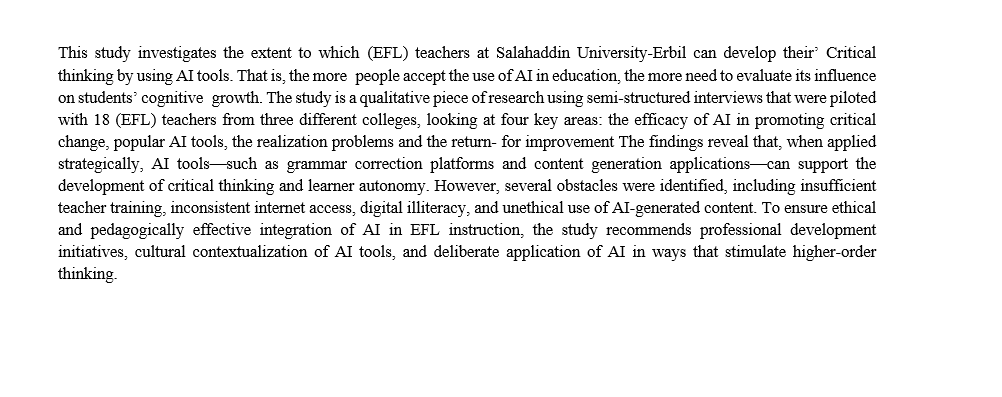
يبحث البحث في كيفية تحسين طلاب اللغة الإنجليزية كلغة أجنبية في جامعة صلاح الدين - أربيل لقدراتهم على التفكير النقدي من خلال دمج أدوات الذكاء الاصطناعي. ونظرًا للاستخدام المتزايد لأدوات الذكاء الاصطناعي في التعليم، هناك حاجة إلى مزيد من البحث لتحديد كيفية تأثيرها على التطور المعرفي للطلاب. تحدد الدراسة أربع سمات مهمة لاستخدام الذكاء الاصطناعي في التدريب اللغوي بناءً على مقابلات شبه منظمة مع 18 أستاذًا للغة الإنجليزية كلغة أجنبية من ثلاث كليات مختلفة: مدى نجاح الذكاء الاصطناعي في تعزيز التفكير النقدي، وأدوات الذكاء الاصطناعي الشائعة، وتحديات التنفيذ، واقتراحات التحسين. تُظهر النتائج أنه عند استخدامها بشكل استراتيجي، يمكن لأدوات مثل منصات القواعد ومولدات النصوص أن تعزز التفكير النقدي واستقلالية المتعلم. ومع ذلك، لوحظت قضايا مثل نقص إعداد المعلم، وعدم اتساق اتصال الإنترنت، والأمية الرقمية، والاستغلال غير الأخلاقي للمحتوى الذي يولده الذكاء الاصطناعي. ولضمان التكامل الأخلاقي والتربوي السليم، تقترح الدراسة النمو المهني، والأهمية الثقافية لتقنيات الذكاء الاصطناعي، والمصداقية الصريحة للتطبيق الفعال للذكاء الاصطناعي في تدريب اللغة الإنجليزية كلغة أجنبية المحفز معرفيًا.
المراجع
- Abdel-Hack, E.M. and Helwa, H.S.A.H.A. (2004) ‘Using digital storytelling and weblogs instruction to enhance EFL narrative writing and critical thinking skills among EFL majors at faculty of education’, Narrative, 5(1), pp.8–41.
- Bloom, B.S. (1956) Taxonomy of educational objectives: The classification of educational goals. Handbook I: Cognitive domain. Rev. Ed. New York: David McKay.
- Bostrom, N., 2006. AI set to exceed human brain power. CNN, 24 July. [Online] Available at: http://edition.cnn.com/2006/TECH/science/07/24/ai.bostrom/index.html [Accessed: 4 February 2025].
- Brookings, 2024. What is artificial intelligence? [Online] Available at: https ://www.brookings.edu/research/what-is-artificial-intelligence [Accessed: 10 August 2024].
- Calma, A. and Davies, M., 2021. Critical thinking in business education: Current outlook and future prospects. Studies in Higher Education, 46(11), pp.2279–2295. Available at: https://doi.org/10.1080/03075079.2020.1716324 [Accessed: 10 June 2025].
- Chou, M.H. (2020) ‘Task-supported language teaching to enhance young EFL adolescent learners’ comprehension and production of English phrasal verbs in Taiwan’, Education 3–13, 48(4), pp.455–470.
- Crevier, D. (1993) AI: The tumultuous history of the search for artificial intelligence. New York: Basic Books.
- Ennis, R.H. (1993) ‘Critical thinking assessment’, Theory into Practice, 32(3), pp.179–186. Available at: https://doi.org/10.1080/00405849309543594
- Godwin-Jones, R. (2018) ‘Using mobile technology to develop language skills and cultural understanding’, Language Learning & Technology, 22(3), pp.3–17.
- Holmes, W., Bialik, M. and Fadel, C. (2019) Artificial intelligence in education. [Online] Amazon.com. Available at: https://www.amazon.com/Artificial-Intelligence-Education-Promises-Implications/dp/1794293701 [Accessed 1 Aug. 2024].
- JISC (2023) Does ChatGPT mean the end of the essay as an assessment tool? [Online] Available at: https://www.jisc.ac.uk/news/does-chatgpt-mean-the-end-of-the-essay-as-an-assessment-tool-10-jan-2023 [Accessed 28 Mar. 2023].
- Krathwohl, D.R. (2002) ‘A revision of Bloom’s taxonomy: An overview’, Theory into Practice, 41(4), pp.212–260. Available at: https://doi.org/10.1207/s15430421tip4104_2
- Li, X. and Wang, Y. (2022) ‘Integrating artificial intelligence in EFL classrooms: Enhancing inquiry-based learning and problem-solving skills’, Journal of Educational Technology & Society, 25(3), pp.45–58.
- Mailwasher (2024) Mailwasher: Uses Bayesian techniques to learn which emails are spam and which are not. [Online] Available at: https://www.mailwasher.net [Accessed 10 Aug. 2024].
- Murawski, L.M. (2014) ‘Critical thinking in the classroom … and beyond’, Journal of Learning in Higher Education, 10, pp.25–30.
- Penkauskiené, D., Railiené, A. and Cruz, G. (2019) ‘How is critical thinking valued by the labour market? Employer perspectives from different European countries’, Studies in Higher Education, 44(5), pp.804–815. Available at: https://doi.org/10.1080/03075079.2019.1586323
- Rudolph, J., Tan, S. and Tan, S. (2023) ‘ChatGPT: Bullshit spewer or the end of traditional assessments in higher education?’, Journal of Applied Learning and Teaching, 6(1), pp.342–363. Available at: https://doi.org/10.37074/jalt.2023.6.1.9.
- Shareef, N.G., 2024. Kurdish EFL students’ perceptions towards AI-powered platforms for learning English grammar. Zanco Journal of Human Sciences, 28(3), pp.321–333. Available at: https://zancojournal.su.edu.krd/index.php/JAHS/article/download/1875/977/14700 [Accessed: 10 June 2025].
- Van Dijk, J. (2020) the digital divide. Cambridge/Medford: Polity.
- Warschauer, M. and Healey, D. (1998) ‘Computers and language learning: An overview’, Language Teaching, 31(2), pp.57–71.
- Yin, Y., Tomita, M.K. and Shavelson, R.J. (2014) ‘Using formal embedded formative assessments aligned with a short-term learning progression to promote conceptual change and achievement in science’, International Journal of Science Education, 36(4), pp.531–552.
- Zhai, C., Wibowo, S. and Li, L.D. (2024) ‘The effects of over-reliance on AI dialogue systems on students’ cognitive abilities: A systematic review’, Smart Learning Environments, 11, Article 28.
التنزيلات
منشور
كيفية الاقتباس
إصدار
القسم
الرخصة
الحقوق الفكرية (c) 2025 Naleen Hassan Tatar, Asma Abbas Brime

هذا العمل مرخص بموجب Creative Commons Attribution 4.0 International License.