Formal Linguistic Insecurity in Hewlêrî Speech Community
DOI:
https://doi.org/10.21271/zjhs.29.SpC.38Keywords:
Linguistic insecurity, Hewlêrî speech community, Labovian linguistic insecurity, Correctness, NormAbstract
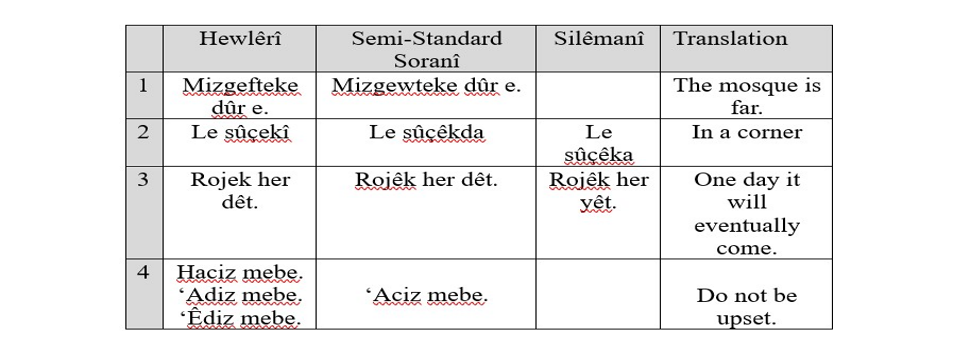
Formal linguistic insecurity (FLI), also known as the Labovian linguistic insecurity, is a manifestation of linguistic insecurity. In this manifestation speakers of a variety regard another language or variety as the reference for correct usage. They may deem their speech patterns incorrect or less correct than those of the norm variety. This study examined FLI quantitively among members of the Hewlêrî speech community, who reside in the capital of the Kurdistan Region of Iraq, KRI. For this purpose, 155 individuals were chosen in order to fill out a test that contained12 double-questions. In each pair, the options in the A part were identical with those in the B counterpart. These options were related to phonological, vocabulary and grammatical variables and contained words or sentences from three relevant varieties of Hewlêrî, the Semi-Standard Soranî and Sɪlêmanî. The A questions required the participants to choose the option that they regarded as the most correct, while their B counterpart asked them to indicate their usual usages. The discrepancies between the norm options and the usual options were calculated, according to a scale of FLI. The researcher had designed the scale by amending the scales in the previous relevant studies. The results suggested that almost half of the respondents suffered from high levels of FLI. The figure was nearly three times higher than the rate of those who did not feel FLI at all. The study is important because it demonstrates how the existence of a prestige variety can alternate the perception of linguistic accuracy by speakers of a local variety and affect their evaluation of their native variety. In terms of methodological implications, the study has incorporated vocabulary and grammatical items in the test of FLI, which is a new development to the Labovian framework.
References
- Al-Asbahy, Mohammed A.A. and Aleemuddin, Seyd (2021). “Symbolic violence mechanism from Bourdieu’s perspective”, Pune Research World, Vol.5(1), pp.1-7.
- Calvet, Louis-Jean (2006). “Towards an ecology of world languages”, (Andrew Brown, Trans.) Cambridge: Polity Press. (Original work published in 1999).
- Ebadi, Saman & Mozafari, Vida (2015) “The realization of address terms in Sorani Kurdish (Jafi Dialect)”, International Journal of English and Education, Vol.4 (2), pp. 264-276.
- Fowler-Graham, Dawn (1985). “Linguistic insecurity among the elderly”, MA thesis, University of Victoria, Canada.
- Hall, Robert A. (1950). “Leave your language alone!” New York: Linguistica.
- Hama-Rashid, Fuad (2008) “Kurdish language and its dialects”, Silemani, Serdam.
- Jantri, Palatee & Phusawisot, Pilanut (2021) “The influence of linguistic insecurity on Thai EFL teachers’ teaching performance”, International Journal of Linguistics, Literature and Translation, Vol.4(8), pp. 35-44.
- Kolçak, Hakan (2016). “Unfinished building: Kurdish language rights during the first AKP ruling period from November 2002 to June 2015”, Journal of Ethnopolitics and Minority Issues in Europe, Vol.15(3), pp.26-56.
- Labov, William (1966). “The Social Stratification of English in New York City”. Washington D.C.: Center for Applied Linguistics.
- Labov, William (1972). “Sociolinguistic Patterns”. Philadelphia: University of Pennsylvania Press.
- Milroy, Lesley & Gordon, Mattew (2003), “Sociolinguistics: Method and interpretation”, Malden, MA: Blackwell Publishing.
- Rasheed, Minwas Jamal (2021). “Diglossia: A mixed method survey analysis on the use of formal and informal speech among Sorani Kurdish speakers”, International Journal of Social Sciences and Educational Studies, Vol.8(3), pp.249-268.
- Sherwani, Kawa Abdulkareem & Barlik, Memet Metin (2020). “The present status of Kurdish language in Turkey: A sociolinguistic study of Van community”, Journal of Xi’an University of Architecture & Technology, Vol.XII(III), pp.748-765.
- Sheyholislami, Jaffer (2015). “The language varieties of the Kurds”, in “The Kurds: History- religion-language-politics”, Alexander Schahbasi & Thomas Schrott (Eds.), Vienna: Austrian Federal Ministry of the Interior.
- Sheyholislami, Jaffer (2017). “Language status and party politics in Kurdistan-Iraq: The case of Badini and Hawrami varieties” in “Zazaki - yesterday, today and tomorrow: Survival and standardization of a threatened language”, Zeynep Arslan (Ed.), Vienna: GLIM.
- Sheyholislami, Jaffer (2019). “Language as a problem: Language policy and language rights in Kurdistan-Iran”, in “Etudes Kurdes”, Salih Akin (Ed.) Paris: Institut Kurde, pp. 95-130.
Downloads
Published
How to Cite
Issue
Section
License
Copyright (c) 2025 Leila Hameed Muhammad, Himdad Abdul-Qahhar Muhammad

This work is licensed under a Creative Commons Attribution 4.0 International License.