
فك شفرة العقل: نهج نظري للصلة الترابطية لبعض الالغاز الانكليزية المختارة
DOI:
https://doi.org/10.21271/zjhs.29.SpB.37الكلمات المفتاحية:
Riddles, Relevance Theory, Cognitive Process, Cultural Contextالملخص
ملخص
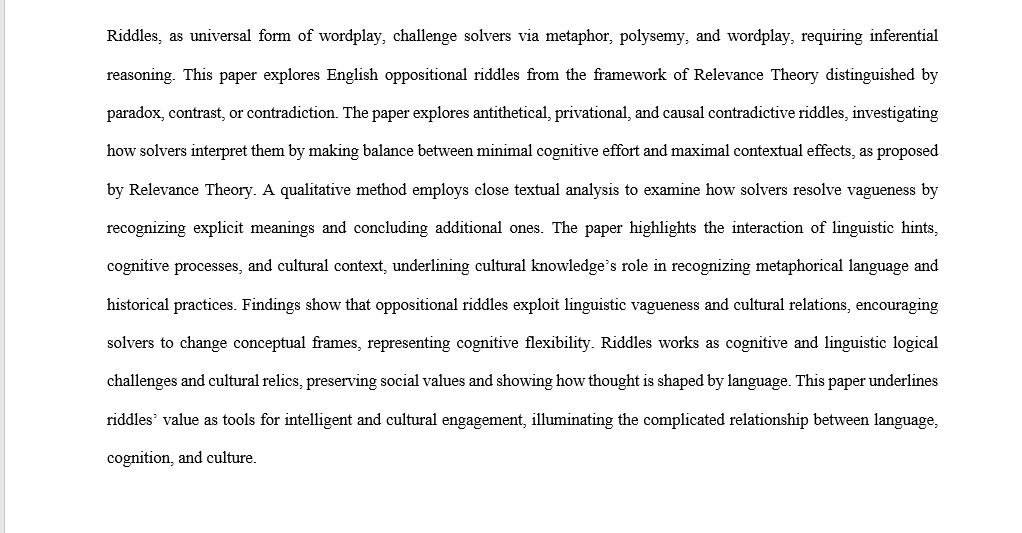
تبحث هذه الدراسة في الالغاز المتعارضة في اللغة الانجليزية، بأستخدام لنظرية الترابطية. وتعرف هذه الالغاز بالتناقض أو التضاد أو المفارقة. ان هذه الالغاز تتحدى المحللين من خلال الاستعارة و تعدد المعاني و التلاعب بالالفاظ، مما يتطلب التفكير الاستنتاجي. تقوم الدراسة بتحليل ثلاثة أنواع من الالغاز المتعارضة والتي هي: المتناقضة، الحرمانية و السببية، وتستكشف كيفية فك المحللين لشفرتها عبر تحقيق التوازن بين الحد الادنى للجهد الادراكي مع اقصى التأثيرات السياقية، كما تفترض النظرية الترابطية. يتم تطبيق النهج الوصفي لتحليل النص بشكل دقيق لغرض الكشف عن كيفية حل المحللين للغموض من خلال تحديد المعاني الصريحة و استنتاج معاني اضافية. تسلط الدراسة الضوء على التفاعل بين الاشارات اللغوية والعمليات الادراكية والسياق الثقافي، مع التركيز على دور المعرفة الثقافية في التعرف على اللغة المجازية والممارسات التاريخية. برهنت النتائج أن الالغاز المتعارضة تستغل الغموض اللغوي والارتباطات الثقافية، مما يدفع المحللين الى تغيير الاطارات المفاهيمية، مبرزا المرونة الادراكية. تعمل الغاز كتحديات استنتاجية ولغوية وتحف ثقافية، حيث تحافظ على القيم الاجتماعية وتكشف كيف تشكل اللغة الفكر. من خلال تصنيف الالغاز بناء على هيكلياتها المتعارضة، تحدد الدراسة استراتيجيات ادراكية متنوعة، من التوفيق بين الصفات المتعارضة الى اعادة تفسير العلاقات السببية. تمتد التداعيات الى العلوم الادراكية، واللغويات والتعليم، حيث يمكن للالغاز ان تعزز التفكير النقدي والوعي الثقافي. تؤكد الدراسة على قيمة الالغاز كأدوات للمشاركة الفكرية والثقافية، مما يلقي الضوء على العلاقة المعقدة بين الادراك واللغة واللثقافة.
الكلمات اللمفتاحية: الالغاز، نظرية الترابطية، التناقض المتعارض، السياق الثقافي
المراجع
-Allott, N., 2013. Relevance theory. Perspectives on linguistic pragmatics, Volume 2, pp. 57-98.
-Augarde, T., 1984. The Oxford Guide to Word Games. Oxford: Oxford University Press.
-Birner, b. J., 2013. introduction to pragmatics. oxford: Billy Blackwell.
-Blacking, J., 1961. The social value of Venda riddles. African Studies, 20(1), pp. 1-32.
-Blakemore, D., 1992. Understanding Utterances. oxford: Blackwell Publishers.
-Bregenhøj, A. K., 2018. The Riddle: Form and Performance. Humanities, 7(2), pp. 1-17.
-Brunvand, J. H. ed., 1996. American folklore: an encyclopedia. New York: .: Garland Pub.
-Bukenya, A. and Nadwa, J., 1983. Oral literature for schools. Nairobi: Longmans.
-Bukenya, A. K. W. M. &. O.-O. D., 1994. Understanding oral literature.. s.l.:Nairobi University Press.
-Chapman, S., 2011. Pragmatics. London: Palgrave Macmillan.
-Clark, B., 2013. Cambridge rtextbooks in linguistics: Relevance Theory. cambridge: cambridge university press.
-Clarck, B., 2022. pragmatics the basics. london: routledge .
-Cole Beuchat, P., 1957. Riddles in Bantu. African Studies, 16(3), pp. 133-149.
-Cruse, A., 2006. A Glossary of Semantics and Pragmatics. Edinburgh: Edinburgh University Press.
-Crystal, D., 2008. A Dictionary ofcLinguistics and Phonetics. sixsth ed. s.l.:blackwell.
-Danesi, M., 2002. The Puzzle instinct: The meaning of puzzles in human life. Bloomington: Indiana University Press.
-Dundes, R. A. G. a. A., 1963. Toward a Structural Definition of the riddle. The Journal of American Folklore, Volume 76, pp. 111-118.
-Elnaz, A., 2021. Stylistic Devices Commonly used in English riddles. Бюллетень науки и практики, 7(2), pp. 411-416.
-Forman, J. M. R. a. M. L., 1971. Riddles: expressive models. Ethnology, 10(4), pp. 509-533.
-Grice, P., 1975. logic and conversation,In COLE, PETER, and JERRY L.. s.l.:academic press.
-Huang, Y., 2017. The Oxford Handbook of Pragmatics. Oxford: Oxford University Press.
-Ishengoma, J., 2005. African Oral Traditions: Riddles Among The Haya of Northwestern Tanzania. International Review of Education, Volume 51, pp. 139-153.
-Kasango, M. M., 2019. an analysis of kikamba riddles and how they relate to metaphor: a relevance theoretical approach. s.l.:(Doctoral dissertation, University of Nairobi).
-Khumalo, J., 1974. Zulu riddles. African Studies, 33(4), pp. 193-225.
-Lilis Ade Sartika, a. B. E. P., 2021. Analysis of Humor in the Big Bang Theory By Using Relevance Theory: a Pragmatic Study. Linguistics and Literature Journal, 2(1), pp. 1-7.
-Magachi, L. N., 2015. A Pragmatic Analysis of Ekegusii Riddles. s.l.:(Doctoral dissertation, University of Nairobi).
-Maranda, E. K., 1976. Riddles and Riddling: An Introduction. The Journal of American Folklore, Volume 89, pp. 127-137.
-Nakene, G., 1943. Tlokwa Riddles. African Studies, 2(3), pp. 125-138.
-Obied, A. A. M. S. a. I. M., 2022. A Pragmatic Analysis of Selected Riddles in English. Social Science Journal , Volume 12, pp. 6717-6726.
-Pepicello, W. J. a. G. T. A., 1984. The language of riddles: New perspectives.. s.l.:Ohaio State University Press.
-Saussure, F. D., 1959. Course in General Linguistics. New York: Philosophical library.
-Sperber, D. W. a. D., 1986. Relevance: Communication and Cognition. second ed. Oxford: Blackwell Publishers.
-Taylor, A., 1951. English riddles from oral tradition. Bekerlyband Los Angeles : University of Californya Press.
-Ward, L. R. H. a. G., 2004. The Handbook of Pragmatics. Oxsford: Blackwell Publishing.
-Wilson, D. and Sperber, D., 2002. Truthfulness and relevance. Mind, 111(443), pp.583–632.
-Wilson, D. S. a. D., 1995. Relevance: Communication and Cognition. second ed. Oxsford: Blackwell.
-Yus, F., 2008. A Relevance-Theoritic Classificationn of Jokes. Lodz Papers in Pragmatics, 4(1), pp. 131-157.
التنزيلات
منشور
كيفية الاقتباس
إصدار
القسم
الرخصة
الحقوق الفكرية (c) 2025 Shara Nmrood Mlkazdin, Kavi Shakir Mohammed

هذا العمل مرخص بموجب Creative Commons Attribution 4.0 International License.