
Kurdish EFL Students’ Perceptions towards Flipped Pronunciation Class at Salahaddin University
DOI:
https://doi.org/10.21271/zjhs.28.4.16Keywords:
EFL students; Flipped classroom model; Perception; Pronunciation.Abstract
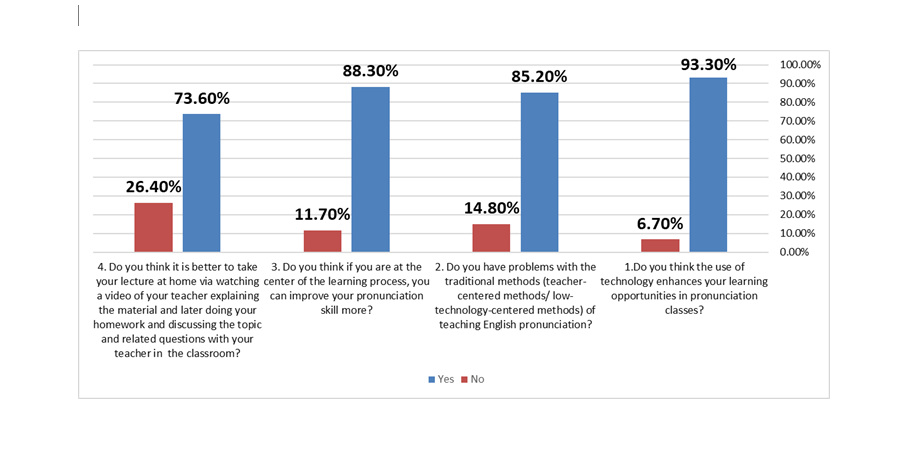
Flipped classroom model is a good teaching method for contemporary students because it resonates with their preferences of using their phones and being online most of their time. This study aims at exploring Kurdish EFL students’ perceptions towards the use of flipped classroom model for improving all facets of pronunciation skills, including phonetic awareness, stress, intonation, rhythm and pacing. Additionally, it aims to further investigate the students’ perceptions of their overall experience of flipped pronunciation classes (FPC). This study employs a mixed-methods approach to achieve the aims of the study. For the quantitative part, a survey questionnaire was administered to 398 first-year students in Salahaddin University. A semi-structured interview was conducted with 30 students to collect the qualitative data. Thematic analysis was carried out to analyze the qualitative part. The findings indicate that Kurdish EFL students perceive flipped pronunciation classes as impactful for improving their pronunciation proficiency. They find FPCs as a wonderful opportunity to get proficiency in sound pronunciation, stress placement, tone, intonation, stress-time rhythm, and pacing. The findings further reveal that the students have had a good experience with FPCs.
References
- Abbasian, M. R. & Azeez, I. B., 2021. The Effect of Using Flipped Class on Teaching Reading Comprehension at Cihan University. Cihan University-Erbil Journal of Humanities and Social Sciences, 5(1), pp. 101-105.
- Abdullah, M. Y., Hussin, S. & Ismail, K., 2021. Does Flipped Classroom Model Affect EFL Learners’ Anxiety in English Speaking Performance? ProQuest, 16(1), pp. 94-108.
- Ali, F. S. & Karim, L. Q., 2022. A Case Study on Lecturer’s Awareness towards of Flipped Classroom Method in EFL Classes from Different Cities of Kurdistan Region. International Journal of Social Sciences & Educational Studies, 9(2), pp. 278-290.
- Al-Mofti, K., 2020. The Effect of Using Flipped Classroom Model to Improve Iraqi EFL Learners' Pronunciation in English at University Level. Education College Journal, Volume 1, pp. 631-654.
- Ameen, C. A. & Muhammad, H. A., 2023. Investigating the Effect of Flipped Classroom Model on Kurdish EFL University Students’ Reading Skill. Journal of University of Human Development (JUHD), 9(2), pp. 27-36.
- Bergmann, J. & Sams, A., 2012. Flip Your Classroom: Reach Every Student in Every Class Every Day. Washington: International Society for Technology in Education.
- Chaqmaqchee, Z. I., 2021. Flipped Teaching: A Trend for Students Learning in Higher Education. Koya University Journal of Humanities and Social Sciences (KUJHSS), 4(1), pp. 144-150.
- Dornyei, Z., 2007. Research Methods in Applied Linguistics. Oxford: Oxford University Press.
- Gustian, K., Aridah2 & Rusmawaty, D., 2023. The Benefits of Flipped Classroom Model for Efl Learners. Journal on Education, 5(4), pp. 13918-13935.
- Huang, Y. & Hong, Z., 2016. The effects of a flipped English classroom intervention on students’ information and communication technology and English reading comprehension. Educational Technology Research and Development, 64(2), pp. 175-193.
- Khalil, N. R., Mohammed, S. J., Naser, N. A. & Vadivel, B., 2021. Flipped Classroom Model and Understanding Student’s Mind-set in English Language Classroom. International Journal of Mechanical Engineering, 6(3), pp. 2821-2826.
- Qader, R. O. & Arslan, F. Y., 2019. THE EFFECT OF FLIPPED CLASSROOM INSTRUCTION IN WRITING: A CASE STUDY WITH IRAQI EFL LEARNERS. Teaching English with Technology, 19(1), pp. 36-55.
- Talbert, R., 2017. Flipped Learning: A Guide for Higher Education Faculty. First ed. New York: Stylus Publishing, LLC.
- Zarrinfard, S., Rahimi, M. & Mohseni, A., 2021. The Impact of Flipped Classroom on Learning Outcome in a General English Course: Grammar and Vocabulary Gains in Focus. International Journal of Foreign Language Teaching and Research, 38(9), pp. 61-75..
Downloads
Published
How to Cite
Issue
Section
License
Copyright (c) 2024 Bekhal Kosrat Rafiq, Nawsha Ghaleb Shareef

This work is licensed under a Creative Commons Attribution 4.0 International License.