
Spatial and Temporal Variability Analysis of Air Quality Indicators in Erbil City Using Geographic Information Systems
DOI:
https://doi.org/10.21271/zjhs.29.SpC.37الكلمات المفتاحية:
Air quality, temporal and spatial variation, interpolation, PM2.5, PM10, and CO2.الملخص
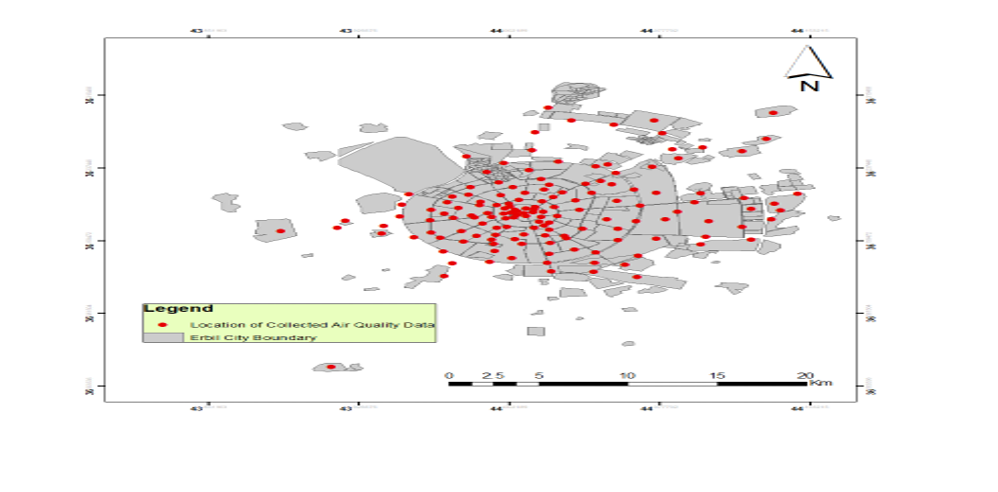
This research explores the spatial and temporal analysis of air quality parameters in Erbil, utilizing Geographic Information Systems (GIS). The primary goal is to monitor and evaluate air quality in this major urban center, identifying pollution levels and their spatial and temporal variations. To achieve this, air quality data was collected over a one-month period from 70 locations across Erbil through field measurements and analyzed using interpolation techniques in ArcMap. The findings reveal that air quality in Erbil is at hazardous levels, particularly in the city center and southwestern regions, primarily due to human activities such as heavy traffic, industrial operations, and oil refinery emissions. For example, the highest concentration of carbon dioxide (CO₂) in the city center was recorded between (1000 – 1500) (ppm), while the concentrations of particulate matter (PM10) in the eastern and western regions ranged from (254 – 354) ug/m³. At the same time, the concentrations of particulate matter (PM2.5) in the same area ranged from (15.4 – 55.5) ug/m³. Based on this, the study results showed significant changes in air pollution levels, with the highest pollution density recorded during working hours, particularly in the afternoon. For instance, the highest concentration of carbon dioxide (CO₂) was recorded between (100 – 1100) (ppm) later in the day. At the same time, the concentration of particulate matter (PM10) reached (180) ug/m³, while the concentration of particulate matter (PM2.5) was around (80) ug/m³. It is worth noting that green spaces and parks play a crucial role in mitigating air pollution. The study recommends several actionable solutions, including expanding green spaces and parks, improving public transportation systems, encouraging the use of renewable energy, regulating industrial emissions, and increasing public awareness. This study provides valuable insights for environmental planning and offers practical strategies to address the challenges of air pollution in Erbil."
المراجع
- Chan, C. K., & Yao, X. J. A. e. (2008). Air pollution in mega cities in China. 42(1), 1-42.
- Hama, R. H., Hamad, R. T., & Aziz, F. H. J. T. A. o. D. G. I., 8Th International Congers Geo Tunis, Tunis. (2014). Climate change in relation to rainfall and temperature in Erbil province, Kurdistan, Iraq. 8.
- Kampa, M., & Castanas, E. J. E. p. (2008). Human health effects of air pollution. 151(2), 362-367.
- Lave, L. B., & Seskin, E. P. J. S. (1970). Air pollution and human health: the quantitative effect, with an estimate of the dollar benefit of pollution abatement, is considered. 169(3947), 723-733.
- Manisalidis, I., Stavropoulou, E., Stavropoulos, A., & Bezirtzoglou, E. J. F. i. p. h. (2020). Environmental and health impacts of air pollution: a review. 8, 14.
- Matese, A., Gioli, B., Vaccari, F., Zaldei, A., Miglietta, F. J. J. o. A. M., & Climatology. (2009). Carbon dioxide emissions of the city center of Firenze, Italy: measurement, evaluation, and source partitioning. 48(9), 1940-1947.
- Mawlood, D. K., Sultan, M. A. J. Z. J. o. P., & Sciences, A. (2022). Analysing the Pollutants Dispersion in Erbil City-Kurdistan with Support of Statistical Analysis. 34(1), 8-17.
- Mayer, H. J. A. e. (1999). Air pollution in cities. 33(24-25), 4029-4037.
- Nasrallah, H. A., Balling Jr, R. C., Madi, S. M., & Al-Ansari, L. J. E. P. (2003). Temporal variations in atmospheric CO2 concentrations in Kuwait City, Kuwait with comparisons to Phoenix, Arizona, USA. 121(2), 301-305.
- Oliver, M. A., & Webster, R. J. I. J. o. G. I. S. (1990). Kriging: a method of interpolation for geographical information systems. 4(3), 313-332.
- Park, D.-U., & Ha, K.-C. J. E. I. (2008). Characteristics of PM10, PM2. 5, CO2 and CO monitored in interiors and platforms of subway train in Seoul, Korea. 34(5), 629-634.
- SHARIF, S. F. A., & ANJEL, H. A. J. J. o. D. U. (2020). Air pollution Estimation in Erbil City Center Using Box Mathematical Model. 23(2), 246-253.
- Wambebe, N. M., & Duan, X. J. A. (2020). Air quality levels and health risk assessment of particulate matters in Abuja municipal area, Nigeria. 11(8), 817.
التنزيلات
منشور
كيفية الاقتباس
إصدار
القسم
الرخصة
الحقوق الفكرية (c) 2025 Saya Dlawer Mohammed , Daban Kadhim Omar , Twana Abdulrahman Hamad

هذا العمل مرخص بموجب Creative Commons Attribution 4.0 International License.