
Decoding the Mind: A Relevance-Theoretic Approach to selected English Riddles
DOI:
https://doi.org/10.21271/zjhs.29.SpB.37Keywords:
Riddles, Relevance Theory, Cognitive Process, Cultural ContextAbstract
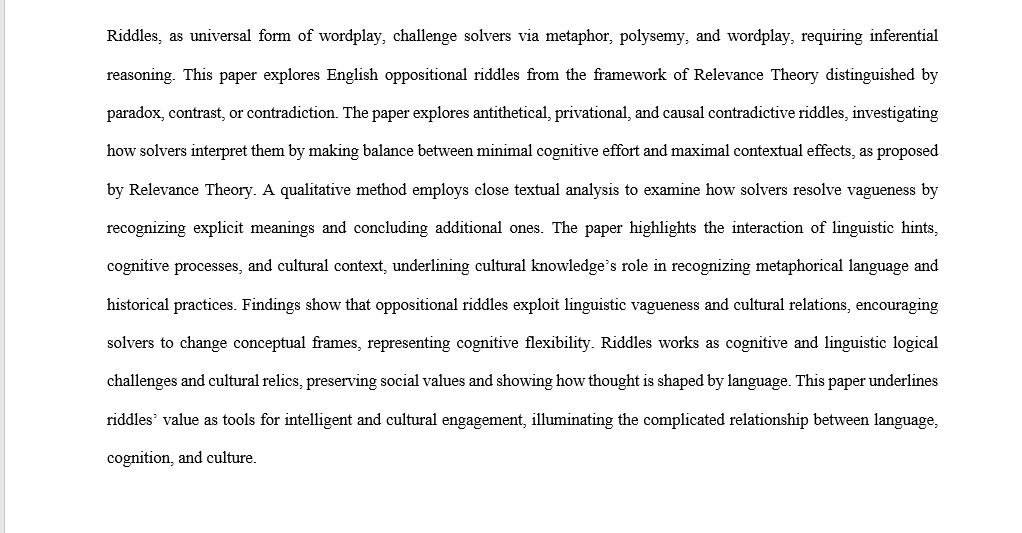
Riddles, as universal form of wordplay, challenge solvers via metaphor, polysemy, and wordplay, requiring inferential reasoning. This paper explores English oppositional riddles from the framework of Relevance Theory distinguished by paradox, contrast, or contradiction. The paper explores antithetical, privational, and causal contradictive riddles, investigating how solvers interpret them by making balance between minimal cognitive effort and maximal contextual effects, as proposed by Relevance Theory. A qualitative method employs close textual analysis to examine how solvers resolve vagueness by recognizing explicit meanings and concluding additional ones. The paper highlights the interaction of linguistic hints, cognitive processes, and cultural context, underlining cultural knowledge’s role in recognizing metaphorical language and historical practices. Findings show that oppositional riddles exploit linguistic vagueness and cultural relations, encouraging solvers to change conceptual frames, representing cognitive flexibility. Riddles works as cognitive and linguistic logical challenges and cultural relics, preserving social values and showing how thought is shaped by language. This paper underlines riddles’ value as tools for intelligent and cultural engagement, illuminating the complicated relationship between language, cognition, and culture.
References
-Allott, N., 2013. Relevance theory. Perspectives on linguistic pragmatics, Volume 2, pp. 57-98.
-Augarde, T., 1984. The Oxford Guide to Word Games. Oxford: Oxford University Press.
-Birner, b. J., 2013. introduction to pragmatics. oxford: Billy Blackwell.
-Blacking, J., 1961. The social value of Venda riddles. African Studies, 20(1), pp. 1-32.
-Blakemore, D., 1992. Understanding Utterances. oxford: Blackwell Publishers.
-Bregenhøj, A. K., 2018. The Riddle: Form and Performance. Humanities, 7(2), pp. 1-17.
-Brunvand, J. H. ed., 1996. American folklore: an encyclopedia. New York: .: Garland Pub.
-Bukenya, A. and Nadwa, J., 1983. Oral literature for schools. Nairobi: Longmans.
-Bukenya, A. K. W. M. &. O.-O. D., 1994. Understanding oral literature.. s.l.:Nairobi University Press.
-Chapman, S., 2011. Pragmatics. London: Palgrave Macmillan.
-Clark, B., 2013. Cambridge rtextbooks in linguistics: Relevance Theory. cambridge: cambridge university press.
-Clarck, B., 2022. pragmatics the basics. london: routledge .
-Cole Beuchat, P., 1957. Riddles in Bantu. African Studies, 16(3), pp. 133-149.
-Cruse, A., 2006. A Glossary of Semantics and Pragmatics. Edinburgh: Edinburgh University Press.
-Crystal, D., 2008. A Dictionary ofcLinguistics and Phonetics. sixsth ed. s.l.:blackwell.
-Danesi, M., 2002. The Puzzle instinct: The meaning of puzzles in human life. Bloomington: Indiana University Press.
-Dundes, R. A. G. a. A., 1963. Toward a Structural Definition of the riddle. The Journal of American Folklore, Volume 76, pp. 111-118.
-Elnaz, A., 2021. Stylistic Devices Commonly used in English riddles. Бюллетень науки и практики, 7(2), pp. 411-416.
-Forman, J. M. R. a. M. L., 1971. Riddles: expressive models. Ethnology, 10(4), pp. 509-533.
-Grice, P., 1975. logic and conversation,In COLE, PETER, and JERRY L.. s.l.:academic press.
-Huang, Y., 2017. The Oxford Handbook of Pragmatics. Oxford: Oxford University Press.
-Ishengoma, J., 2005. African Oral Traditions: Riddles Among The Haya of Northwestern Tanzania. International Review of Education, Volume 51, pp. 139-153.
-Kasango, M. M., 2019. an analysis of kikamba riddles and how they relate to metaphor: a relevance theoretical approach. s.l.:(Doctoral dissertation, University of Nairobi).
-Khumalo, J., 1974. Zulu riddles. African Studies, 33(4), pp. 193-225.
-Lilis Ade Sartika, a. B. E. P., 2021. Analysis of Humor in the Big Bang Theory By Using Relevance Theory: a Pragmatic Study. Linguistics and Literature Journal, 2(1), pp. 1-7.
-Magachi, L. N., 2015. A Pragmatic Analysis of Ekegusii Riddles. s.l.:(Doctoral dissertation, University of Nairobi).
-Maranda, E. K., 1976. Riddles and Riddling: An Introduction. The Journal of American Folklore, Volume 89, pp. 127-137.
-Nakene, G., 1943. Tlokwa Riddles. African Studies, 2(3), pp. 125-138.
-Obied, A. A. M. S. a. I. M., 2022. A Pragmatic Analysis of Selected Riddles in English. Social Science Journal , Volume 12, pp. 6717-6726.
-Pepicello, W. J. a. G. T. A., 1984. The language of riddles: New perspectives.. s.l.:Ohaio State University Press.
-Saussure, F. D., 1959. Course in General Linguistics. New York: Philosophical library.
-Sperber, D. W. a. D., 1986. Relevance: Communication and Cognition. second ed. Oxford: Blackwell Publishers.
-Taylor, A., 1951. English riddles from oral tradition. Bekerlyband Los Angeles : University of Californya Press.
-Ward, L. R. H. a. G., 2004. The Handbook of Pragmatics. Oxsford: Blackwell Publishing.
-Wilson, D. and Sperber, D., 2002. Truthfulness and relevance. Mind, 111(443), pp.583–632.
-Wilson, D. S. a. D., 1995. Relevance: Communication and Cognition. second ed. Oxsford: Blackwell.
-Yus, F., 2008. A Relevance-Theoritic Classificationn of Jokes. Lodz Papers in Pragmatics, 4(1), pp. 131-157.
Downloads
Published
How to Cite
Issue
Section
License
Copyright (c) 2025 Shara Nmrood Mlkazdin, Kavi Shakir Mohammed

This work is licensed under a Creative Commons Attribution 4.0 International License.