
Model in ESP: Enhancing Pharmacy Students' Mastery of Medical Terminology Through Pre-Class Digital Resources and In-Class Application
DOI:
https://doi.org/10.21271/zjhs.30.2.12Keywords:
Flipped classroom, ESP, Pharmacy students, medical terminologiesAbstract
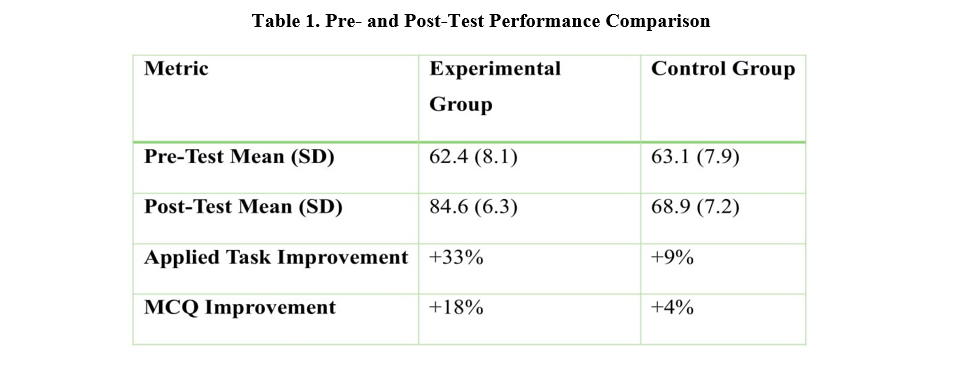
This research gauges the efficacy of the flipped classroom model in helping students of pharmacy achieve mastery of medical terminology within an English for Specific Purposes (ESP) program at the National Institute of Technology (NIT). The research applied a mixed-methods quasi-experimental design, with 60 students divided into experimental (flipped classroom) and control (customary classes) groups. The experiment of the groups involved participated in interactive in-class activities (e.g., role-playing patient consultations) and pre-class digital resources (e.g., video lectures), while the control group joined standard lectures. Pre- and post-tests measured terminology application and retention, while focus groups and surveys examined student perceptions. The results revealed notable gains in the experimental group, with post-test scores expanding by 35.6% compared to 9.2% in the control group. Gains were particularly visible in practical activities, such as illuminating medical terms to patients, displaying the flipped model’s strength in bridging theory and practice. High engagement was observed in the qualitative data, particularly with pre-class resources (85% found videos cooperative), and confidence was increased in clinical communication (78%). Challenges included uneven group participation (15%) and technical issues (25%). The paper found the flipped classroom’s potential to boost ESP pedagogy through application-focused learning and fostering active engagement. It additionally stresses the need for faculty training and localized resources to focus on infrastructural barriers. These outcomes point out practical understandings for developing pharmacy education, particularly in resource-constrained settings, and stress the consequences of effective communication in healthcare settings.
References
- Abdullah, G. (2013) ‘Strategies and approaches for teaching and learning of medical terminology’, International Journal of English and Education, 2.
- Adinda, D. & Mohib, N. (2020) ‘Teaching and instructional design approaches to enhance students’ self-directed learning in blended learning environments’, Electronic Journal of eLearning, 18(2), pp. 162–174.
- Akçayır, G. & Akçayır, M. (2018) ‘The flipped classroom: A review of its advantages and challenges’, Computers & Education, 126, pp. 334–345.
- Anand, S., Singh, A., Singh, V. & Sharma, S. (2021) ‘Comprehensive assessment of the quality and reliability of the ten most-viewed YouTube videos on thoracoscopic lobectomy in children: a comparison from the available videos on a peer-reviewed platform’, Pediatric Surgery International, 37, pp. 1627–1632.
- Chabner, D.-E. (2022) Medical Terminology: A Short Course-E-Book. Elsevier Health Sciences.
- Ding, C., Li, S. & Chen, B. (2019) ‘Effectiveness of flipped classroom combined with team-, case-, lecture-and evidence-based learning on ophthalmology teaching for eight-year program students’, BMC Medical Education, 19, pp. 1–9.
- Fasih, P. (2023) ‘Teachers’ and Students’ Attitudes toward Traditional and Task-based Methods of Teaching and Assessment: Reading Comprehension and Content Material Learning’, Filologické štúdie 9 Studia Philologica, 9, pp. 39–55.
- Freeman, K., Brown, K., Miller, L., Nissly, T., Ricco, J. & Weinmann, A. (2022) ‘Knowledge Retention Using “Relay”: A Novel Active-Learning Technique’, PRiMER: Peer-Reviewed Reports in Medical Education Research, 6, p. 12.
- Hudes, R., Rich, J.B., Troyer, A.K., Yusupov, I. & Vandermorris, S. (2019) ‘The impact of memory-strategy training interventions on participant-reported outcomes in healthy older adults: A systematic review and meta-analysis’, Psychology and Aging, 34(4), pp. 587.
- Johnson, R., Turner, K., Feder, G. & Cramer, H. (2021) ‘Shared decision making in consultations for hypertension: Qualitative study in general practice’, Health Expectations, 24(3), pp. 917–929.
- Joshi, M.D. & Klausner, E.A. (2022) ‘Course design, delivery, and assessment strategies for pharmaceutical calculations course in a doctor of pharmacy program: A review’, Currents in Pharmacy Teaching and Learning, 14(4), pp. 526–535.
- Lee, J.Y., Song, Y.A., Jung, J.Y., Kim, H.J., Kim, B.R., Do, H.K. & Lim, J.Y. (2018) ‘Nurses’ needs for care robots in integrated nursing care services’, Journal of Advanced Nursing, 74(9), pp. 2094–2105.
- Li, B.-Z., Cao, N.-W., Ren, C.-X., Chu, X.-J., Zhou, H.-Y. & Guo, B. (2020) ‘Flipped classroom improves nursing students’ theoretical learning in China: a meta-analysis’, PloS One, 15(8), e0237926.
- Marcu, N.A. (2020) ‘Designing functional ESP (English for specific purposes) courses’, Procedia Manufacturing, 46, pp. 308–312.
- Martínez-Sáez, A. (2019) ‘Design and development of online learning resources to foster academic writing skills in an ESP flipped classroom context’, WCOL 2019, p. 595. Available at: https://wcol2019.ie.
- Mohammad, A., Saini, B. & Chaar, B.B. (2015) ‘Exploring culturally and linguistically diverse consumer needs in relation to medicines use and health information within the pharmacy setting’, Research in Social and Administrative Pharmacy, 11(4), pp. 545–559.
- Moll, L.C. & Whitmore, K.F. (2013) ‘Vygotsky in classroom practice: Moving from individual transmission to social transaction’, in Learning relationships in the classroom, pp. 131–155. Routledge.
- Saleem, A., Kausar, H. & Deeba, F. (2021) ‘Social constructivism: A new paradigm in teaching and learning environment’, Perennial Journal of History, 2(2), pp. 403–421.
- Senel Tekin, P., Ilgaz, H., Afacan Adanir, G., Yildirim, D. & Gülbahar, Y. (2020) ‘Flipping e-Learning for Teaching Medical Terminology: A Study of Learners' Online Experiences and Perceptions’, Online Learning, 24(2), pp. 76–93.
- SivaKumar, A. (2023) ‘Augmenting the flipped classroom experience by integrating Revised Bloom's Taxonomy: A faculty perspective’, Review of Education, 11(1), e3388.
- Zarrinabadi, N. & Ebrahimi, A. (2019) ‘Increasing peer collaborative dialogue using a flipped classroom strategy’, Innovation in Language Learning and Teaching, 13(3), pp. 267–276.
Downloads
Published
How to Cite
Issue
Section
License
Copyright (c) 2026 Hemn Mohammed Ali Mahmood

This work is licensed under a Creative Commons Attribution 4.0 International License.