
The Application of the Seven Standards of Textuality to the Quranic Discourse
DOI:
https://doi.org/10.21271/zjhs.29.SpB.35Keywords:
The seven standards, oneness of Allah, intertextuality.Abstract
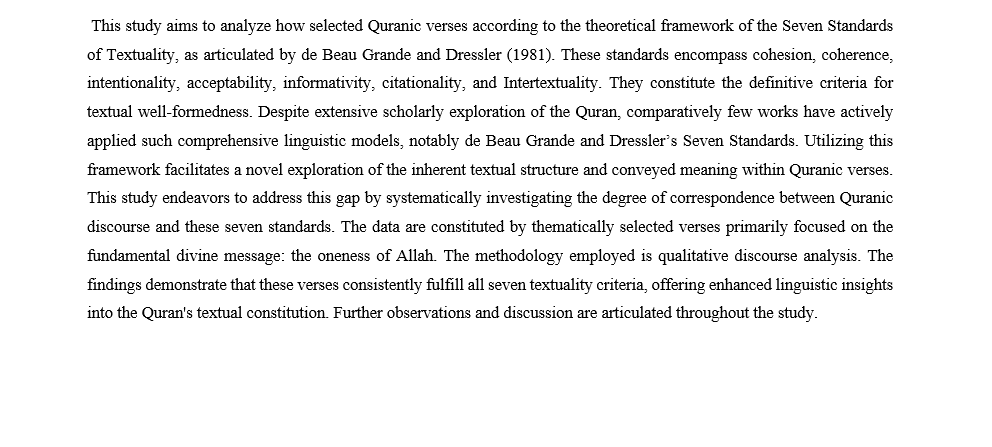
This study aims to analyze how selected Quranic verses according to the theoretical framework of the Seven Standards of Textuality, as articulated by de Beau Grande and Dressler (1981). These standards encompass cohesion, coherence, intentionality, acceptability, informativity, citationality, and Intertextuality. They constitute the definitive criteria for textual well-formedness. Despite extensive scholarly exploration of the Quran, comparatively few works have actively applied such comprehensive linguistic models, notably de Beau Grande and Dressler’s Seven Standards. Utilizing this framework facilitates a novel exploration of the inherent textual structure and conveyed meaning within Quranic verses. This study endeavors to address this gap by systematically investigating the degree of correspondence between Quranic discourse and these seven standards. The data are constituted by thematically selected verses primarily focused on the fundamental divine message: the oneness of Allah. The methodology employed is qualitative discourse analysis. The findings demonstrate that these verses consistently fulfill all seven textuality criteria, offering enhanced linguistic insights into the Quran's textual constitution. Further observations and discussion are articulated throughout the study.
References
- Abdul-Raof, H. 2019. Text linguistics of Qur'anic discourse: an analysis. Abingdon: Routledge.
- Al Zeebari, Y. R. (2025) ‘Quran's Explanation for Civilizations Fall’, Zanco Journal of Human Sciences, 26(1), pp. 78–92. Available at: https://doi.org/10.21271/zjhs.29.Con.1.30 (Accessed: 13 March 2025).
- Al-Azzawi, Q.O.D., 2017. Informativity in Translation: A Research about Code Switching and Code Mixing Project. Available at: https://scholar.google.com/scholar?hl=en&as_sdt=0%2C5&q=Al-Azzawi%2C+Q.+O.+%282017%29.+Informativity+in+Translation.+A+Research+About+Code+Switching+and+Code+Mixing+Project&btnG= [Accessed 4 Se 2024].
- Brown, G. & Yule, G. 1983. Discourse analysis. Cambridge: Cambridge University Press.
- Carter, R., 1998. Vocabulary: Applied Linguistic Perspectives. 2nd ed. London: Routledge.
- Ciula, A. 2017. Modeling Textuality: A Material Culture Framework. In P. Boot, A. Cappellotto,
- De Beaugrande, R.A. and Dressler, W.U., 1981. Introduction to text linguistics (Vol. 1). London: Longman.
- Dressler, W.U. & de Beaugrande, R.A., 2017, Text Linguistics and Classical Studies: Procedural Approach, London: Routledge.
- Halliday, M. A. K. & Hasan R. 1976. Cohesion in English. London: Longman
- Halliday, M.A.K. & Matthiessen, C.M.I.M., 2014. Halliday’s introduction to functional grammar. 4th ed. London: Routledge.
- Halliday, M.A.K. 1994. An introduction to functional grammar. London: Edward Arnold.
- Hammoodi, B. A. (2025) ‘The Semantic Dimensions of the Verb (Zakka) in the Holy Qur’an’, Zanco Journal of Human Sciences, 27(2), pp. 150–165. Available at: https://doi.org/10.21271/zjhs.29.Con.1.20 (Accessed: 13 March 2025).
- Hatim, B. and Munday, J., 2004. Translation: An Advanced Resource Book. London: Routledge.
- Hoey, M., 1991. Patterns of lexis in text. Oxford: Oxford University Press.
- Huddleston, R. & Pullum, G. K. 2002. The Cambridge grammar of the English language. Cambridge: Cambridge University Press, pp. 1278-1284.
- Hymes, D.H. 1974. Foundations in sociolinguistics: an ethnographic approach. Philadelphia: University of Pennsylvania Press.
- Itani, T. 2012 .The Clear Quran: Arabic-English Translation. Available at: www.clearquran.com (Accessed: 1 March 2025).
- Khan, M.W., 2000. The Quran: A Simple English Translation. New Delhi: Goodword Books.
- Kolln, M. and Funk, R., 2011. Understanding English grammar. 9th ed. New York: Pearson, pp. 131-139.
- Martin, J.R. 2015. ‘Evolving systemic functional linguistics: beyond the clause’, Functional Linguistics, 2(1), pp. 1–22.
- Merriam-Webster. 2024. Coherence. In: Merriam-Webster.com dictionary [Online]. Available at: https://www.merriam-webster.com/dictionary/coherence (Accessed: 2024-07-28).
- Mikhchi, H.H., 2011. Standards of Textuality : Rendering English and Persian texts based on a textual model. Journal of Universal Language, 12(1), p47-74.
- Neubert, A. & Shreve, G. M. (1992). Translation as Text. Kent and London: Kent State University Press.
- Niya, M. S. 2015. Textuality Found on The Jakarta Post in Education Section of Opinion Columns. Central Library of Maulana Malik Ibrahim State the Islamic University of Malang.
- Oshima, A. and Hogue, A., 2006. Writing academic English. 4th ed. White Plains, NY: Pearson Longman.
- Quirk, R., Greenbaum, S., Leech, G., & Svartvik, J. (1985) A comprehensive grammar of the English language. London: Longman, pp. 918-936.
- Searle, J. R. 1969. Speech acts: An essay in the philosophy of language. Cambridge: Cambridge University Press.
- Temirova, F. T. q. 2021. The Concept of Discourse Analysis in Linguistics Artistic Discourse and Discourse Analysis. International Journal of Multidisciplinary Research and Analysis, 4(11), pp. 1713-1716.
- Titscher, S., Meyer, M., Wodak, R. and Vetter, E., 2000. Methods of Text and Discourse Analysis. Sage Publications.
- Van Dijk, T.A. (1981) Studies in the pragmatics of discourse. The Hague: Mouton.
Downloads
Published
How to Cite
Issue
Section
License
Copyright (c) 2025 Luqman Abdulrahman Abdulla, Suhayla Hameed Majeed

This work is licensed under a Creative Commons Attribution 4.0 International License.