
Bridging the Gap: Integrating Career and Entrepreneurship Education in the Curriculum at the University of Duhok
DOI:
https://doi.org/10.21271/zjhs.29.SpB.43Keywords:
Entrepreneurship Education, Career Development, Graduate Employability, Entrepreneurial Mindset, University of Duhok (UoD).Abstract
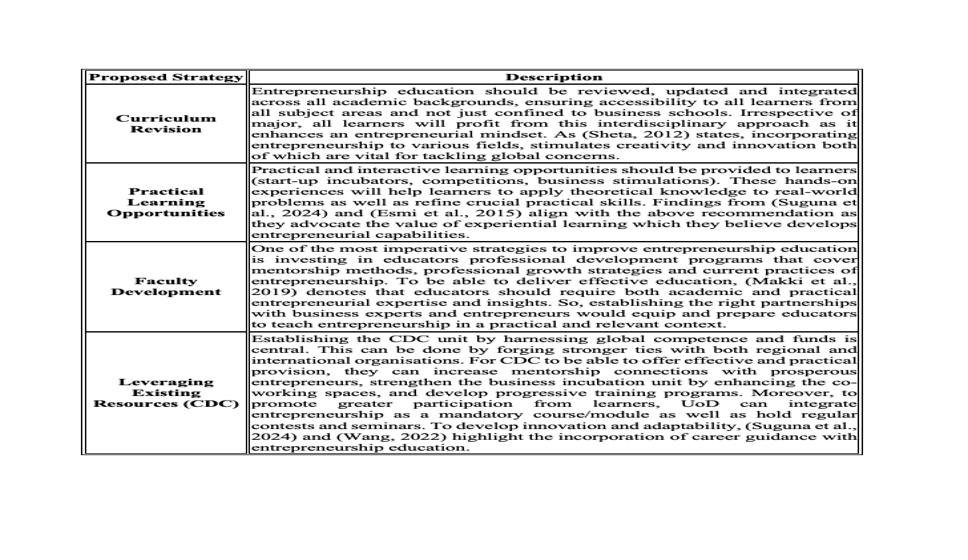
Focusing on the University of Duhok (UoD), this study explores the role of entrepreneurship education within the Kurdistan Region, Iraq (KRI). Existing research is analysed by means of a qualitative literature review methodology to understand the value of entrepreneurship education for driving economic prosperity and to address regional challenges. Obstacles that affect entrepreneurship teaching comprise faculty lack of familiarity with entrepreneurial practices, the absence of an integrated syllabi and cultural attitudes that favour governmental employment over entrepreneurship. Although the findings show that practical, hands-on learning prospects including industry collaborations and internships are in need, entrepreneurial education is of positive impact for learners’ innovative skills and aspirations. The inclusion of a revised curriculum to incorporate entrepreneurship across all disciplines, investing in the development of educators, expanding the Career Development Center (CDC) in offering focused mentorship programs, networking occasions, industrial alliances, and career guidance to further promote entrepreneurial efforts are some recommendations to overcome the challenges that may surface. To overcome other potential challenges, introducing extensive policy reforms are necessary for securing funds, and other barriers. Entrepreneurship education is momentous in cultivating entrepreneurial mindsets and improving the employability of graduates. Dealing with such issues and adopting international best practices, UoD can progress the framework for entrepreneurship training which contributes to maintain economic growth and creativity in KRI.
References
- Bandura, A., 1969. Social-learning theory of identificatory processes. Handbook of socialization theory and research, 213, p.262. available at: https://n9.cl/kwvyv [Accessed: 5 August 2023].
- Abbes, I. (2024). Shaping Entrepreneurial Intentions Through Education: An Empirical Study. Sustainability, 16(22), 10070.
- Akhuemonkhan, I., Raimi, L., & Sofoluwe, A. (2013). Entrepreneurship education and employment stimulation in Nigeria. Journal of studies in social sciences, 3(1).
- Alavi, H., & Ghafour, S. I. (2019). A study of challenges in entrepreneurship development and potential role of public sector in mitigating them–evidence from Kurdistan region of Iraq. Multidisciplinary Aspects of Production Engineering, 2(1).
- Anwar, K., & Qadir, G. H. (2017). A study of the relationship between work engagement and job satisfaction in private companies in Kurdistan. International Journal of Advanced Engineering, Management and Science, 3(12), 239944.
- Atrup, A., Diawati, P., Syamsuri, S., Pramono, S. A., & Ausat, A. M. A. (2023). The effect of entrepreneurship education and creativity on students’ entrepreneurial intention: The perspective of effectuation and cognitive flexibility theory. Jurnal Kependidikan: Jurnal Hasil Penelitian dan Kajian Kepustakaan di Bidang Pendidikan, Pengajaran dan Pembelajaran, 9(2), 555-569.
- Doan, K. H. (2021). THE RELATIONSHIP BETWEEN ENTREPRENEURSHIP AND NATIONAL COMPETITIVENESS. Annals of the University of Oradea, Economic Science Series, 30(2).
- Esmi, K., Marzoughi, R., & Torkzadeh, J. (2015). Teaching learning methods of an entrepreneurship curriculum. Journal of advances in medical education & professionalism, 3(4), 172.
- Ghafar, Z., & Mohamedamin, A. A. (2023). An Overview of the Challenges and Solutions for English Language Teaching in Iraq-Kurdistan. Canadian Journal of Educational and Social Studies, 3(1), 38-48.
- Gibb, A. (2002). In pursuit of a new ‘enterprise’and ‘entrepreneurship’paradigm for learning: creative destruction, new values, new ways of doing things and new combinations of knowledge. International journal of management reviews, 4(3), 233-269.
- Gutterman, A. S. (2020). Definitions and types of entrepreneurship. Available at SSRN 3930375.
- Kirby, D. A. (2004). Entrepreneurship education: can business schools meet the challenge? Education+ training, 46(8/9), 510-519.
- Kuratko, D. F. (2005). The emergence of entrepreneurship education: Development, trends, and challenges. Entrepreneurship theory and practice, 29(5), 577-597.
- Kurotimi, M. F., Franklin, A., Aladei, G., & Helen, O. (2017). Entrepreneurship education as a 21st century strategy for economic growth and sustainable development. International Journal of Social, Behavioural, Educational, Economic, Business and Industrial Engineering, 11(9), 2168-2179.
- Long, Z., Zhao, G., Wang, J., Zhang, M., Zhou, S., Zhang, L., & Huang, Z. (2021). Research on the drivers of entrepreneurship education performance of medical students in the digital age. Frontiers in Psychology, 12, 733301.
- Mahmudin, T. (2023). The Importance of entrepreneurship education in preparing the young generation to face global economic challenges. Journal of Contemporary Administration and Management (ADMAN), 1(3), 187-192.
- Makki, K. A., Hussein, J. S., & Abdulqadir, Z. (2019). Effect of Entrepreneurship Education on University Students Entrepreneurial Skills and Intentions in The Kurdistan Region of Iraq. Paper presented at the International Conference on Accounting, Business, Economics and Politics. Erbil: Tishk International University.
- Mohammadali, Z. M., & Abdulkhaliq, S. S. (2019). Prospects and challenges of entrepreneurship development in the Kurdistan region of Iraq: an overview. International Journal of Entrepreneurial Knowledge, 7(2).
- Mohammed, K. N., Alnoori, A. A. H., & Jasim, A. I. (2020). Developing the Knowledge Workers Model for Core Competencies Management in Iraqi Higher Education Institutions. Journal of Reviews on Global Economics, 9, 181-190.
- Muramalla, V. S. S. R., Gurram, N. K., & Sudheer, K. (2021). Entrepreneurship opportunities and challenges in the Kurdistan Region of Iraq (KRI).
- Nabi, G., Liñán, F., Fayolle, A., Krueger, N., & Walmsley, A. (2017). The impact of entrepreneurship education in higher education: A systematic review and research agenda. Academy of management learning & education, 16(2), 277-299.
- Nicola, S.-L., & Faraj, S. M. (2020). Should I stay, or should I go? Migration attitudes after the financial crisis (2014–19) among students from Halabja (KRI). Journal of Contemporary Iraq & the Arab World, 14(3), 201-222.
- Patricia, P. (2024). THE ROLE OF ENTREPRENEURSHIP EDUCATION IN UNIVERSITIES TO PURSUE SUSTAINABLE DEVELOPMENT GOALS. Feedforward: Journal of Human Resource, 4(1), 23-40.
- Pianda, D., Hilmiana, H., Widianto, S., & Sartika, D. (2024). The impact of internship experience on the employability of vocational students: a bibliometric and systematic review. Cogent Business & Management, 11(1), 2386465.
- Rasmussen, E. A., & Sørheim, R. (2006). Action-based entrepreneurship education. Technovation, 26(2), 185-194.
- Riesenberg, L. A., & Justice, E. M. (2014). Conducting a successful systematic review of the literature, part 1. Nursing2024, 44(4), 13-17.
- Rosário, A. T., & Raimundo, R. (2023). Sustainable Entrepreneurship Education: a Literature Review. Preprints (Basel), 1, 1-20.
- Saini, A. (2020). Exploring the potential of digital technology in achieving quality education: Rethinking pedagogy. Paper presented at the INTED2020 Proceedings.
- Saputra, Y. A., Novilia, F., & Hendrayati, H. (2023). Entrepreneurship curriculum in higher education: a systematic literature review (SLR). West Science Interdisciplinary Studies, 1(12), 1519-1531.
- Satriadi, S., Almaududi Ausat, A. M., Heryadi, D. Y., Widjaja, W., & Sari, A. R. (2022). Determinants of Entrepreneurial Intention: A Study on Indonesian Students. BISNIS & BIROKRASI: Jurnal Ilmu Administrasi dan Organisasi, 29(3), 3.
- Sheta, A. (2012). Developing an entrepreneurship curriculum in Egypt: The road ahead. Journal of Higher Education Theory and Practice, 12(4), 51-65.
- Suguna, M., Sreenivasan, A., Ravi, L., Devarajan, M., Suresh, M., Almazyad, A. S., . . . Mohamed, A. W. (2024). Entrepreneurial education and its role in fostering sustainable communities. Scientific reports, 14(1), 7588.
- Syed, R. T., Singh, D., Agrawal, R., & Spicer, D. P. (2023). Entrepreneurship development in universities across Gulf Cooperation Council countries: a systematic review of the research and way forward. Journal of Enterprising Communities: People and Places in the Global Economy, 17(5), 1045-1062.
- Uctu, R., & Al-Silefanee, R. (2024). UNDERSTANDING ENTREPRENEURIAL ECOSYSTEM IN THE MIDDLE EAST: INSIGHTS FROM ISENBERG'S MODEL. International Journal of Entrepreneurial Knowledge, 12(1), 86-109.
- Wang, Y. (2022). Exploration on the Integrated Development of Labor Education and Innovation and Entrepreneurship Education for Students in Applied Undergraduate Colleges and Universities. International Journal of New Developments in Education, 4(2).
- Whiteside, V., & Cross, J. (2023). Recontextualising graduate employability in support of pedagogical reform in public universities in the Kurdistan Region‐Iraq. Studies in Ethnicity and Nationalism, 23(3), 355-368.
Downloads
Published
How to Cite
Issue
Section
License
Copyright (c) 2025 Suzanne Sherzad Mohammed-Salih Alsoufi, Hogir Najm Abdullah

This work is licensed under a Creative Commons Attribution 4.0 International License.