
Kurdish High School Students' Perceptions on Integrating AI to Mitigate Anxiety and Cultivate Motivation
DOI:
https://doi.org/10.21271/zjhs.30.SpB.28Keywords:
Artificial Intelligence, Language Learning Anxiety, Student Motivation, English as a Foreign LanguageAbstract
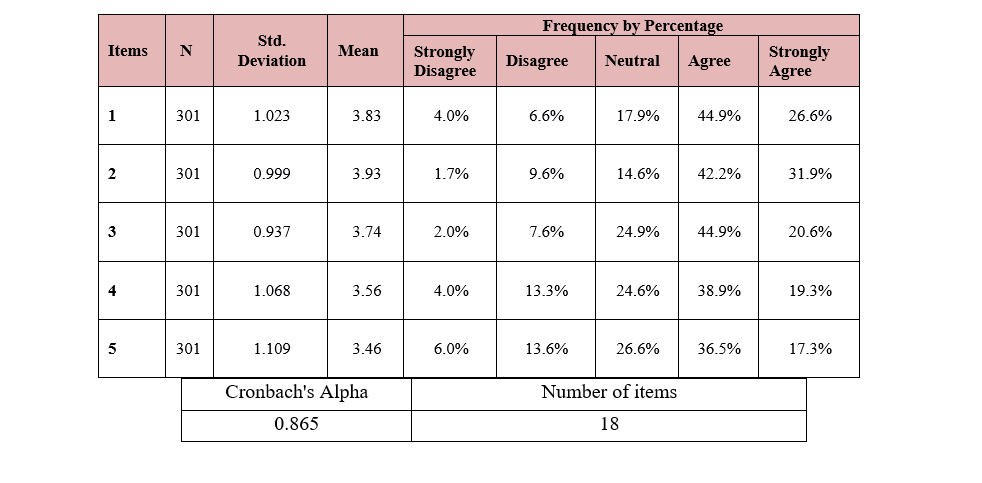
Artificial intelligence tools are adaptive technological systems that personalize learning experiences through intelligent feedback mechanisms. Despite growing availability, AI tools are rarely used in EFL classrooms across the Kurdistan Region, where educators continue relying on traditional instruction methods. This approach limits student engagement and creates learning barriers, particularly for students struggling with elevated anxiety levels. This descriptive study examines the impact of AI tools on motivation and the reduction of learning anxiety among Kurdish high school students. The research employed a quantitative approach using a five-point Likert scale questionnaire distributed to 301 students from grades 10-11 across six English systematic schools during the 2024-2025 academic year. This study measured student perceptions of AI's impact rather than experimentally verified outcomes. Reliability testing confirmed a Cronbach's alpha of 0.865, with data analysis conducted using SPSS (Version 27). Findings show that AI tools substantially boost student motivation, as 74.1% agreed that AI makes English learning more enjoyable compared to traditional methods. Adaptive feedback, interactivity, and self-paced practice were features students reported as improving engagement. Some students had challenges with technical issues; however, many of them felt far more secure by rehearsing tough concepts privately. Furthermore, AI tools fostered psychologically safe learning environments that reduced both academic and social anxieties. Nevertheless, some students reported that unfamiliarity with AI technology initially heightened stress levels, suggesting that gradual implementation with proper support is essential. The research emphasizes the importance of careful AI integration and thoughtful instructional design. Properly implemented AI tools can effectively bridge traditional anxiety-inducing teaching methods with supportive, student-centered learning environments.
References
- Abdullah, K.N.; Razi, Ö., 2022. Investigation of Kurdish students’ L2 motivational self-system and their motivational beliefs in high school. Frontiers in Psychology, Volume 13, p. 974748. Available at: https://doi.org/10.3389/fpsyg.2022.974748
- Anderson, J.R.; Boyle, C.F.; Corbett, A.T.; Lewis, M.W., 1986. Cognitive modelling and intelligent tutoring. Pittsburgh: Carnegie Mellon University. Available at: https://files.eric.ed.gov/fulltext/ED267977.pdf
- Artino Jr, A.R.; Holmboe, E.S.; Durning, S.J, 2012. Control‐value theory: Using achievement emotions to improve understanding of motivation, learning, and performance in medical education: AMEE Guide No. 64. Medical Teacher, Volume 34, p. e148–e160. Available at: http://dx.doi.org/10.3109/0142159X.2012.651515
- Bandura, A., 1997. Self-efficacy: The exercise of control. New York: Freeman.
- Deci, E.L.; Ryan, R.M., 2000. The “what” and “why” of goal pursuits: Human needs and the self-determination of behavior. Psychological Inquiry, Volume 11, p. 227–268. Available at: https://doi.org/10.1207/S15327965PLI1104_01
- Faqe, C.K.; Moheddin, K.R.; Kakamad, K.K., 2016. Reducing test anxiety among 12th grade students: Iraqi Kurdistan Region/Soran City as an example. Journal of Education and Practice, Volume 7, p. 69–75. Available at: https://www.researchgate.net/publication/308888609_Reducing_Test_Anxiety_among_12th_Grade_Students_Iraqi_Kurdistan_Region_Soran_City_as_an_Example
- Hawanti, S.; Zubaydulloevna, K.M., 2023. AI chatbot-based learning: alleviating students' anxiety in English writing classroom. Bulletin of Social Informatics Theory and Application, Volume 7, p. 182–192. Available at: http://dx.doi.org/10.31763/businta.v7i2.659
- Holmes, W.; Bialik, M.; Fadel, C., 2019. Artificial intelligence in education: Promises and implications for teaching and learning. Boston: Centre for Curriculum Redesign.
- Koedinger, K.R.; Corbett, A.T., 2006. Cognitive tutors: technology bringing learning science to the classroom. In: The Cambridge handbook of the learning sciences. Cambridge: Cambridge University Press, p. 61–78. Available at: https://d1wqtxts1xzle7.cloudfront.net/39560171/koedingercorbett06-libre.pdf
- Krashen, S., 1982. Principles and practice in second language acquisition. Oxford: Pergamon Press.
- Li, Y.; Zhou, X.; Chiu, T.K.F., 2024. Systematic review on artificial intelligence chatbots and ChatGPT for language learning and research from self-determination theory (SDT): what are the roles of teachers?. Interactive Learning Environments, Volume 33, p. 1850–1864. Available at: https://awspntest.apa.org/doi/10.1080/10494820.2024.2400090
- Locke, E.A. and Latham, G.P., 1990. A theory of goal setting & task performance. Englewood Cliffs, NJ: Prentice Hall. Available at: https://doi.org/10.2307/258875
- Krejcie, R.V. & Morgan, D.W., 1970. Determining sample size for research activities. Educational and Psychological Measurement, 30, pp.607–610. Available at: https://doi.org/10.1177/001316447003000308
- OpenAI, 2023. GPT-4 Technical Report, San Francisco: OpenAI. Available at: https://arxiv.org/pdf/2303.08774
- Pan, Zilong; Biegley, Lauren; Taylor, Allen; Zheng, Hua, 2024. A systematic review of learning analytics-incorporated instructional interventions on learning management systems. Journal of Learning Analytics, Volume 11, p. 52–72. Available at: http://dx.doi.org/10.18608/jla.2023.8093
- Pekrun, R., 2006. The control-value theory of achievement emotions: Assumptions, corollaries, and implications for educational research and practice. Educational Psychology Review, 18(4), pp.315-341. Available at: https://doi.org/10.1007/s10648-006-9029-9
- Salloum, S.A.; Alomari, K.M.; Alfaisal, A.M.; Aljanada, R.A.; Basiouni, A., 2025. Emotion recognition for enhanced learning: using AI to detect students’ emotions and adjust teaching methods. Smart Learning Environments, Volume 12, p. 1–17. Available at: https://doi.org/10.1186/s40561-025-00374-5
- Shao, S., 2025. The role of AI tools on EFL students’ motivation, self-efficacy, and anxiety: through the lens of control-value theory. Learning and Motivation, Volume 91, p. 102154. Available at: https://doi.org/10.1016/j.lmot.2025.102154
- Sims, C.; Thompson, N.; Moursounidis, J.; Sheffield, R.; Singh, A.; Bunn, A.; Sha, L., 2024. AI Am Motivated: leveraging self-determination theory in chatbots. Miri, Sarawak, International Conference on Higher Education Learning and Teaching (ICHELT) 2024. Available at: https://nikthompson.com/PDF/Sims-Thompson-2024-SDT-Chatbots.pdf
- Singh, H.P. & Aziz, A.A., 2025. Impact of intelligent learning assistants on creativity of university students: a self-determination theory perspective. Future Business Journal, Volume 11, p. 1–18. Available at: http://dx.doi.org/10.1186/s43093-025-00544-4
- Skinner, B., 1958. Teaching machines: From the experimental study of learning come devices which arrange optimal conditions for self-instruction. Science, Volume 128, p. 969–977. Available at: https://doi.org/10.1126/science.128.3330.969
- Syifauddin, M.; Yuliansyah, A.R., 2023. The effect of using AI on students’ motivation and anxiety in learning English. Transformational Language Literature and Technology Overview in Learning (Transtool), Volume 2, p. 9–15. Available at: https://doi.org/10.55047/transtool.v2i2.1354
- Vistorte, A.O.R.; Deroncele-Acosta, A.; Ayala, J.L.M.; Barrasa, A.; López-Granero, C.; Martí-González, M., 2024. Integrating artificial intelligence to assess emotions in learning environments: a systematic literature review. Frontiers in Psychology, Volume 15, p. 1387089. Available at: https://doi.org/10.3389/fpsyg.2024.1387089.
- Xia, Q.; Chiu, T.K.; Lee, M.; Sanusi, I.T.; Dai, Y.; Chai, C.S., 2022. A self-determination theory (SDT) design approach for inclusive and diverse artificial intelligence (AI) education. Computers & Education, Volume 189, p. 104582. Available at: https://doi.org/10.1016/j.compedu.2022.104582
Downloads
Published
How to Cite
Issue
Section
License
Copyright (c) 2026 Shvan Samad Youns, Parween Shawkat Kawther

This work is licensed under a Creative Commons Attribution 4.0 International License.