
The Role of Flipped Classroom on Improving EFL Students' Speaking Skills at Salahaddin University
##semicolon##
https://doi.org/10.21271/zjhs.29.6.14##semicolon##
Flipped classroom, Speaking skill, EFL context, University Studentsپوختە
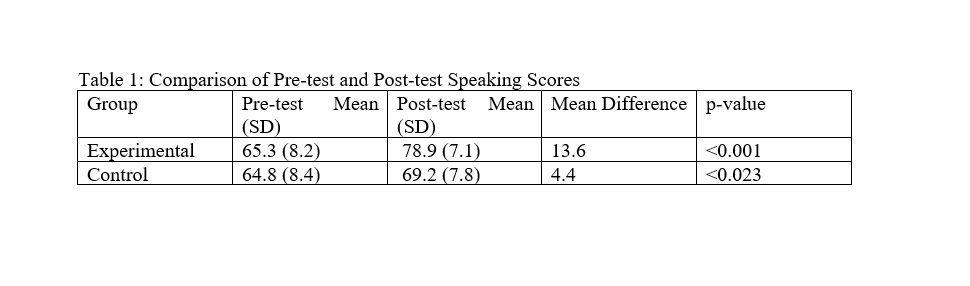
This study investigates the effectiveness of the flipped classroom model in enhancing English as a Foreign Language (EFL) students' speaking skills at Salahaddin University, Kurdistan region of Iraq. The research employed a mixed-methods approach, combining quantitative data from speaking assessments in the form of a pre-test and post intervention test with qualitative insights from student survey, student interviews and classroom observations and notes. The study involved 120 undergraduate EFL students over two academic semesters in the English department, college of education at Salahaddin University in the academic year 2023-2024. Results indicate that the flipped classroom model significantly improved students' speaking proficiency, particularly in areas of fluency, pronunciation, and vocabulary usage. These results also have some pedagogical implication for both EFL teachers at the university level and for people who are responsible for designing course-books and syllabi. The findings suggest that this pedagogical approach can effectively address the common challenges faced in EFL speaking instruction within the Iraqi higher education in EFL context.
سەرچاوەکان
- Ahmed, R. Z., & Hassan, S. A. (2020). Digital transformation in EFL teaching: A study of Iraqi universities. Journal of Education and Practice, 11(15), 45-56.
- Al-Hassan, M., & Shukri, N. (2017). The effect of blended learning in enhancing female students' satisfaction in the Saudi context. English Language Teaching, 10(6), 190-203.
- Al-Jabouri, S., & Al-Khatib, M. (2019). Challenges in teaching speaking skills to Iraqi EFL learners. Arab World English Journal, 10(2), 81-93.
- Al-Zahrani, M. (2016). The impact of the flipped classroom on EFL students' speaking skills. Journal of Language Teaching and Research, 7(3), 657-664.
- Amin, Ch.A,& Muhammad, HA(2023) . Investigating the Effect of Flipped Classroom Model on Kurdish EFL University Students’ Reading Skill, Journal of University of Human Development, Volume 9 No. 2(2023); .pp27-36
- DOI: 10.21928/juhd.v9n2y2023
- Baker, J. W. (2000). The “Classroom Flip”: Using Web Course Management Tools to Become the Guide on the Side. Selected Papers from the 11th International Conference on College Teaching and Learning.
- Bergmann, J., & Sams, A. (2012). Flip your classroom: Reach every student in every class every day. International Society for Technology in Education.
- Chen Hsieh, J. S., Wu, W. C. V., & Marek, M. W. (2016). Using the flipped classroom to enhance EFL learning. Computer Assisted Language Learning, 30(1–2), 1–21. https://doi.org/10.1080/09588221.2015.1111910
- Hung, H.-T. (2015). Flipped classroom: A learning model for the 21st century. Journal of Education and Practice, 6(3), 76-82.
- Jensen, J. L., Kummer, T. A., & Godoy, P. D. D. M. (2015). Improvements from a flipped classroom may simply be the fruits of active learning. CBE Life Sciences Education, 14(1), 1–12.
- https://doi.org/10.1187/CBE.14-08-0129
- Kim, J. Y., Park, H., & Jang, M. (2020). Effects of flipped learning on EFL students' speaking performance and learning engagement. English Teaching, 75(2), 89-114.
- Lage, M. J., Platt, G. J., & Treglia, M. (2000). Inverting the classroom: A gateway to creating an inclusive learning environment. The Journal of Economic Education, 31(1), 30-43.
- Lee, G., & Wallace, A. (2018). Flipped learning in the English as a foreign language classroom: Outcomes and perceptions. TESOL Quarterly, 52(1), 62-84.
- Mohammed, A. S. (2019). Investigating the use of technology in Iraqi EFL classrooms. International Journal of English Linguistics, 9(4), 55-69.
##submission.downloads##
بڵاو کرایەوە
چۆنییەتی بەکارهێنانی سەرچاوە
ژمارە
بەش
##submission.license##
##submission.copyrightStatement##
##submission.license.cc.by4.footer##