
AI and Academic Productivity: Evaluating Its Impact on Research Output in Kurdistan’s Public Universities
DOI:
https://doi.org/10.21271/zjhs.30.2.13Keywords:
Artificial Intelligence, Academic Productivity, Research Output, Public Universities, Kurdistan RegionAbstract
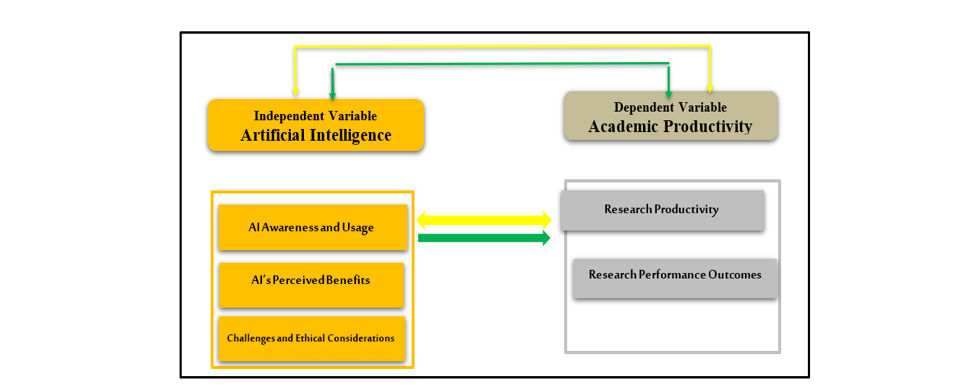
The use of Artificial Intelligence (AI) within public educational institutions creates a paradigm shift that produces elevated academic performance quality in addition to boosted research outputs. This study examines the effects of AI technology on public university productivity levels in the Kurdistan Region of Iraq, specifically analyzing the relationship between AI knowledge and estimated advantages and moral concerns affecting research performance. The study employs AI as its independent variable through three separate analysis dimensions: AI awareness and usage behaviors; perceived benefits from AI implementations; and related ethical challenges. Research productivity and research performance outcomes serve as the two components through which the dependent variable, academic productivity, is measured. The study used a structured questionnaire to collect data from 11,641 permanent academicians and staff members at public universities in the Kurdistan Region. A total of 320 questionnaires were returned, of which 314 were valid and used for the analysis. To achieve the research objectives, the researchers adopted a descriptive and analytical approach. The study provides data that can enable educational leaders to develop policies and design institutional practices for adopting AI in pursuit of scientific progress and academic sustainability. The research evaluates the relationship between AI technology usage and productivity measures, advancing the digital transformation discussion in higher education practices.
References
Adefioye, O., Sandra, A. and Oni, M. (2025). Leveraging AI and Technology to Address the Challenges of Underdeveloped Countries, ResearchGate, p. 4. [online] Available at: https://www.researchgate.net/publication/389775396 [Accessed 3 Apr. 2025].
Ahmed, S. J., & Ibrahim, H. R. (2022). Towards Directing Agricultural Graduates to Small Agricultural Projects. Journal of historical & cultural studies an academic magazin, 13(56).
Albuhairy, M.M. and Algaraady, J. (2025). Understanding User Perceptions of DeepSeek: A Mixed-Methods Sentiment and Thematic Analysis, ResearchGate, p. 6. [online] Available at: https://www.researchgate.net/publication/389674307 [Accessed 3 Apr. 2025].
Antunes, H. (2025) ‘Higher Education in Transformation: A Sociological View of Academic Careers in Portugal’, INTED2025 Proceedings, p. 4. Available at: https://library.iated.org/view/ANTUNES2025HIG [Accessed 3 Apr. 2025].
Antunes, H. (2025) ‘Higher Education in Transformation: A Sociological View of Academic Careers in Portugal’, INTED2025 Proceedings, p. 5. Available at: https://library.iated.org/view/ANTUNES2025HIG [Accessed 3 Apr. 2025].
Aristovnik, A., Ravšelj, D. and Umek, L. (2024) ‘Higher Education Student Experiences With ChatGPT: Some Insights Across Academic Disciplines Worldwide’, EDULEARN24 Proceedings, p. 3. Available at: https://library.iated.org/view/ARISTOVNIK2024HIG [Accessed 3 Apr. 2025].
August, E. (2025). Teaching Academic Writing in the Health Sciences: A Guide for Instructors, Mentors, and Trainers. University of Michigan. pp. 158–164. [online] Available at: https://deepblue.lib.umich.edu/handle/2027.42/196582 [Accessed 3 Apr. 2025].
Badulescu, D., Bodog, S.A., Dzitac, S. and Toca, C.V. (2024) ‘Students' Perception Regarding the Impact of AI in Education and Career Prospects’, ICERI2024 Proceedings, p. 6. Available at: https://library.iated.org/view/BADULESCU2024STU [Accessed 3 Apr. 2025].
Basilio, S.G. (2025) ‘Knowledge production and intellectual property: A Marxist approach to higher education systems’, tripleC: Communication, Capitalism & Critique, 23(1), p. 4. Available at: https://triple-c.at/index.php/tripleC/article/view/1520 [Accessed 3 Apr. 2025].
Basnyat, I., de Souza, R.T. and V-Team (2025) ‘Centering Women, Health, and Health Equity in Health Communication’, Frontiers in Communication, 10(1513715), p. 5. Available at: https://www.frontiersin.org/articles/10.3389/fcomm.2025.1513715/full [Accessed 3 Apr. 2025].
Blackmoor, H.S. (2024) AI Policy and Ideological Polarisation in Art Ownership: Constructing a Discourse between Walter Benjamin and Yukio Mishima. University of Tokyo Discussion Papers, [online] Available at: https://www.pp.u-tokyo.ac.jp/wp-content/uploads/2016/02/AI-Policy-and-Ideological-Polarisation-in-Art-Ownership-Constructing-a-Discourse-between-Walter-Benjamin-and-Yukio-Mishima.pdf [Accessed 3 Apr. 2025].
Blbas, H., Faraj, S., & Ahmed A., (2022). A Statistical Study of the Influence of COVID-19 on the Agricultural Supply Chain (Vegetative) Production in Halabja Governorate. Cihan University-Erbil Scientific Journal, 6(1), 1-6. https://doi.org/10.24086/cuesj.v6n1y2022.pp1-6
Blitz, C., Trees, F., Amiel, D., and Detrick, D. (2025). A University-Led Computer Science Education Summit: Meeting the Moment with Actionable, Relevant, and Timely Explorations. INTED2025 Proceedings, pp. 210–213. [online] Available at: https://library.iated.org/view/BLITZ2025AUN [Accessed 3 Apr. 2025].
Bouhouita-Guermech, S., Gogognon, P. and Bélisle-Pipon, J.C. (2023) ‘Specific Challenges Posed by Artificial Intelligence in Research Ethics’, Frontiers in Artificial Intelligence, 6:1149082, p. 2. Available at: https://doi.org/10.3389/frai.2023.1149082 [Accessed 3 Apr. 2025].
Buechele, S., Hügel, M., Kadriu, V., and Koenig, J. (2025) New Players, Different Output? A Longitudinal Analysis of Research Dynamics at German Public and Private Universities, MAGKS Joint Discussion Paper Series in Economics, No. 06-2025, p. 2. Available at: https://www.econstor.eu/bitstream/10419/312914/1/1917585497.pdf [Accessed 3 Apr. 2025].
Buniel, J.C., Peñalba, J.L., and Co, E. (2025). Generative AI in Engineering Research and Higher Education: Opportunities and Barriers. Ateneo Research Review, 12(1), p. 10. [online] Available at: https://ajol.info/index.php/arr/article/view/234199 [Accessed 3 Apr. 2025].
Buniel, J.M., Intano, J., Cuartero, O., and Grustan, K.J. (2025). Modelling the influence of AI dependence to research productivity among STEM undergraduate students: Case of a state university in the Philippines, Frontiers in Education. [online] Available at: https://www.frontiersin.org/journals/education/articles/10.3389/feduc.2025.1535466/full [Accessed 3 Apr. 2025].
Carobene, A., Padoan, A., Cabitza, F., Banfi, G. and Plebani, M. (2024) ‘Rising adoption of artificial intelligence in scientific publishing: evaluating the role, risks, and ethical implications in paper drafting and review process’, Clinical Chemistry and Laboratory Medicine, 62(5), pp. 835–836. DOI: 10.1515/cclm-2023-1372.
Castillo-López, Á.G. del (2025). An integrative proposal in addiction and health behaviors psychosocial research: overview of new trends and future orientations. Frontiers in Psychology, 16, p. 6. [online] Available at: https://www.frontiersin.org/articles/10.3389/fpsyg.2025.1565681/full [Accessed 3 Apr. 2025].
Castro, R. et al. (2023) AI-Driven University Research: A Bibliometric Perspective. [unpublished manuscript]. [Summary available via ScholarIndex].
Choi, W.C. and Chang, C.I. (2025). Advantages and Limitations of Open-Source Versus Commercial Large Language Models (LLMs): A Comparative Study of DeepSeek and OpenAI's ChatGPT. Preprints.org, p. 4. [online] Available at: https://www.preprints.org/manuscript/202503.1081 [Accessed 3 Apr. 2025].
Cui, B., Jiao, W., Gui, S., Li, Y., and Fang, Q. (2025). ‘Innovating Physical Education with Artificial Intelligence: A Potential Approach’, Frontiers in Psychology, p. 3–4. [online] Available at: https://www.frontiersin.org/articles/10.3389/fpsyg.2025.1490966/full [Accessed 3 Apr. 2025].
Cui, B., Jiao, W., Gui, S., Li, Y. and Fang, Q. (2025) ‘Innovating Physical Education with Artificial Intelligence: A Potential Approach’, Frontiers in Psychology, p. 6. [online] Available at: https://www.frontiersin.org/articles/10.3389/fpsyg.2025.1490966/full [Accessed 3 Apr. 2025].
Doskaliuk, B. and Zimba, O. (2023) ‘Beyond the keyboard: academic writing in the era of ChatGPT’, Journal of Korean Medical Science, 38(26), p. e207. [online] Available at: https://synapse.koreamed.org/articles/1516090023 [Accessed 3 Apr. 2025].
García del Castillo-López, Á. (2025). An integrative proposal in addiction and health behaviors psychosocial research: overview of new trends and future orientations. Frontiers in Psychology, [online] Available at: https://www.frontiersin.org/articles/10.3389/fpsyg.2025.1565681/full [Accessed 3 Apr. 2025].
Gharieb, A., Gabry, M.A., and Soliman, M.Y. (2024). Personalized Generative AI in Advancing Petroleum Engineering and Energy Industry: A Roadmap to Secure and Cost-Efficient Knowledge Integration: A Case Study. SPE Annual Technical Conference, [online] Available at: https://onepetro.org/SPEATCE/proceedings-abstract/24ATCE/24ATCE/563531 [Accessed 3 Apr. 2025].
Gomis, E.M. and Perea, C. (2025). Innovative Pedagogical Strategies for AI Literacy in STEM Education: A Systematic Review and Practical Implications. INTED2025 Proceedings, pp. 85–89. [online] Available at: https://library.iated.org/view/GOMIS2025INN [Accessed 3 Apr. 2025].
Gursoy, S. (2025) ‘Artificial Intelligence Literacy and the Digital Divide: Implications for Financial Investors’, Journal of Business and Econometrics Studies, 2(1), p. 2. Available at: https://oaskpublishers.com/assets/article-pdf/artificial-intelligence-literacy-and-the-digital-divide-implications-for-financial-investors.pdf [Accessed 3 Apr. 2025].
Gürsoy, S. (2025) ‘Artificial Intelligence Literacy and the Digital Divide: Implications for Financial Investors’, Journal of Business and Econometrics Studies, 2(1), pp. 2, 6–7. [online] Available at: https://oaskpublishers.com/assets/article-pdf/artificial-intelligence-literacy-and-the-digital-divide-implications-for-financial-investors.pdf [Accessed 3 Apr. 2025].
Gursoy, S. (2025). Artificial Intelligence Literacy and the Digital Divide: Implications for Financial Investors, Journal of Business and Econometrics Studies, 2(1), p. 3. Available at: https://oaskpublishers.com/assets/article-pdf/artificial-intelligence-literacy-and-the-digital-divide-implications-for-financial-investors.pdf [Accessed 3 Apr. 2025].
Ibrahim, H.R. and Ahmed, H.I., 2023. The Role of Civilization Management in Social Life-Analytical Research (Economic, Administration, and Cultural) in Erbil City. Iraqi Journal of Humanitarian, Social and Scientific Research, 3(8S).
Ibrahim, H.R. and Omer, T.Q., 2024. The Role of Air Transportation in Importing Gold for the Year 2024 in the City of Erbil. Zanco Journal of Human Sciences, 28(5).
Ibrahim, H.R. and Wali, A.I., 2022. The Role of Knowledge Economy in Achieving Strategic Success: Analytical study of the opinions of department heads in a sample of Colleges of Salahaddin University-Erbil. Zanco Journal of Human Sciences, 26(4), pp.178-194.
Jose, B., Cherian, J., Verghis, A.M. and Varghise, S.M. (2025) ‘The Cognitive Paradox of AI in Education: Between Enhancement and Erosion’, Frontiers in Psychology, p. 3. [online] Available at: https://www.frontiersin.org/articles/10.3389/fpsyg.2025.1550621/full [Accessed 3 Apr. 2025].
Jose, B., Cherian, J., Verghis, A.M., and Varghise, S.M. (2025). The Cognitive Paradox of AI in Education: Between Enhancement and Erosion. Frontiers in Psychology, 16, p. 5. [online] Available at: https://www.frontiersin.org/articles/10.3389/fpsyg.2025.1550621/full [Accessed 3 Apr. 2025].
Kalva, H., Zhuang, H., and Romance, N. (2024). Data Driven Approaches to Integrating AI in K-12 Education Using Social Media Analysis, pp. 2–3. [online] Available at: https://stelar.edc.org/sites/default/files/2024-09/Rapid%20Project%20Brief.pdf [Accessed 3 Apr. 2025].
Kasun, G.S., Liao, Y.C., Margulieux, L.E. and Woodall, M. (2024) ‘Unexpected Outcomes from an AI Education Course Among Education Faculty’, Frontiers in Education, 9:1368604, p. 8. Available at: https://doi.org/10.3389/feduc.2024.1368604 [Accessed 3 Apr. 2025].
Kaur, K., Kaur, J., and Singh, R. (2024). Re-engineering education and training: Fostering digitalization for sustainability. In: Digital Analytics Applications for Knowledge Societies. Taylor & Francis. [online] Available at: https://www.taylorfrancis.com/chapters/edit/10.1201/9781032713366-14 [Accessed 3 Apr. 2025].
Kawtar, B. and Khadija, B. (2025) ‘The Impact of Risk Management Efficiency on Organizational Performance in State-Owned Enterprises and the Mediating Effect of Supply Chain Maturity: Evidence from Morocco’, Qubahan Academic Journal, 5(2), p. 7. Available at: https://journal.qubahan.com/index.php/qaj/article/view/1454 [Accessed 3 Apr. 2025].
Kelly, M.P. and Smith, D. (2024). How to Think About Integrating Generative AI in Professional Military Education, Military Review, p. 4. [online] Available at: https://www.armyupress.army.mil/. [Accessed 3 Apr. 2025].
Kerr, D. and Kim, Y. (2025) Generative AI Tools and Academic Content Development: A Case Study on Higher Education Use, Journal of Academic Innovation, 13(1), pp. 3–4.
Kerr, R.C. and Kim, H. (2025). From Prompts to Plans: A Case Study of Pre-Service EFL Teachers' Use of Generative AI for Lesson Planning, 영어교육. [online] Available at: https://www.researchgate.net/profile/Robert-C-Kerr/publication/390184505 [Accessed 3 Apr. 2025].
Luong, H. and Luong, K. (2025) ‘A Chatbot-Based Academic Advising Model for Student in Information Technology: A Case Study’, Saudi Journal of Engineering and Technology, 10(3), pp. 94–95. [online] Available at: https://saudijournals.com/media/articles/SJEAT_103_93-100.pdf [Accessed 3 Apr. 2025].
Luong, H. and Luong, K. (2025) A Chatbot-Based Academic Advising Model for Student in Information Technology: A Case Study, Saudi J Eng Technol, 10(3), pp. 93–100. [online] Available at: https://saudijournals.com/media/articles/SJEAT_103_93-100.pdf [Accessed 3 Apr. 2025].
Mendonça, P.C., Quintal, F. and Mendonça, F. (2025) ‘Evaluating LLMs for Automated Scoring in Formative Assessments’, Applied Sciences, 15(5), p. 5. [online] Available at: https://www.mdpi.com/2076-3417/15/5/2787 [Accessed 3 Apr. 2025].
Mok, K.H. and Jiang, J. (2023). The Rise of AI and the Changing Nature of Academic Research. Journal of Higher Education Policy and Management, [Abstract referenced via Scopus].
Monteiro, A.M.V. and Fernandes, D.A. (2025) ‘Structural diversity and technological trajectories in the agrarian sector in the Amazon: A testimony by Francisco de Assis Costa’, Cadernos de Saúde Pública, 41(Suppl 1), p. 6. Available at: https://www.scielosp.org/article/csp/2025.v41suppl1/e00229623/ [Accessed 3 Apr. 2025].
Naderi, N., Baharvand, F. and Rezaee, B. (2025) ‘Analyzing the Barriers for Nurturing Hybrid Entrepreneurs in the Higher Education System’, Journal of Public Management Research, 17(1), p. 7. Available at: https://jmr.usb.ac.ir/article_8971_en.html?lang=en [Accessed 3 Apr. 2025].
Naderi, N., Baharvand, F. and Rezaee, B. (2025) ‘Analyzing the Barriers for Nurturing Hybrid Entrepreneurs in the Higher Education System’, Journal of Public Management Research, 17(1), p. 6. Available at: https://jmr.usb.ac.ir/article_8971_en.html?lang=en [Accessed 3 Apr. 2025].
Nguyen, N.L. (2025). Exploring Academics’ Perceptions of GenAI Usage in Research: A Netnographic Analysis of YouTube Comments. International Journal of Innovation Science, 17(1), pp. 106–110. [online] Available at: https://www.emerald.com/insight/content/doi/10.1108/ijis-08-2024-0219/full/html [Accessed 3 Apr. 2025].
Nguyen, N.L. (2025). Exploring Academics’ Perceptions of GenAI Usage in Research: A Netnographic Analysis of YouTube Comments. International Journal of Innovation Science, 17(1), pp. 106–110. [online] Available at: https://www.emerald.com/insight/content/doi/10.1108/ijis-08-2024-0219/full/html [Accessed 3 Apr. 2025].
Nogueira, L.A. (2025) Chatbots and Scholarly Databases: Impressions from Trying out Scopus AI. Information Technology and Libraries, 44(1), pp. 30–35. [online] Available at: https://ital.corejournals.org/index.php/ital/article/view/17116 [Accessed 3 Apr. 2025].
Nulton, K. and Fenton, D. (2024) Using Work-Integrated Learning to Explore Knowledge Transfer Involving Artificial Intelligence, in Zegwaard, K.E. and Fleming, J. (eds.) Refereed Proceedings of the 5th WACE International Research Symposium on Cooperative and Work-Integrated Education, University West, Sweden, pp. 212–214. [online] Available at: https://waceinc.org/resources/Documents/WACE%20IRS%202024/WACE%20IRS%20Proceedings%202024.pdf#page=212 [Accessed 3 Apr. 2025].
Nyaga, D. (2024). Utilization of ChatGPT for Learning at Daystar and Strathmore University: A Stakeholder's Perspective, Journal of Current Issues in Open Distance and E-Learning, 1(1), p. 5. [online] Available at: https://journals.dolpak.or.ke/index.php/jcodel/article/view/10 [Accessed 3 Apr. 2025].
Prasetya, F., Fortuna, A. and Samala, A.D. (2025) Harnessing Artificial Intelligence to Revolutionize Vocational Education: Emerging Trends, Challenges, and Contributions to SDGs 2030, Social Sciences & Humanities Open, p. 5. [online] Available at: https://www.researchgate.net/publication/390231420 [Accessed 3 Apr. 2025].
Rashidi, M. and Rahimi, A. (2024) ‘Identifying and Analyzing Strategies for Enhancing Work-Family Balance Among Employees in Public Organizations in Birjand’, Journal of Socio-Cultural Strategies, 11(2), p. 4. Available at: https://www.farhangekhorasan.ir/article_217025_en.html?lang=en [Accessed 3 Apr. 2025].
Rehman, A., Laffier, J. and Westley, M. (2025) ‘Leveraging AI to Enhance Mental Health Support in Post-Secondary Education’, INTED2025 Proceedings, p. 5. Available at: https://library.iated.org/view/REHMAN2025LEV [Accessed 3 Apr. 2025].
Rezende, L.R., Branco, V.T.F.C. and Savasini, K.V. (2025) ‘Criteria for Research Productivity Grants in Brazil Applied to Civil Engineering: Reflections on Gender Differences and the Current Context’, Anais da Academia Brasileira de Ciências, 97(1), p. 3. Available at: https://www.scielo.br/j/aabc/a/t7mj4t3nBCmBr4SBtZKg7gx/ [Accessed 3 Apr. 2025].
Rosenkranz, B. (2024). Drug outcomes research and policies – trends and challenges. Frontiers in Pharmacology, [online] Available at: https://www.frontiersin.org/articles/10.3389/fphar.2024.1476849/full [Accessed 3 Apr. 2025].
Runceanu, A., Balan, A., Gavanescu, L. and Neagu, M.M. (2025) ‘Enhancing the Learning Experience with AI’, Preprints.org, p. 4. [online] Available at: https://www.preprints.org/manuscript/202503.2041 [Accessed 3 Apr. 2025].
Sadeghi Naeini, H. and Golestaneh, H. (2024). The Transformative Role of Design for Social Innovation in Community Development at the Local Level. Quarterly Journal of Urban and Regional Development Planning, [online] Available at: https://urdp.atu.ac.ir/article_18101_en.html [Accessed 3 Apr. 2025].
Salazar-Altamirano, M.A. and Martínez-Arvizu, O.J. (2025) AI as a Facilitator of Creativity and Wellbeing in Business Students: A Multigroup Approach, CETYS Repository, p. 5. [online] Available at: https://repositorio.cetys.mx/handle/60000/1920 [Accessed 3 Apr. 2025].
Salh.D.M.Ibrahim.H.R.Jameel.D.I. (2018). Use the Six Sigma technique to configure the plate ratio of defective units for quality control and compare them with plate ratio of defective units using three Sigma with the application. Qalaai Zanist Journal, 3(4), 756-772.
Sánchez-Paniagua-López, M.S. and Rodríguez-Rodríguez, E. (2024) ‘The Power of Artificial Intelligence in University Education’, ICERI2024 Proceedings, p. 4. Available at: https://library.iated.org/view/SANCHEZPANIAGUALOPEZ2024POW [Accessed 3 Apr. 2025].
Saragih, R. (2025). Student Perception of the Advantages and Challenges of Using ChatGPT (Artificial Intelligence) for Academic Assignments. Journal of Information Technology, Computer Science and Engineering, [online] Available at: https://ysmk.org/ejournal/index.php/jitcse/article/view/158 [Accessed 3 Apr. 2025].
Shahidi Hamedani, S. and Aslam, S. (2025) ‘AI in Business Operations: Driving Urban Growth and Societal Sustainability’, Frontiers in Artificial Intelligence, 6:1568210, pp. 5–9. Available at: https://www.frontiersin.org/articles/10.3389/frai.2025.1568210/full [Accessed 3 Apr. 2025].
Stahl, B.C. and Eke, D. (2024) ‘The ethics of ChatGPT – exploring the ethical issues of an emerging technology’, International Journal of Information Management, 74, p. 2. [online] Available at: https://doi.org/10.1016/j.ijinfomgt.2024.102700 [Accessed 3 Apr. 2025].
Stahl, B.C. and Eke, D. (2024) ‘The ethics of ChatGPT – exploring the ethical issues of an emerging technology’, International Journal of Information Management, 74, p. 2. [online] Available at: https://doi.org/10.1016/j.ijinfomgt.2024.102700 [Accessed 3 Apr. 2025].
Szulc, T. (2024) ‘How Emissions at Source Affect Environmental and Economic Efficiency of Electric Buses? A Comparative Case Analysis’, Scientific Papers of Silesian University of Technology, Organization and Management Series, 214, pp. 282–284. Available at: https://managementpapers.polsl.pl/wp-content/uploads/2025/02/214-Szulc.pdf [Accessed 3 Apr. 2025].
Tasker, G. (2025). Recurrent Multi-Scale U-Nets for Improved Medical Image Segmentation: A Comprehensive Investigation, Master’s thesis, Victoria University of Wellington, p. 6. Available at: https://openaccess.wgtn.ac.nz/articles/thesis/Recurrent_Multi-Scale_U-Nets_for_Improved_Medical_Image_Segmentation_A_Comprehensive_Investigation/28600049 [Accessed 3 Apr. 2025].
Vineis, P. (2024). Scientific publishing: crisis, challenges, and new opportunities. Frontiers in Public Health, [online] Available at: https://www.frontiersin.org/articles/10.3389/fpubh.2024.1417019/full [Accessed 3 Apr. 2025].
Wali, P.D.A.I. and Ibrahim, H.R., 2022. The Role of Knowledge Economy Indicators in Achieving Entrepreneurial Performance Analytical of the opinions of a sample of small project managers in Erbil City. JOURNAL OF HISTORICAL & CULTURAL STUDIES an academic magazin, 13(53/1).
Wu, X., Duan, R. and Ni, J. (2024) ‘Unveiling security, privacy, and ethical concerns of ChatGPT’, Journal of Information Intelligence, 2(2), pp. 103–104. [online] Available at: https://www.journals.elsevier.com/journal-of-information-intelligence [Accessed 3 Apr. 2025].
Wu, Y. and Wang, L. (2025). Exploring the New Knowledge with AI: An Early Look at the Application of AI for Science, SSRN. [online] Available at: https://papers.ssrn.com/sol3/papers.cfm?abstract_id=5197821 [Accessed 3 Apr. 2025].
Yousif, J.H. and Yousif, M.J. (2025). Enhancing Academic Advising Through AI: A Conceptual Model for Furhat Robot Adoption in Higher Education, Artificial Intelligence & Robotics Journal. [online] Available at: https://testojs.acaa-p.com/index.php/AIRDJ/article/view/37 [Accessed 3 Apr. 2025].
Yousif, M.A. and Yousif, R.M. (2025) Accelerating Knowledge Generation: The Role of Artificial Intelligence in Research Workflows, Journal of Higher Education Innovation, 18(2), pp. 3–4.
Zipf, S., Wu, C., and Petricini, T. (2025). Using the Information Inequity Framework to Study GenAI Equity: Analysis of Educational Perspectives, Information Research, 30(iConf), pp. 533–536. [online] Available at: https://doi.org/10.47989/ir30iConf47284 [Accessed 3 Apr. 2025].
Downloads
Published
How to Cite
Issue
Section
License
Copyright (c) 2026 Maqsood Saadi Mohammed, Hoshmand Rafiq Ibrahim

This work is licensed under a Creative Commons Attribution 4.0 International License.