
Synoptic-Climatic Analysis of the Red Sea Trough in its Dry and Moist Types over Syria During the Period (1980-2015) using NCEP/NCAR Analysis
DOI:
https://doi.org/10.21271/zjhs.29.Con2.4Keywords:
Red Sea trough, synoptic characteristics, climate change, Eastern Mediterranean.Abstract
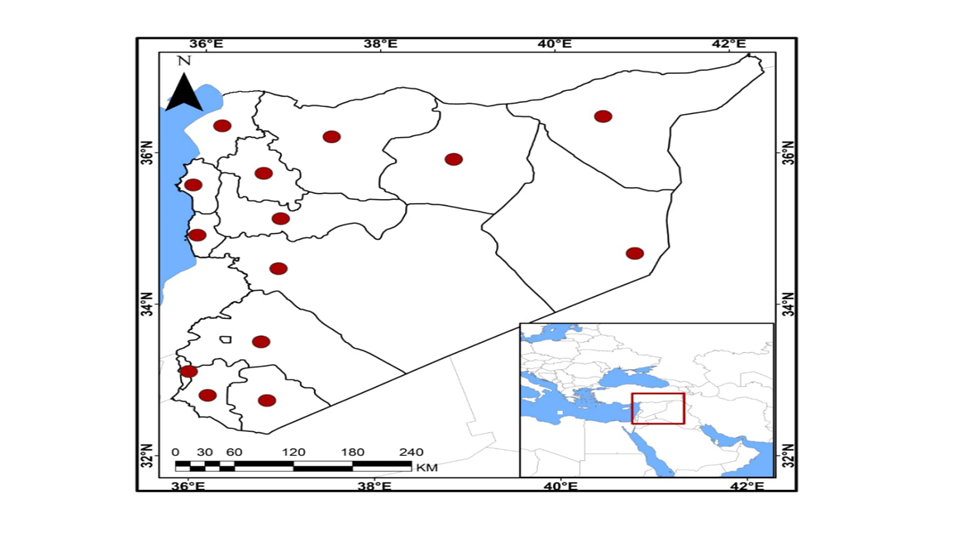
This research aims to identify the synoptic-climatic conditions in Syria during the active and dry phases of the Red Sea trough extension between 1980-2015. It monitors the evolution of the extension over the Red Sea-Eastern Mediterranean region and determines the associated features, such as the Convective Available Potential Energy (CAPE) during southward flows in the middle troposphere over the Eastern Mediterranean region. It also quantifies the relative humidity transported from the tropical region in the form of warm air masses in the atmosphere from equatorial Africa towards the Eastern Mediterranean, enhancing the atmospheric moisture (PRWT) over the study area. This was done by utilizing gridded data for the Geopotential variables at 1000, 500 hPa, CAPE or PRWT over the Eastern Mediterranean and North Africa region in the NCEP/NCAR reanalysis model. The analysis was applied every 6 hours during the Red Sea trough extension over 48 cases within the study area (28°-35°N) and (32°-40°E). Daily variations in Geopotential values during the Red Sea trough extension were observed, with the lowest values recorded at 12 o'clock and the highest values at 6 o'clock. There was also a relationship identified between moisture flows from the Eastern Mediterranean and rainfall in southern regions of Syria during the Red Sea trough extension.
References
- عبد السلام، عادل- 1990-1989: جغرافية سورية العامة، الطبعة الأولى، مطبعة الاتحاد، دمشق،ص7.
-Alpert, P., Osetinsky, I., Ziv, B. & Shafir, H. (2004) ‘A new seasons definition based on the classified daily synoptic systems, an example for the eastern Mediterranean’, International Journal of Climatology, 24, pp. 1013–1021.
-Cotton, W. R. (1990) Storms, Geophysical Science Series Vol. 1. Fort Collins: ASTeR Press, pp. 158.
-Dayan, U. & Abramski, R. (1983) ‘Heavy rain in the Middle East related to unusual Jet Stream properties’, Bulletin of the American Meteorological Society, 64, pp. 1138–1140.
-El-Fandy, M. G. (1950) ‘Effects of topography and other factors on the movement of lows in the Middle East and Sudan’, Bulletin of the American Meteorological Society, 41(10), pp. 375–381.
-Inbar, M. (1987) ‘Effects of a high magnitude flood in a Mediterranean climate: a case study in the Jordan River basin’, in L. Mayer & D. Nash (eds.) Catastrophic Flooding, London: Allen and Unwin, pp. 333–353.
-Kalnay, E., Kanamitsu, M., Kistler, R. et al. (1996) ‘The NCEP/NCAR 40-years Reanalysis’, Proj. Bull. Amer. Meteorol. Soc., 77(3), pp. 437–471.
-Krichack, S. O., Alpert, P. & Krishnamurti, T. N. (1997) ‘Red Sea Trough/cyclone development – numerical investigation’, Meteorology and Atmospheric Physics, 63, pp. 159–170.
-Krichak, S. O. & Alpert, P. (1998) ‘Role of large scale moist dynamics in hazardous Mediterranean weather’, Journal of Geophysical Research, 103(D16), pp. 19453–19468.
-Krichak, S. O. & Alpert, P. (1998) ‘Role of large scale moist dynamics in hazardous Mediterranean weather’, Journal of Geophysical Research, 103, pp. 19453–19458.
-Mashat, A.-W., Awad, A., Alamoudi, A. O. & Assiri, M. E. (2019) ‘Monthly and seasonal variability of dust events over northern Saudi Arabia’, International Journal of Climatology, 40(3), pp. 1607–1629.
-Schick, A. P. & Lekach, J. (1987) ‘A high magnitude flood in the Sinai desert’, in L. Mayer & D. Nash (eds.) Catastrophic Flooding, London: Allen and Unwin, pp. 381–410.
-Simmons, A., Uppala, C., Dee, D. & Kobayashi, S. (2007) ‘ERA Interim: New ECMWF reanalysis products from 1989 onwards’, ECMWF Newsletter, 110, pp. 25–35.
-Steven, P. F. (2012) ‘A Conceptual Model for the Identification of Active Red Sea Trough Synoptic Events over the Southeastern Mediterranean’, American Meteorological Society, 51, pp. 963.
-Yu, L. & Weller, R. A. (2007) ‘Objectively analyzed air–sea heat fluxes for the global ice-free oceans (1981–2005)’, Bulletin of the American Meteorological Society, 88, pp. 527–539.-Ziv, B., Saaroni, H., Romem, M., Heifetz, E., Harnik, N. & Baharad, A. (2010) ‘Analysis of conveyor belts in winter Mediterranean cyclones’, Theoretical and Applied Climatology, 99, pp. 441–455. DOI: 10.1007/s00704-009-0150-9.
Downloads
Published
How to Cite
Issue
Section
License
Copyright (c) 2025 Kinana Ghazi Haleme

This work is licensed under a Creative Commons Attribution 4.0 International License.