
Application of Krashen’s Input Hypothesis in a Listening Comprehension Blended Learning Classroom
DOI:
https://doi.org/10.21271/zjhs.30.SpB.36الكلمات المفتاحية:
Krashen’s Input Hypothesis, comprehensible input, blended learning, listening comprehension, Kurdish EFL adolescents.الملخص
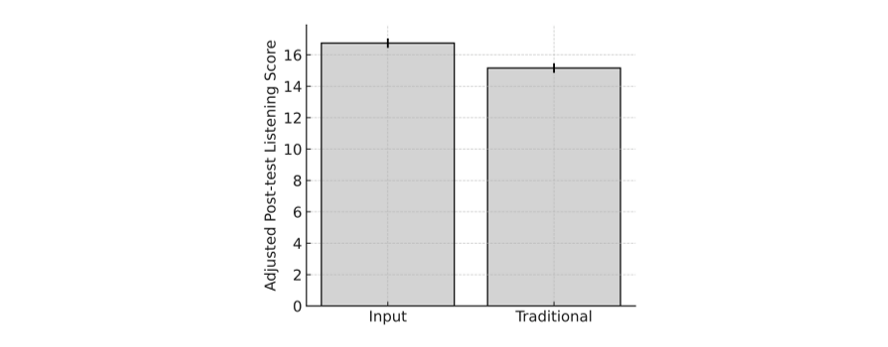
Listening remains central in EFL classrooms but is still under-studied, particularly for adolescents in low-resource settings. This study aimed to examine whether meaning-focused Comprehensible Input (CI) delivered in a blended format outperforms conventional accuracy-focused drills. Two intact eighth-grade classes (N = 44) at a K–8 school in Halabja, Kurdistan Region, Iraq, completed eight weeks of instruction. Listening was measured with parallel forms of the Cambridge A2 Key (KET) test, and baseline comparability was checked before analysis. An ANCOVA with pre-test as covariate showed a clear group effect favoring CI, F(1, 41) = 13.83, p < .001, partial η² = .252; adjusted means were 16.75 (SE = 0.30) for the experimental (CI) group and 15.16 (SE = 0.30) for the control group. A gain-score check pointed the same way (d = 1.05). Taken together, the findings suggest that abundant, level-matched input—supported by simple smartphone-based tools—can improve EFL listening for secondary learners. The study used class-level assignment (two clusters) and online engagement was not equated across groups; therefore, the results should be read with caution. To strengthen the evidence and aid classroom adoption, future work should use more classes with cluster randomization, include fidelity checks, and add follow-up testing to see whether gains last.
المراجع
- Al Mansour, M.I. (2019) Investigating the Effectiveness of Blended Learning Approach and Perceptions of EFL Learners' Listening Performance at the Saudi Electronic University. Unpublished PhD dissertation. Al-Imam Muhammad Ibn Saud Islamic University.
- Al-Rashidy, A.M. and Alsabbagh, A.A. (2023) ‘Enhancing listening comprehension skills of EFL learners through using web-based learning’, International Journal of Advanced Humanities Research, 3(1), pp. 53–69. https://doi.org/10.21608/ijahr.2023.245579.1036
- Cambridge Assessment English (2020) A2 Key and A2 Key for Schools: Handbook for Teachers (for exams from 2020). Cambridge: Cambridge University Press & Assessment. https://www.cambridgeenglish.org/images/504505-a2-key-handbook-2020.pdf
- Ellis, R. (2015) Understanding Second Language Acquisition. 2nd edn. Oxford: Oxford University Press.
- Field, J. (2009) Listening in the Language Classroom. Cambridge: Cambridge University Press. https://doi.org/10.1017/CBO9780511575945
- Garrison, D.R. and Kanuka, H. (2004) ‘Blended learning: Uncovering its transformative potential in higher education’, The Internet and Higher Education, 7(2), pp. 95–105. https://doi.org/10.1016/j.iheduc.2004.02.001
- Graham, C.R. (2019) ‘Current research in blended learning’, in Spector, J.M., Lockee, B.B. and Childress, M.D. (eds.) Learning, Design, and Technology: An International Compendium of Theory, Research, Practice and Policy. Cham: Springer. https://doi.org/10.1007/978-3-319-17727-4_34-1
- Graham, S. and Macaro, E. (2008) ‘Strategy instruction in listening for lower-intermediate learners of French’, Language Learning, 58(4), pp. 747–783. https://doi.org/10.1111/j.1467-9922.2008.00478.x
- Halverson, L.R., Graham, C.R., Spring, K.J., Drysdale, J.S. and Henrie, C.R. (2017) ‘Blended learning research in higher education and K–12 settings’, in Spector, J.M., Lockee, B.B. and Childress, M.D. (eds.) Learning, Design, and Technology: An International Compendium of Theory, Research, Practice and Policy. Cham: Springer. https://doi.org/10.1007/978-3-319-17727-4_31-1
- Krashen, S.D. (1982) Principles and Practice in Second Language Acquisition. Oxford: Pergamon Press.
- Krashen, S.D. (1985) The Input Hypothesis: Issues and Implications. London: Longman.
- Long, M.H. (2015) Second Language Acquisition and Task-Based Language Teaching. Malden, MA: Wiley-Blackwell.
- Mayer, R.E. (2009) Multimedia Learning. 2nd edn. Cambridge: Cambridge University Press. https://doi.org/10.1017/CBO9780511811678
- Nation, I.S.P. and Newton, J. (2008) Teaching ESL/EFL Listening and Speaking. New York: Routledge. https://doi.org/10.4324/9780203891704
- Rost, M. (2013) Teaching and Researching Listening. 2nd edn. London: Routledge. https://doi.org/10.4324/9781315833705
- Sholihah, F.A., Permadi, M.B. and Umamah, A. (2018) ‘Blended learning and extensive listening: A promising collaboration to enhance listening skill’, ELT Echo: Journal of English Language Teaching in Foreign Language Context, 3(2), pp. 88–96. DOI: 10.24235/eltecho.v3i2.3323
- Swain, M. (1985) ‘Communicative competence: Some roles of comprehensible input and comprehensible output in its development’, in Gass, S.M. and Madden, C.G. (eds.) Input in Second Language Acquisition. Rowley, MA: Newbury House, pp. 165–179.
- Vandergrift, L. and Goh, C.C.M. (2012) Teaching and Learning Second Language Listening: Metacognition in Action. New York: Routledge. https://doi.org/10.4324/9780203843376.
- Vandergrift, L. and Tafaghodtari, M.H. (2010) ‘Teaching L2 learners how to listen does make a difference: An empirical study’, Language Learning, 60(2), pp. 470–497. https://doi.org/10.1111/j.1467-9922.2009.00559.x.
- Zolfaghari, A., Sepehri, M., Hosseini, E. (2023). 'Effects of Virtual Vs. Blended-Language Instruction on the Development of Listening and Reading Skills by Iranian Intermediate EFL Learners', Iranian Journal of Applied Language Studies, 15(2), pp. 201-216. https://doi.org/10.22111/ijals.2023.41980.2270
التنزيلات
منشور
كيفية الاقتباس
إصدار
القسم
الرخصة
الحقوق الفكرية (c) 2026 Miran Abdulrahman Abdullah , Omar Fouad Ghafor

هذا العمل مرخص بموجب Creative Commons Attribution 4.0 International License.