
رصد تغيرات الاستعمال الأرضي والغطاء الارضي في المنطقة شبه الجبلية في محافظة دهوك بتوظيف صور لاندسات وآلة المتجهات الدعمة (SVM)
DOI:
https://doi.org/10.21271/zjhs.30.SpB.31الكلمات المفتاحية:
نظم المعلومات الجغرافية (GIS)؛ استخدام الأراضي/الغطاء الأرضي (LULC)؛ الاستشعار عن بعد (RS)؛ التعلم الآلي (ML)؛ آلة دعم المتجهات (SVM).الملخص
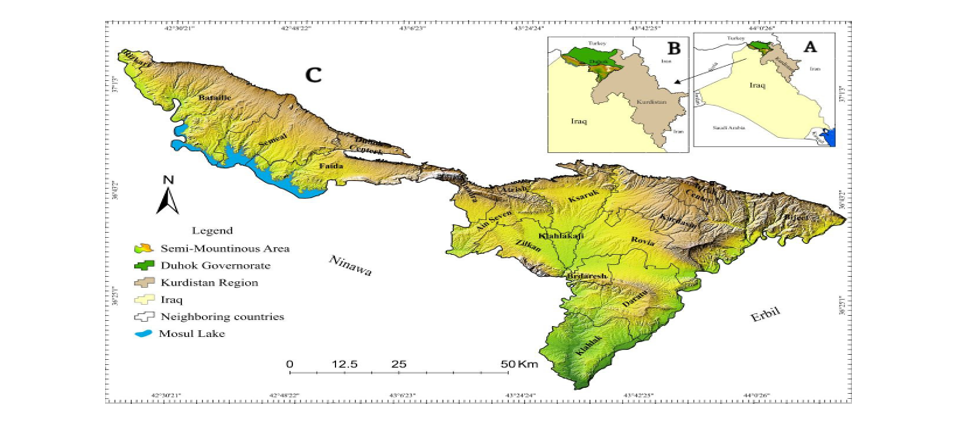
تحلل هذه الدراسة التغيرات طويلة الامد في استخدام الأراضي والغطاء الأرضي في المنطقة شبه الجبلية من محافظة دهوك في اقليم كوردستان العراق خلال الفترة 2000-2023، باستخدام صور الأقمار الصناعية Landsat 5 TM و8 OL، وتقنيات تصنيف التعلم الآلي (ML). تتميز تضاريس منطقة الدراسة بتضاريس متداخلة تجمع بين الهضاب والسهول الزراعية. وهذا يخلق تحديات طيفية في التمييز بين فئات الأراضي المتشابهة ويجعلها نموذجًا مثاليًا لاختبار فعالية خوارزميات التعلم الآلي في البيئات المعقدة.
تم تطبيق التصنيف الموجّه باستخدام خوارزمية آلة دعم المتجهات (SVM) ضمن بيئة نظام المعلومات الجغرافية GIS Pro 3.5. أظهرت النتائج تغيرات كبيرة في أنماط الغطاء الأرضي، حيث ارتفعت مساحة الأراضي المطورة من 3.5% إلى 7.4%، بينما انخفضت مساحة الأراضي الجرداء من 42.1% إلى 35%. كما زادت مساحة المزروعة/المحروثة من 26.5% إلى 31.3%. وبلغت الدقة الإجمالية للتصنيف 99.04% لعام 2000 و97.10% لعام 2023، وبلغت قيمتي Kappa 0.9868 و0.9609 على التوالي، مما يشير إلى كفاءة تصنيف عالية.
كما كشفت الدراسة أيضاً عن تغيرات بيئية كبيرة، أبرزها انتقال مساحات كبيرة من الأراضي الجرداء إلى فئات مزروعة/المحروثة وعشبية مما يعكس آثار التوسع العمراني والاستغلال غير المستدام لموارد الأراضي.
المراجع
- Abburu, Sunitha, and Suresh Babu Golla. 2015. Satellite Image Classification Methods and Techniques: A Review. International Journal of Computer Applications. 119 (8): 1–6. https://doi.org/10.5120/21088-3779.
- Adam, E., O. Mutanga, J. Odindi, and E. M. Abdel-Rahman. 2014. Land-Use/Cover Classification in a Heterogeneous Coastal Landscape Using Rapid Eye Imagery: Evaluating the Performance of Random Forest and Support Vector Machines Classifiers. International Journal of Remote Sensing. 35 (10): 3440–3458. https://doi.org/10.1080/01431161.2014.903353.
- Alam, Ha-mim Ebne, Md. Nizam Uddin, Kazi Tawkir Ahmed, Md. Jahidul Hasan, Md. Yeasir Arafat, and Md. Enamul Hoque. 2025. “Performance Assessment of Maximum Likelihood, Random Forest and Support Vector Machines Classifier for Urban Land Use Classification: A Case Study of Dhaka Metropolitan City, Bangladesh.” Journal of Geospatial Information Science and Engineering 8 (1). https://doi.org/10.22146/jgise.73283.
- Ali, Ahmed, and Mark Johnson. 2022. “Spectral Confusion in Semi-Arid Land Cover Classification: Challenges and Deep Learning Solutions. Sensors, 22 (14): 5123, https://doi.org/10.3390/s22228750.
- Aljanabi, Firas, Mert Dedeoğlu, and Cevdet Şeker. 2024. “Environmental Monitoring of Land Use/Land Cover by Integrating Remote Sensing and Machine Learning Algorithms.” Journal of Engineering and Sustainable Development 28 (4): 455–466. https://doi.org/10.31272/jeasd.28.4.4.
- Amini, S., M. Saber, H. Rabiei-Dastjerdi, and S. Homayouni. 2022. Urban Land Use and Land Cover Change Analysis Using Random Forest Classification of Landsat Time Series. Remote Sensing. 14 (11): 2654. https://doi.org/10.3390/rs14112654.
- Anderson, James R. 1971. “Land Use Classification Schemes Used in Selected Recent Geographic Applications of Remote Sensing.” Photogrammetric Engineering 27 (4): 379–387.
- Anderson, James R., Ernest E. Hardy, John T. Roach, and Richard E. Witmer. 1976. A Land Use and Land Cover Classification System for Use with Remote Sensor Data. Professional Paper 964. Washington, DC: US Government Printing Office. https://doi.org/10.3133/pp964.
- Aspinall, Richard J., and Michael J. Hill, eds. 2007. Land Use Change: Science, Policy and Management. 1st ed. London: CRC Press. https://doi.org/10.1201/9781420042979.
- Basseville, Michèle. 2009. “Statistical Methods for Change Detection.” In Land Use, Land Cover and Soil Sciences – Vol. I, edited by Willy H. Verheye. Oxford: EOLSS Publishers. https://www.eolss.net/Sample-Chapters/C18/E6-43-31-05.pdf.
- Bechtel, B., and C. Daneke. 2012. Classification of Local Climate Zones Based on Multiple Earth Observation Data. IEEE Journal of Selected Topics in Applied Earth Observations and Remote Sensing. 5 (4): 1191–1202. https://doi.org/10.1109/JSTARS.2012.2189873.
- Bhagawat Rimal. 2011. - URBAN GROWTH AND LAND USE/LAND COVER CHANGE OF POKHARA SUB-METROPOLITAN CITY, NEPAL. Journal of Theoretical and Applied Information Technology 26 (2).
- Bouaziz, Moncef, Stefanie Eisold, and Emna Guermazi. 2017. Semiautomatic Approach for Land Cover Classification: A Remote Sensing Study for Arid Climate in Southeastern Tunisia, Euro-Mediterranean Journal for Environmental Integration 2 (24). https://doi.org/10.1007/s41207-017-0036-7.
- Chuvieco, Emilio. 2016. Fundamentals of Satellite Remote Sensing: An Environmental Approach. Boca Raton, FL: CRC Press. https://doi.org/10.1201/9780429506482.
- Debebe, Belete, Feyera Senbeta, Ermias Teferi, Dawit Diriba, and Demel Teketay. 2023. ‘Analysis of Forest Cover Change and Its Drivers in Biodiversity Hotspot Areas of the Semien Mountains National Park, Northwest Ethiopia’. Sustainability 15 (4): 3001. https://doi.org/10.3390/su15043001.
- Esri ArcGIS Pro Documentation – Compute Confusion Matrix (Spatial Analyst), https://pro.arcgis.com/en/pro-app/latest/tool-reference/spatial-analyst/compute-confusion-matrix.htm.
- Fouad, Saffa F. A. 2015. Tectonic Map of Iraq, Scale 1:1000 000, 3rd Edition. Iraqi Bulletin of Geology and Mining. 11 (1): 1–7.
- Gaznayee, Heman Abdulkhaleq A., Ayad M. Fadhil Al-Quraishi, Karrar Mahdi, and Coen Ritsema. 2022. A Geospatial Approach for Analysis of Drought Impacts on Vegetation Cover and Land Surface Temperature in the Kurdistan Region of Iraq. Water. 14 (6): 927. https://doi.org/10.3390/w14060927.
- Ge, G., Z. Shi, Y. Zhu, X. Yang, and Y. Hao. 2020. Land Use/Cover Classification in an Arid Desert-Oasis Mosaic Landscape of China Using Remote Sensed Imagery: Performance Assessment of Four Machine Learning Algorithms. Global Ecology and Conservation. 22: e00971. https://doi.org/10.1016/j.gecco.2020.e00971.
- Ghayour, L., A. Neshat, S. Paryani, H. Shahabi, A. Shirzadi, W. Chen, N. Al-Ansari, M. Geertsema, M. Pourmehdi Amiri, and M. Gholamnia. 2021. Performance Evaluation of Sentinel-2 and Landsat 8 OLI Data for Land Cover/Use Classification Using a Comparison Between Machine Learning Algorithms. Remote Sensing. 13 (7): 1349. https://doi.org/10.3390/rs13071349.
- Ghayour, Laleh, Aminreza Neshat, Sina Paryani, Himan Shahabi, Nadhir Al-Ansari, Marten Geertsema, Ataollah Shirzadi, Mehdi Pourmehdi Amiri, Mehdi Gholamnia, Wei Chen, Jie Dou, and Anuar Ahmad. 2021. Performance Evaluation of Sentinel-2 and Landsat 8 OLI Data for Land Cover/Use Classification Using a Comparison between Machine Learning Algorithms. Remote Sensing 13 (7): 1349. https://doi.org/10.3390/rs13071349.
- Jambally, Mohammed. 2013. “Land Use and Cover Change Assessment Using Remote Sensing and GIS: Dohuk City, Kurdistan, Iraq (1998–2011).” International Journal of Geomatics and Geosciences 3 (3): 552–569.
- Jassim, S. Z., and T. Buday. 2006. Units of the Unstable Shelf and the Zagros Suture. In: Geology of Iraq, edited by S. Z. Jassim and J. C. Goff, 71. Prague: Dolin, and Brno: Moravian Museum.
- Kumar, Ajitesh. Support Vector Machine Explained with Example. Machine Learning Plus. March 27, 2023. Accessed Jun 18, 2025. https://machinelearningplus.com/machine-learning/support-vector-machine-svm/.
- Liang, J., C. Chen, Y. Song, W. Sun, and G. Yang. 2023. Long-Term Mapping of Land Use and Cover Changes Using Landsat Images on the Google Earth Engine Cloud Platform in Bay Area—A Case Study of Hangzhou Bay, China. Sustainable Horizons. 7: 100061. https://doi.org/10.1016/j.horiz.2023.100061.
- Lunetta, Ross S., David M. Johnson, John G. Lyon, and Jill Crotwell. 2004. Impacts of Imagery Temporal Frequency on Land-Cover Change Detection Monitoring. Remote Sensing of Environment. 89 (4): 444.
- Maxwell, A. E., T. A. Warner, and F. Fang. 2018. Implementation of Machine-Learning Classification in Remote Sensing: An Applied Review. International Journal of Remote Sensing. 39 (9): 2784–2817. https://doi.org/10.1080/01431161.2017.1410301.
- Mzuri, Rebar Tahseen, Abdulla Amir Omar, and Yaseen Taha Mustafa. 2021. Spatiotemporal Analysis of Vegetation Cover and Its Response to Terrain and Climate Factors in Duhok Governorate, Kurdistan Region, Iraq. Iraqi Geological Journal. 54 (1A): 110–126. https://doi.org/10.46717/igj.54.1A.10Ms-2021-01-31.
- OĞUZ, Hakan, Tarq K. Hassan, and Farhad O. Omar. 2025. “The Spatial Analysis of the Terrain Impact on Agricultural Land Use by Using GIS and RS Techniques: A Case Study of Soran District-Erbil-Iraq.” ZANCO Journal of Pure and Applied Sciences. 24 (6): 269–289. https://doi.org/10.21271/zjhs.24.6.20.
- Pal, Mahesh, and Giles M. Foody. 2010. Feature Selection for Classification of Hyperspectral Data by SVM. IEEE Transactions on Geoscience and Remote Sensing. 48 (5): 2297–2307. https://doi.org/10.1109/TGRS.2009.2039484
- Raguraman, Naren, and Ashutosh Bhardwaj. 2024. Spatial Analysis of Land Use Land Cover Dynamics in the Madurai District Using Sentinel-2 Data and Supervised Learning Algorithms. In The International Archives of the Photogrammetry, Remote Sensing and Spatial Information Sciences, XLVIII-4-2024, 367–372. ISPRS TC IV Mid-term Symposium, Spatial Information to Empower the Metaverse, Fremantle, Perth, Australia, October 22–25, 2024. https://doi.org/10.5194/isprs-archives-XLVIII-4-2024-367-2024
- Rahman, A., Abdullah, H. M., Tanzir, M. T., Hossain, M. J., Khan, B. M., Miah, M. G., and Islam, I. 2020. Performance of Different Machine Learning Algorithms on Satellite Image Classification in Rural and Urban Setup. Remote Sensing Applications: Society and Environment 20: 100410. https://doi.org/10.1016/j.rsase.2020.100410
- Rahman, Md. M., Tabash, M. I., Salamzadeh, A., Abduli, S., & Rahaman, Md. S. 2022. Sampling Techniques (Probability) for Quantitative Social Science Researchers: A Conceptual Guidelines with Examples. SEEU Review, 17(1), 42–51. https://doi.org/10.2478/seeur-2022-0023
- Romaszewski, Michał, Przemysław Głomb, and Michał Cholewa. 2016. Semi-Supervised Hyperspectral Classification from a Small Number of Training Samples Using a Co-Training Approach. ISPRS Journal of Photogrammetry and Remote Sensing. 121: 60–76. https://doi.org/10.1016/j.isprsjprs.2016.08.011.
- Schmitt, M., J. Prexl, P. Ebel, L. Liebel, and X. X. Zhu. 2020. Weakly Supervised Semantic Segmentation of Satellite Images for Land Cover Mapping—Challenges and Opportunities. ISPRS Annals of the Photogrammetry, Remote Sensing and Spatial Information Sciences. V-3-2020: 795–802. https://doi.org/10.5194/isprs-annals-V-3-2020-795-2020.
- Shih, Hsiao-Chien, Douglas A. Stow, and Yu Hsin Tsai. 2019. Guidance on and Comparison of Machine Learning Classifiers for Landsat-Based Land Cover and Land Use Mapping, International Journal of Remote Sensing, 40 (4): 1248–1274. https://doi.org/10.1080/01431161.2018.1524179.
- Sreenivasa, K. R., and Roddam Narasimha. 2011. Laboratory Simulations Show Diabatic Heating Drives Cumulus-Cloud Evolution and Entrainment.” Proceedings of the National Academy of Sciences of the United States of America. 108 (30): 12300–12304. https://doi.org/10.1073/pnas.1112281108
- Su, Yiting, Xingguang Yan, Jing Li, Andy Smith, Di Yang, and Tianyue Ma. 2017. Rapid Land Cover Classification Using a 36-Year Time Series of Multi-Source Remote Sensing Data. Land 12 (12): 2149. https://doi.org/10.3390/land12122149
- Talukdar, Swapan, Pankaj Singha, Susanta Mahato, Shahfahad, Yuei-An Liou, and Atiqur Rahman. 2020. Land-Use Land-Cover Classification by Machine Learning Classifiers for Satellite Observations-A Review, Remote Sensing, 12 (7): 1135. https://doi.org/10.3390/rs12071135.
- Tarabalka, Y., J. Benediktsson, and J. Chanussot. 2009. Spectral-Spatial Classification of Hyperspectral Imagery Based on Partitional Clustering Techniques. IEEE Transactions on Geoscience and Remote Sensing 47 (8): 2973–2987.
- Tariq, Aqil, Yan Jiango, Walid Soufan, Qingting Li, Khalid F. Almutairi, Jianwei Gao, Linlin Lu, and Muhammad Habib-ur-Rahman. 2023. Modelling, Mapping and Monitoring of Forest Cover Changes, Using Support Vector Machine, Kernel Logistic Regression and Naive Bayes Tree Models with Optical Remote Sensing Data. Heliyon 9: e13212.https://doi.org/10.1016/j.heliyon.2023.e13212.
- Thanh Noi, P., and M. Kappas. 2017. Comparison of Random Forest, k-Nearest Neighbor, and Support Vector Machine Classifiers for Land Cover Classification Using Sentinel-2 Imagery. Sensors. 17 (18): 452. https://doi.org/10.3390/s17020452.
- Tong, Xin-Yi, Gui-Song Xia, Qikai Lu, Huanfeng Shen, Shengyang Li, Shucheng You, and Liangpei Zhang. 2020. “Land-Cover Classification with High-Resolution Remote Sensing Images Using Transferable Deep Models.” ISPRS Journal of Photogrammetry and Remote Sensing, 158: 279–293. https://doi.org/10.1016/j.rse.2019.111322.
- UN-Habitat. 2020. Annual Report 2020. Nairobi: United Nations Human Settlements Programme. https://unhabitat.org/annualreport
- Wu, Qiang, Li Zhang, and Xiaohui Li. 2025. “Improving Land Cover Classification Accuracy by Integrating Spectral and Spatial Features.” PLOS One, 20 (3): e0281234.
- Wu, W., & Shao, G., 2002, Optimal combinations of data, classifiers, and sampling methods for accuracy assessment of land cover classification. Canadian Journal of Remote Sensing, 28(4), 601–609.
- Xia, J., J. Chanussot, P. Du, and X. He. 2014. Semi-Supervised Probabilistic Principal Component Analysis for Hyperspectral Remote Sensing Image Classification. IEEE Journal of Selected Topics in Applied Earth Observations and Remote Sensing 7 (6): 2224–2236.
- Zhang, C., and X. Li. 2022. Land Use and Land Cover Mapping in the Era of Big Data. Land 11 (1692). https://doi.org/10.3390/land11101692.
- Zhang, L., L. Zhang, D. Tao, and X. Huang. 2012. On Combining Multiple Features for Hyperspectral Remote Sensing Image Classification. IEEE Transactions on Geoscience and Remote Sensing 50 (3): 879–893.
التنزيلات
منشور
كيفية الاقتباس
إصدار
القسم
الرخصة
الحقوق الفكرية (c) 2026 Dastan Fathi Ahmed, Nashwan Shukri Abdullah

هذا العمل مرخص بموجب Creative Commons Attribution 4.0 International License.