
Word Formation Processes Used in Kurdish Community Facebook Platform
DOI:
https://doi.org/10.21271/zjhs.29.SpA.16%20Keywords:
Word formation Digital Communication Facebook Platform Kurdish Community Social MediaAbstract
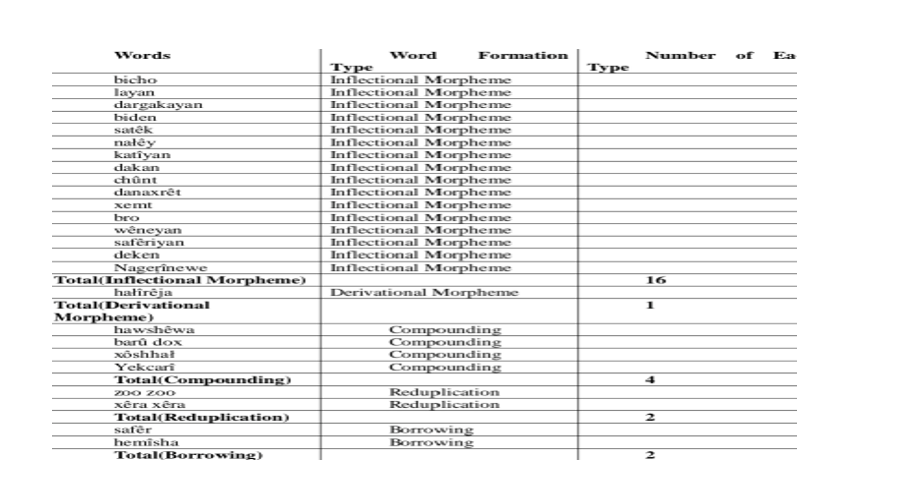
Word formation is an essential aspect of linguistic evolution. This study is entitled "Word Formation Processes Used in Kurdish Community Facebook Platform". A wide range of research has been conducted for explaining word formation processes in many languages, this study investigates (10) types of word formation processes such as (Inflectional and derivational morphemes, Compounding, Borrowing and some others) in four different Kurdish Facebook pages which are (Rudaw, Dengi Parwarda, and Erbil Life). The study is limited to the year (2024). The main research question is what are the most commonly used word formation processes in the selected Kurdish Facebook pages. The study aims to identify the most and least frequently used word formation processes in Kurdish online communication, compare their occurrences, and analyze their impact on the linguistic landscape. It focuses particularly on newly formed words in digital communication, examining popular methods, language mixing (Kurdish with Arabic or English), and abbreviation trends. This study contributes to Kurdish linguistics by emphasizing how social media platforms foster the formation and spread of new lexical items, thus documenting an ongoing shift in language use among Kurdish speakers. It also offers insights into sociolinguistic patterns within the Kurdish digital community, showing the influence of globalization and digitalization on everyday communication. By focusing on a relatively under-researched area, it fills a gap in digital communication studies and provides a foundation for further exploration of language evolution in Kurdish-speaking online environments. The study adopts a qualitative and quantitative approach, and utilizes Yule’s (2010) framework of word formation processes to analyze (4) Kurdish Facebook posts. It has been concluded that inflectional morphemes are the most frequently used, followed by derivational morphemes, compounding, and borrowing, while conversion, clipping, blending, reduplication, and initialism occur less frequently.
References
-Kurdish References
- Abdullah, K., & Amin, A. (2020). The Morphology of Kurdish. University of Kurdistan.
- Abdullah, S.A. and Amin, W.O., 2020. The process of word formation in English and Kurdish languages: A comparative typological study. Zanco Journal of Humanity Sciences, 24(6), pp.343-355. Available at: https://doi.org/10.21271/zjhs.24.6.15 [Accessed 12 October 2024].
- Ahmad, M. (2020) ,Kurdish Language - Morphology. Mardin: Mardin Publisher.
- Ahmadi, S. (2021). Computational Approaches to Kurdish Morphology. Kurdish Linguistics Review, p.2.
- Ahmadi, S., & Hassani, M. (2020). Finite-State Transducers and Kurdish Morphology. Computational Linguistics Journal.
- Ahmadi, S. and Hassani, H. (2020) ‘Towards finite-state morphology of Kurdish’, ACM Transactions on Asian and Low-Resource Language Information Processing (under review), 1(1), pp. 1–8. Available at: https://doi.org/10.1145/nnnnnnn.nnnnnn (Accessed: 8 March 2025). Also available at: arXiv: 2005.10652v1 [cs.CL].
- Asmaa, Kh. A. (2015) ,Word formation by clipping, blending, and acronyms in Kurdish and English languages. Term paper. Salahaddin University-Hawler, College of Basic Education. 7-8. Available at: https://www.academia.edu/10518814/word_formation_by_clipping_acronym_and_blending_in_kurdish_and_english_languages [Accessed: 9 March 2025].
- Awlla, I. K., & Abdulla, I. A. (2023). The hegemony of English loanwords over Kurdish language on Facebook. Zanco Journal of Human Sciences, 27(SpB). https://doi.org/10.21271/zjhs.27.SpB.30
- Bakir, A & Awl, M (2012), Durstai Nawawai Nawi Nasa:da La Dyalekti Kirmanji Nawarastda (The Internal Structure of Non-Simple Nouns in the Central Kurdish Dialects), Al Ustath Journal, no. 102, College of Education, Ibn Rushd, University of Baghdad, Baghdad.
- Bauer, L. (1983). English Word-Formation. 1st ed. Cambridge: Cambridge University Press.
- Dzayi, A.M. (2013) ,Wshasazi Zmani Kurdi (Word Formation in the Kurdish Language). 1st edn. Hawler: Berewaberaty Ktebxane Gshtiakan.
- Fattah, MM & Qadir, SR (2006), Several aspects of Kurdish morphology, Roon Publications.
- Hassan, H.C. (2021) 'Kurdish writing language in social networks (Facebook chat, as an example)', Twejer Journal, 4(2), pp. 153–198. Available at: https://journals.soran.edu.iq/index.php/Twejer/article/view/214 (Accessed: 6 March 2025).
- Hassanpour, A. (1992), The Kurdish Language and Its Development. Kurdish Studies Review.
- Hassanpour, A., (1992),Nationalism and Language in Kurdistan 1918-1985. 1st ed (Edwin Mellen Press).
- Hassanpour, A. (1992) Nationalism and Language in Kurdistan, 1918–1985. Toronto: Mellen Research University Press.
- Hasan, K.A. and Hassan, S.A., (2021). Globalization of English language: a blessing or curse on Kurdish language. Journal of University of Garmian. p.273. Available at: http://jgu.garmian.edu.krd [Accessed 12 March 2025]. https://doi.org/10.24271/jug.1964021.
- Hu, Z. (2017) ,Workbook for Linguistics: A Course Book. 5th ed. Beijing: Peking University Press. p.p.15-17.
- Kaml, H. (1979), (Zarawey Kurdi). Slemani: College of Slemani Press.
- Marif, A ,(2014), Wiša Ŕonan le Zimanî Kûrdîda (Word Formation in the Kurdish Language), Ŕojhalat Publishing House, Hewler.
- Naserzade, M., Mahmudi, A., Veisi, H., Hosseini, H. and MohammadAmini, M. (2023) 'CKMorph: a comprehensive morphological analyzer for Central Kurdish', International Journal of Digital Humanities, 5, p.2. Available at: https://doi.org/10.1007/s42803-022-00062-7 .
- Rahimi, A., & Amiri, A., (2022). Language Change in Digital Communication: A Case Study of Kurdish Social Media. Journal of Sociolinguistics.
- Saeed, N., & Qadir, R. (2023). The Influence of English on Kurdish Word Formation in Social Media. Kurdish Journal of Social Media Studies, 5(1).
- Salih Sabir, P. H. S. (2022), 'The use of English neologisms in social media: A case of Facebook language in Iraqi Kurdistan', International Journal of Health Sciences, 6(S4), pp. 3186–3211. Available at: https://doi.org/10.53730/ijhs.v6nS4.10128 (Accessed: 13 March 2025).
- Conference
- Institut Français Erbil, Kurdistan Center for Art and Culture & Zar & Zaman Magazine (2024) The Impact of Social and Digital Media on the Kurdish Language. Conference held on 7 May, Erbil, Kurdistan Region of Iraq.
English References
- Bauer, L. (1983). English Word-Formation. Cambridge University Press.
- Bauer, L. (2003). Introducing Linguistic Morphology. 2nd ed. Edinburgh University Press, Edinburgh.
- Blau, J. (1980) Kurdish grammar. Paris.
- Carlos, M., Gailea, N. and Rima, R. (2019) ‘A descriptive analysis of slang terms in Scarface movie’, Jurnal Makna, 5(2).
- Cao, P. (2022), ‘Distinction and examples of morpheme, morph and allomorph in English linguistics teaching’, Foreign Language School, Sichuan Minzu College. Available at: https://doi.org/10.2991/978-2-494.069-02-2_36 (Accessed: 9 March 2025).
- Caers, R. et al., 2013. Facebook: A literature review. New Media & Society, 15(6).
- Crystal, D. (2006). Language and the Internet (2nd ed.). Cambridge University Press, Chapter 5.
- Crystal, D. (2006). The Cambridge Encyclopedia of the English Language (2nd ed.). Cambridge University Press.
- Danet, B. & Herring, S.C. (eds.) (2007), The multilingual internet: Language, culture, and communication online. 1st edn. Oxford: Oxford University Press.
- Danet, B. & Herring, S.C. (eds.) (2007) ,The multilingual internet: Language, culture, and communication online. 1st edn. Oxford: Oxford University Press.
- Dehkhoda, A.A. (1998), Loghatnameh Dehkhoda [Dehkhoda Dictionary]. Available at: https://vajehyab.com/dehkhoda (Accessed: 2 March 2025).
- El-Sharkawy, M. A. (2008) 'Arabic Influence on Kurdish Vocabulary', Journal of Semitic Studies, 53(2).
- Fromkin, V., Rodman, R., & Hyams, N. (2014). An Introduction to Language (10th ed.). Wadsworth Publishing.
- Herring, S.C. (2010), ‘Computer-mediated conversation: Introduction and overview’, Language@Internet, 7, p. 267. Available at: https://scholarworks.iu.edu/journals/index.php/li/article/view/37584 (Accessed: 14 March 2025).
- Lieber, R. (2010), Introducing Morphology. Cambridge: Cambridge University Press.
- Liurunqing, W. (2006), Linguistics: A New Coursebook, p. 56. Beijing: Foreign Language Teaching and Research Press.
- Moïse, S., (2018). Call the FBI, CIA, and PD, ASAP!: Acronyms and Initialisms. The Scrivener, 57. Available: at: https://www.nelsonmullins.com/storage [Accessed 12 March 2025).
- Merriam-Webster (2023) Group. Available at: https://www.merriam-webster.com (Accessed: 23 December 2024).
- Plag, I. (2003). Word Formation in English. Cambridge University Press.
- Plag, I. (2003). Word-Formation in English. 1st ed (Cambridge University Press).
- Quirk, R. and Greenbaum, S., 1987. A university grammar of English. London: Longman.p.45.
- Shokhayeva, K., Auyelbekova, A., Shomanova, G., Dutbayeva, S., & Zhapanova, M. (2023) ‘Features of word formation of new vocabulary in English’, XLinguae, 16(1), pp. 155–165. doi:10.18355/XL.2023.16.01.11.
- Stageberg, N.C. and Oaks, D.D., (2000). An introductory English grammar. 5th ed. USA: Thomson Heinle. Stageberg Norman c., (1981). An Introductory English Grammar. 4th ed. Holt, Rinehart and Winston, inc.
- Staticta, (2022), Most popular social networks worldwide as of January 2021, ranked by number of active users. [Online] Vol.27, No.SpB, 2023Available at: https://www.statista.com/statistics/272014/global-social-networks-ranked-by-number-of-users/[Accessed 14 March 2025).
- Steingass, F. (1892), A Comprehensive Persian-English Dictionary. 1st edn. London: Routledge & Kegan Paul.
- -Rippin, A. (2012) ,The Islamic World. Abingdon: Routledge.
- Thackston, W.M., (2006), Kurmanji Kurdish: A Reference Grammar with Selected Readings. Boston: Harvard University.
- Trask, R.L., (1993),. A dictionary of grammatical terms in linguistics. London: Routledge.
- Valera, S., (2005), Conversion vs unmarked word-class change. SKASE Journal of Theoretical Linguistics, 2(1).
- Windfuhr, G., (2009), The Iranian Languages. London: Routledge.
- Yule, G. (2020), The Study of Language. 7th ed. Cambridge: Cambridge University Press, Chapter 5.
- Wehr, H. (1994) ,A Dictionary of Modern Written Arabic. 4th edn. Edited by J. Milton Cowan. Urbana: Spoken Language Services.
- Wehr, H. (2014), A Dictionary of Modern Written Arabic. 4th ed. Beirut: Spoken Language Services, Inc.
- Yule, G. (2010), The Study of Language. 4th edn. Cambridge: Cambridge University Press.
- Zand, R. W. (2007)., Kurdish: A brief grammar. LINCOM Europa.
- Bauer, L. (2003). Introducing Linguistic Morphology. 2nd ed. Edinburgh University Press, Edinburgh.
- Plag, I. (2003). Word Formation in English. Cambridge University Press, Cambridge.
- Hassanpour, A., Nationalism and Language in Kurdistan 1918-1985. 1st ed (Edwin Mellen Press, 1992).
- Crystal, D., Language and the Internet. 2nd ed ( Cambridge University Press,2006).121-149.
- Danet, B. & Herring, S.C. (eds.) (2007) ,The multilingual internet: Language, culture, and communication online. 1st edn. Oxford: Oxford University Press.
- Rahimi, A., & Amiri, A., Language Change in Digital Communication: A Case Study of Kurdish Social Media.( Journal of Sociolinguistics ,2022 ).
- Ali, S., & Karim, M., Neologisms in Kurdish Social Media: A Study of Facebook Posts. (Journal of Kurdish Linguistics, 10(2), 2023).
- Saeed, N., & Qadir, R. ,The Influence of English on Kurdish Word Formation in Social Media.( Kurdish Journal of Social Media Studies, 5(1), 2023).
- Khan, A. ,Language and Resistance: Word Formation in Arabic Social Media During the Arab Spring.( Journal of Middle Eastern Studies, 2021). 53(3).
- Sabir, P. H. S. (2022). The use of English neologisms in social media: A case of Facebook
- language in Iraqi Kurdistan. International Journal of Health Sciences, 6(S4), 3186–3211.
- https://doi.org/10.53730/ijhs.v6nS4.10128.
- Hans Wehr (2014). A Dictionary of Modern Written Arabic. 4th ed. Beirut: Spoken Language Services, Inc.
Downloads
Published
How to Cite
Issue
Section
License
Copyright (c) 2025 Hawar Aziz Hamasalih , Dilovan Sayfuddin Ghafoory

This work is licensed under a Creative Commons Attribution 4.0 International License.