
The Impact of Affiliative Leadership on Organizational Prosperity: The Mediating Role of Employee Well-Being
An Analytical Study of the Opinions of a Sample of Workers at Private Universities in the City of Erbil in the Kurdistan Region of Iraq
DOI:
https://doi.org/10.21271/zjhs.29.3.4Keywords:
affiliative leadership, organizational prosperity, employee well-being, private universities, Erbil city, Kurdistan Region of IraqAbstract
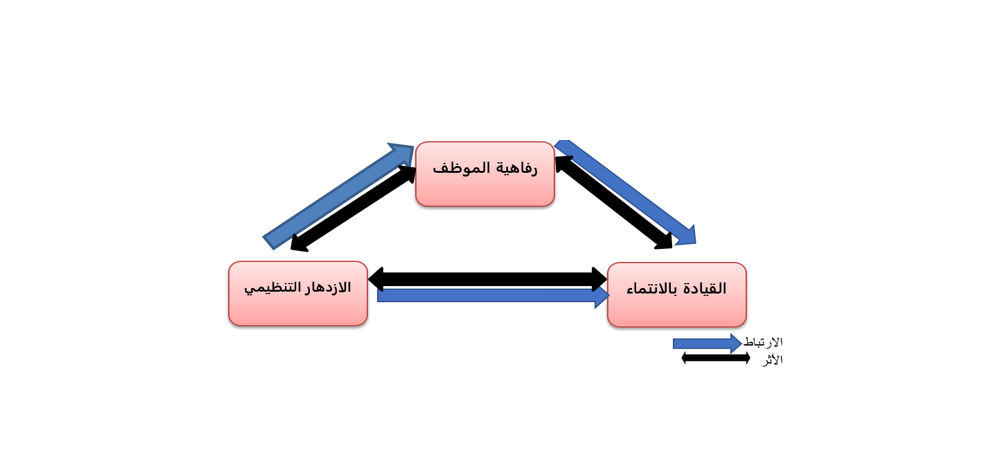
The current research aims to test the role of Affiliative leadership in organizational prosperity through employee well-being. In order to achieve the research objectives, a hypothetical diagram was designed that explains the nature of the relationship between the variables of the current research. For the purpose of testing the research hypotheses, the research was applied to a sample of employees at private universities in the city of Erbil in the Kurdistan Region of Iraq through a questionnaire prepared for this purpose. The researchers distributed (150) forms to the employees, and (114) forms were retrieved suitable for analysis. The current research used several statistical tools to reach the relevant results by relying on the statistical programs (SPSS. V. 24) and (Amos. V. 24). The research reached a set of conclusions, the most important of which is that there is a correlation between the research variables and a positive, statistically significant effect of the variable of affiliative leadership on organizational prosperity through the mediating role of employee well-being. Based on these conclusions, the research presented a set of recommendations, the most prominent of which is that the universities studied should increase their focus on dealing with work issues and interests from an open perspective and meeting employees' emotional needs in the context of work.
References
1. المصادر العربية:
- الجرجاوي، زياد (2010) القواعد المنهجية لبناء الاستبيان, الطبعة الثانية, مطبعة أبناء الجراح, فلسطين.
- الطائي ، يوسف حجيم سلطان و الشيباني ،حمزة كاطع مهدي ،(2016)، تأثير التنفيذ إدارة المعرفة في تحقيق الازدهار التنظيمي ، مجلة الغري للعلوم الاقتصادية و الإدارية ، المجلد 13 ، العدد 40 .
- العطار ،فؤاد حمودي و الغنيماوي ،حازم ربح نجم وكاظم ،جاسم راهي ،(2020)،القيادة الذكية ودورها في تحقيق الازدهار التنظيمي ، مجلة واسط للعلوم الإنسانية، المجلد 14 ، العدد 45.
- عمير ،عراك عبود ،(2019)، دور المرونة التنظيمية في تحقيق الازدهار التنظيمي ، مجلة الاقتصاد والعلوم الإدارية، المجلد 25 ،العدد 114، ص 151-130.
- محمد ، يزن سالم ،(2019)، دور سمعة المنظمة في العلاقة بين القيادة الفاضلة والازدهار التنظيمي، المجلة العراقية للعلوم التنظيمية ،المجلد 15، العدد 60
2. المصادر الانكليزية:
- Abubakari, A., (2017). The Nature of leadership styles of leaders in selected polytechnics in Ghana. Journal of Business and Management, 19(6), pp.36-46.
- Alipour, F., & Karimi, R. (2011). Mediation role of innovation and knowledge transfer in the relationship between learning organization and organizational performance. International Journal of Business and Social Science, 2(19).
- Anninos, L. N. (2007). The archetype of excellence in universities and TQM. Journal of Management History, 13(4), 307-321.
- Barnes, J., Stevens, M. J., Ekelund, B. Z., & Perham-Lippman, K. (Eds.). (2023). Inclusive Leadership: Equity and Belonging in Our Communities. Emerald Publishing Limited.
- Chapman, A.L., Johnson, D. and Kilner, K., (2014). Leadership styles used by senior medical leaders: patterns, influences and implications for leadership development. Leadership in Health Services, 27(4), pp.283-298.
- CIPD. (2020). Health and well-being at work. [https://www.cipd.org/globalassets/media/comms/news/eehealth-and-well-being-2020-report_tcm18-73967.pdf].
- Douglas, O., Lennon, M. and Scott, M., (2017). Green space benefits for health and well-being: A life-course approach for urban planning, design and management. Cities, 66, pp.53-62.
- Gagnon, S., Vough, H.C. and Nickerson, R., (2012). Learning to lead, unscripted: Developing affiliative leadership through improvisational theatre. Human Resource Development Review, 11(3), pp.299-325.
- Goleman, D., (2000). Leadership that gets results. Harvard business review, 78(2), pp.4-17.
- Goleman, D., Boyatzis, R.E. and McKee, A., (2002). The new leaders: Transforming the art of leadership into the science of results.
- Gustafsson, S., Gillespie, N., Searle, R., Hope Hailey, V. and Dietz, G., 2020. Preserving organizational trust during disruption. Organization Studies, p.0170840620912705.
- Hernandez, R., Bassett, S.M., Boughton, S.W., Schuette, S.A., Shiu, E.W. and Moskowitz, J.T., (2018). Psychological well-being and physical health: Associations, mechanisms, and future directions. Emotion Review, 10(1), pp.18-29.
- Kowalski, T. H., & Loretto, W. (2017). Well-being and HRM in the changing workplace. The International Journal of Human Resource Management, 28(16), 2229-2255.
- Manzoor, Q. A. (2012). Impact of employees’ motivation on organizational effectiveness. Business management and strategy, 3(1), 1-12.
- Martin, R. L., Balsillie, J., Dattels, T., de Wilde, L., Folk, D., Fortier, S., ... & Trefler, D. (2010). Task Force on Competitiveness, Productivity and Economic Progress.
- Rew, C. and Risk, A., (2016). License to Innovate: How Government can Reward, The Institute for Competitiveness and Prosperity:1-40.
- Schmidt, B., Schneider, M., Seeger, P., van Vianen, A., Loerbroks, A. and Herr, R.M., (2019). A comparison of job stress models: associations with employee well-being, absenteeism, presenteeism, and resulting costs. Journal of occupational and environmental medicine, 61(7), pp.535-544.
- Sekaran, U. (2005) Research Method for Business: A Skill Building Approach. 2nd ed. New York: John Wiley & Sons.
- Soriano, A., Kozusznik, M.W., Peiró, J.M. and Mateo, C., 2018. Mediating role of job satisfaction, affective well-being, and health in the relationship between indoor environment and absenteeism: Work patterns matter! Work, 61(2), pp.313-325.
- Spence, G.B., (2015). Workplace wellbeing programs: if you build it, they may NOT come... because it's not what they really need.
- Thoha, N. and Avandana, I., (2020). Project Managers' Leadership Styles and Their Effects on Project Management Performance. Pertanika Journal of Social Sciences & Humanities, 28(2).
- Veld, M. and Alfes, K., (2017). HRM, climate and employee well-being: Comparing an optimistic and critical perspective. The International Journal of Human Resource Management, 28(16), pp.2299-2318.
- Wachira, J.G., Karanja, K. and Iravo, M., (2018). Influence of affiliative leadership style on organizational performance of commercial state corporations in kenya. European Journal of Business and Strategic Management, 3(3), pp.17-28.
- Wang, J., Lee-Davis, L., Kakabadse, N.K., & Xie, Z. (2011). Leader characteristics and styles in the SMEs of the People’s Republic of China during the Global Financial Crisis. Strategic Change. John Wiley & Sons Inc. DOI:10.1002/jsc.882.
Downloads
Published
How to Cite
Issue
Section
License
Copyright (c) 2025 Bewar Ahmed Abdullah , Lovan Akram Saeed , Zana Majed Sadq , Media Aras Mohammed Saeed

This work is licensed under a Creative Commons Attribution 4.0 International License.