
Competence and Performance through the Lens of a Psycho-cognitive Analytical Approach: Kurdish Folklore Vocabularies as Case Study
DOI:
https://doi.org/10.21271/zjhs.29.3.13Keywords:
Cognitive psychology, memory, Communicative competence, performance, Kurdish folklore vocabularyAbstract
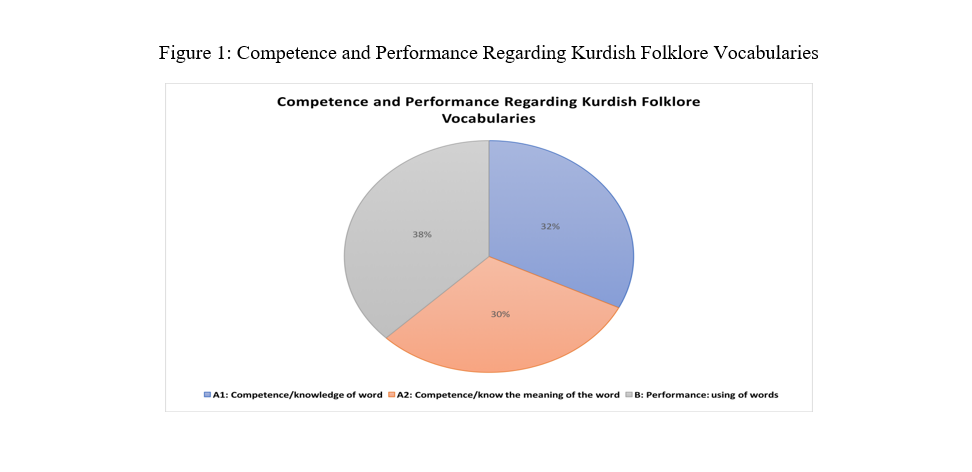
Effective communication demands heightened linguistic proficiency, particularly in the vocabulary used in today's interconnected world. This study, rooted in cognitive psychology, investigates how young native Kurdish speakers process and perform traditional Kurdish folklore words in their daily communication with a focus on mental functions such as perception, memory, and the systematic understanding of language rules that underpin effective communication. A critical issue arises from the disconnect between linguistic competence and performance among young native Kurdish speakers: while they may recognize and understand folklore words, they often choose not to use them in everyday communication. The research employs a qualitative descriptive analysis, involving 100 participants under the age of 30 in the Garmian district, focusing on their recognition and production of folklore words. The core assumption of this study refers to analyzing the way young native Kurdish speakers process original folklore Kurdish words and develop them in their communicative competence, and whether to perform them in their daily life communications. Findings reveal a significant cognitive competence among participants, with high levels of recognition and understanding of folklore words stored in long-term memory. However, actual usage in daily communication shows a notable gap, as participants reported using only a subset of these words.
References
- Asatrian, G. 2009. The folklore of Kurdistan. In Folklore: An encyclopedia of beliefs, customs, tales, music, and art (pp. 710-712). Santa Barbara: ABC-CLIO.
- Brodowicz, G. 2024. Advanced studies in cognitive processes. Oxford, UK: Oxford University Press.
- Canale, M. 1983. From communicative competence to communicative language pedagogy. In J. C. Richards & R. W. Schmidt (Eds.), Language and communication (pp. 2-27). London, UK: Longman.
- Chomsky, N. 1965. Aspects of the theory of syntax. Cambridge, MA: MIT Press.
- Clark, A. 1997. Being there: Putting brain, body, and world together again. Cambridge, MA: MIT Press.
- Crystal, D. 1985. A dictionary of linguistics and phonetics. Oxford, UK: Blackwell.
- Dawson, M. 2023. Contemporary cognitive psychology. New York, NY: Routledge.
- Eysenck, M. W., & Keane, M. T. (2015). Cognitive Psychology: A Student's Handbook (7th ed.). Psychology Press.
- Gerrig, R. J., & Zimbardo, P. G. 2002. Psychology and life (16th ed.). Boston, MA: Allyn & Bacon.
- HamaKhurshid, F. 2018. Kurdish language and its dialects; A geographical analysis. Hawler.
- Hymes, D. H. 1972. On communicative competence. In J. B. Pride & J. Holmes (Eds.), Sociolinguistics (pp. 269-293). Harmondsworth, UK: Penguin Books.
- Neisser, U. 1967. Cognitive psychology. New York, NY: Appleton-Century-Crofts.
- Robins, R. H. 1979. General linguistics: An introductory survey (3rd ed.). London, UK: Longman.
- Robins, R. H. 1980. A short history of linguistics (2nd ed.). London, UK: Longman.
- Savignon, S. J. 1983. Communicative competence: Theory and classroom practice. Reading, MA: Addison-Wesley.
- Sheriff, H. S., Bob, J. K., & Smith, A. L. 2019. Cognitive psychology in context. San Diego, CA: Academic Press.
- Subedi, B. 2022. Fundamentals of cognitive psychology. Thousand Oaks, CA: Sage Publications.
- Wolfram, W., Adger, C. T., & Christian, D. 1999. Dialects in schools and communities. Mahwah, NJ: Lawrence Erlbaum Associates
Downloads
Published
How to Cite
Issue
Section
License
Copyright (c) 2025 Khoshi Anwer Hasan Al-Jaf

This work is licensed under a Creative Commons Attribution 4.0 International License.