Exploring The Implementation of Syllabus Design Principles in EFL Syllabi: Teachers’ Approach
DOI:
https://doi.org/10.21271/mj.1.1.10Keywords:
Syllabus design principles, EFL syllabi, teachers’ approachAbstract
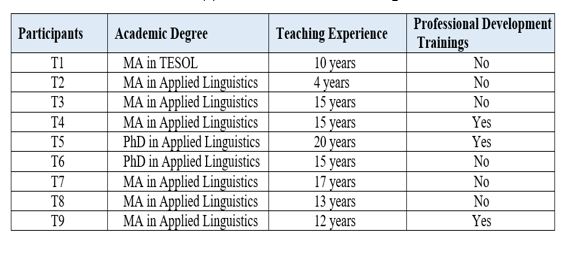
The current qualitative study explores the extent to which Kurdish EFL teachers navigate syllabus design principles within the EFL context at Salahaddin University-Erbil, College of Basic Education. It also explores the challenges they encounter during implementing syllabus design principles. To achieve the objectives of the study a semi-structured interview was conducted with nine EFL teachers in the Department of English, College of Basic Education. They revealed their perspectives and implementations to the embedding principles (e.g., needs analysis, learning objectives, content selection and sequencing, skills integration, flexibility and assessment) in their syllabi, in addition to systemic barriers. The collected date was analyzed qualitatively through thematic analysis. The results of the study show differences between teachers’ knowledge and application of syllabus design principles. The major challenges faced by teachers include lack of professional development programs, time constraints, large class sizes and limited resources, which affect the quality and consistency of the syllabus. The study recommends the need for a systematic approach to syllabus design and implementation to improve the quality of language instruction.
References
Anderson, L. W., Krathwohl, D. R., & Bloom, B. S. (2001). A taxonomy for learning, teaching, and
assessing:A revision of Bloom’s taxonomy of educational objectives. Longman
Bazyar, Z., Dastpak, M. & Taghinezhad, A. (2015). Syllabus Design and Needs Analysis of Students in
Educational System, Advances in Language and Literary Studies, Vol. 6 No. 4, PP. 162-165
Biggs, J., & Tang, C. (2011). Teaching for Quality Learning at University. 4th edition. England: McGraw-Hill
Education
Bocanegra-Valle, A. (2016). Needs analysis for curriculum design. The Routledge handbook of English for
Academic Purposes (pp. 560–576). Routledge.
Braun, V. & Clarke, V. (2006). Using thematic analysis in psychology Qualitative Research in Psychology, 3,
-101.
Creemers, B., Kyriakides, L. & Antoniou, P. (2013). Teacher Professional Development for Improving Quality
of Teaching. New York: Springer Science
Creswell, J. W. & Creswell, J. D. (2018). Research Design: Qualitative, Quantitative, and Mixed Methods
Approaches, 5th edn. California: Sage Publications
Eshtehardi, R. (2017). Needs Analysis and Course Design; A Framework for Designing Exam Courses,
International Journal of Applied Linguistics & English Literature, Vol. 6 No. 6. Pp. 274-288.
Faravani, A., Zeraatpishe, M., Azarnoosh, M., and Kargozari, H. R. (eds) (2018). In Issues in Syllabus Design,
Leiden, The Netherlands: Brill. available from: <https://brill.com/view/book/9789463511889/front
xml> [Accessed 25 December 2024]
Gilbert, G. E. and Prion, S. (2016). Making Sense of Methods and Measurement: Lawshe’s ContentValidity
Index, International Nursing Association for Clinical Simulation and Learning, Vol,12. Issue 12. Pp:
-531.
Graves, K. (2000). Designing language courses: A guide for teachers. Canada: Heinle & Heinle Publisher.
Jalilzadeh, K. and Tahmasebi, A. (2014). Content-Based Syllabus, European Scientific Journal, Vol.1.
Jamaluddin J., Hanafi, M. & Sadapotto, A. (2019). Correlation between ESP syllabus design and material
adaptation based on needs analysis: A review of literature, The 5th UAD TEFL International
Conference (5th UTIC), available Online: Correlation between ESP syllabus design and material adaptation based on needs analysis: A review of literature | Jamaluddin | UAD TEFL International Conference [Accessed 28 December 2024]
Jordan, R. R. (1997). English for Academic Purposes: A Guide and Resource Book for Teachers, Cambridge:
Cambridge University Press.
Juan, L. (2014). Literature Review of the Classifications of "Needs" in Needs Analysis Theory, International
Journal of Education & Literacy Studies, Vol. 2 No. 3. Pp 12-16.
Mahdi, R. N., Ehsan, A. and Javad, Z. (2013). A critical review of recent trends in second language syllabus
design and curriculum development, International Journal of Research Studies in Language
Learning, Vol. 2. No. 2, pp. 63-82.
Nation, I.S.P. and Macalister, J. (2010). Language curriculum design. New York: Routledge.
Nazim, M. & Ahmad, J. (2017). Selection and Gradation of Materials: A Review of the Second Semester’s
English Materials of Preparatory Year, Najran University, International Journal of English
Linguistics, Vol. 7, No. 5. Pp 196-206.
Nita, F. R. & Purwati, O. (2022). The Perceptions of Indonesian Secondary EFL Teachers Concerning Their
Roles in Syllabus Design. LLT Journal, Vol. 25, No. 2, pp. 616-625.
Nunan, D. (1988). Syllabus Design. Hong Kong: Oxford University Press
Nunan, D. (2004). Task-Based Language Teaching. Cambridge: Cambridge University Press
Nunan, D. (2013). Learner-Centered English Language Education. London & New yourk: Routledge Taylor
& Francis,
Nuraini, N. (2019). Competency-Based Syllabus and Skills-Based Syllabus of Arabic Learning in College,
Jurnal Al Bayan: Jurnal Jurusan Pendidikan Bahasa Arab, 11 (1): pp. 25-52.
Oxford, R., 2001. Language Learning Styles and Strategies. United States of America: Heinle & Heinle
Publisher
Pandya, H. A. (2017). Syllabus Design– An Overview. International Journal in Commerce, IT & Social
Sciences. Vol.04, Issue-07, (July, 2017). Available Online (46) Syllabus Design-An Overview | Journal ijmr.net.in(UGC Approved) - Academia.edu access at 2024/11/17.
Pujiati, H. (2023). Integrating 21st Century Skills in Curriculum and Material Development Course, STAIRS:
English Language Education Journal, 4(2). Pp. 147- 156.
Print, M. (1993). Curriculum Development and Design. Sydney: Routledge
Raxmatillayeva, F. M. & Kizi, M. F. (2023). Course Syllabus Design: Language Teaching Based Syllabi
Types, EPRA International Journal of Research and Development (IJRD), Volume: 8, Issue: 3. Pp.
-250.
Ria, T. N. and Malik, D. (2020). Syllabus design in Business English based on the needs of Economics
students, Journal of English Language Teaching, 9 (2).
Richards, J. C. (2017). Curriculum Development in Language Teaching 2nd ed, Cambridge University Press,
Cambridge.
Richards, J. C., & Rodgers, T. S. (2014). Approaches and Methods in Language Teaching.3rd edit.
Cambridge University Press.
Robinson, p. (2009). Syllabus design. In M. Long & C. Doughty (Eds.), Handbook of Language Teaching
(pp.294-310). Oxford: Blackwell. Online: https://onlinelibrary.wiley.com/doi/10.1002/9781444315783.ch17
Sabbah, S. S. () English Language Syllabuses: Definition, Types, Design, and Selection, Arab World English Journal (AWEJ), Vol 9 (2). Pp. 127-142.
Sadiq, B. J. (2009). Designing an ESP syllabus for Students at Iraqi Colleges of Physical Education. PhD.
University of Baghdad.
Saraa, N. (2020). Teachers’ Challenges while Designing an ESP Syllabus, International Arab Journal of
English for Specific Purposes (IAJESP), Vol. 3. No.1. Pp. 83-92.
Sárdi, C. (1997). Needs-based syllabus design for students of English in Hungarian technical universities,
Anglais et français de spécialité.15-18(15-18). Pp. 285-304
Wahedi, N. (2020). A Course Syllabus Design: Initial Steps and Recommendations, Bulletin of Science and
Practice, 6 (7). Pp. 348-356.
Wilkins, D.A. (1976) Notional Syllabuses. Oxford: Oxford University Press.
White, R. (1988). The ELT curriculum: Design, Innovation and Management. Oxford: Blackwell.
Yalden, J. (1987). Principles of Course Design for Language Teaching. New York: Cambridge University
Press
Yue, Ch. and Cui, X. (2023). An Analysis of the Content-based Syllabus in Higher Education. EDP Sciences,
Vol. 157. 01017. Online: https://www.shs-conferences.org/articles/shsconf/abs/2023/06/shsconf_essc2023_01017/shsconf_essc2023_01017.htmlAccessed at [6th April, 2025).
Downloads
Published
How to Cite
Issue
Section
License
Copyright (c) 2026 iman najmadin

This work is licensed under a Creative Commons Attribution 4.0 International License.