Kurdish EFL Students’ Perspectives on the Use of TikTok for Enhancing English Fluency
DOI:
https://doi.org/10.21271/mj.1.1.11Keywords:
TikTok, English fluency development, students’ perceptions, language learning technologyAbstract
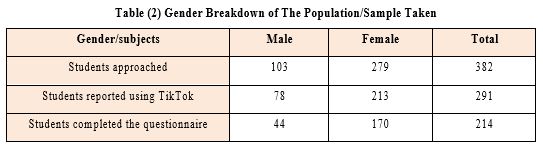
Social media platforms have become increasingly popular in daily life and are now used for purposes beyond entertainment, including language teaching and learning. In particular, TikTok has experienced rapid growth, exceeding one billion users in the past two years. The main aim of this study is to understand Kurdish EFL students’ perceptions of TikTok as a tool for enhancing spoken English fluency. Data were collected through a 33-item questionnaire completed by 214 third- and fourth-year students from the Colleges of Languages, Education, and Basic Education at Salahaddin University. Participants were non-randomly selected based on relevance to the study focus; that is, eligibility to complete the questionnaire was restricted to students who confirmed that they used TikTok. The gathered responses were analyzed using SPSS software (version 27).
Findings indicate that students generally view TikTok as an engaging, flexible, and motivating platform that supports language fluency development. It was particularly effective in improving listening and oral fluency. However, its impact on speaking confidence and writing skills was limited, mainly due to short video formats and limited interaction opportunities. These limitations are significant, as confidence and writing are essential for comprehensive language proficiency and academic achievement. Overall, TikTok appears most beneficial when used as a supplementary resource alongside structured, output-driven learning activities.
References
Abdullah, N., Mohamad, F., Kamal, M., and Isa, I. (2023). The acceptance of TikTok as a tool in English language learning among university students. Arab World English Journal, 14(3), pp.445–461. [Online] Available at: https://awej.org/wp-content/uploads/2023/10/29.pdf [Accessed 25 May, 25].
Afidah, N., Sari, N.K., and Hanifah, H. (2021). Investigating students’ perspectives on the use of TikTok as an instructional media in distance learning during pandemic era. Dinamika: Jurnal Kajian Pendidikan dan Keislaman, 6(2), pp.47–68. [Online] Available at: https://www.researchgate.net/publication/359873925_INVESTIGATING_STUDENTS'_PERSPECTIVES_ON_THE_USE_OF_TIKTOK_AS_AN_INSTRUCTIONAL_MEDIA_IN_DISTANCE_LEARNING_DURING_PANDEMIC_ERA [Accessed 3 March 2025].
Ahmed, I. and Ishtiaq, S. (2021). Reliability and validity: Importance in medical research. The Journal of the Pakistan Medical Association, 71(10), pp.2401–2406. [Online] Available at: https://archive.jpma.org.pk/PdfDownload/10905 [Accessed 2 May 2025].
Aisyiah, V.M.N. and Erizar, E. (2024). Utilizing TikTok application in learning English for EFL university students in Indonesia. English Franca: Academic Journal of English Language and Education, 7(2), pp.383–392. [Online] Available at: https://journal.iaincurup.ac.id/index.php/english/article/view/7868 [Accessed 2 January 2025].
Asyrofi, S. and Wati, N.S. (2024). A comprehensive analysis of integrating TikTok for enhancing EFL students’ speaking skills. Journal of Nusantara Education, 3(2), pp.60–68. [Online] Available at: https://journal.unu-jogja.ac.id/fip/index.php/JONED/article/view/98 [Accessed 25 January 2025].
Atkin, E. (2021). A complete history of TikTok – from launch and banning controversy, to best viral trends. Metro [Online] Available at: https://metro.co.uk/2021/01/01/a-complete-history-of-TikTok-launch-us-ban-and-best-viral-dances-13823263/ [Accessed 27 December 2024].
Ayodele, J. (2012). Validity and reliability issues in educational research. Journal of Educational and Social Research, 2 (2), pp.391-400. [Online] Available at: https://scispace.com/pdf/validity-and-reliability-issues-in-educational-research-ylq04uq2w7.pdf [Accessed 2 April 2025].
Bilge, H. and Kalenderoglu, I. (2022). The relationship between reading fluency, writing fluency, speaking fluency, reading comprehension, and vocabulary. Turkish Education Association, 47(209), pp.25–53. [Online] Available at: https://www.researchgate.net/publication/358536570_The_Relationship_Between_Reading_Fluency_Writing_Fluency_Speaking_Fluency_Reading_Comprehension_and_Vocabulary [Accessed 23 March 2025].
Blake, R. J. (2013). Brave New Digital Classroom: Technology and Foreign Language Learning (2nd ed.). Washington: Georgetown University Press. [Online] Available at: https://books.google.iq/books?id=9woQNDu0XboC&printsec=frontcover&hl=ar&source=gbs_ge_summary_r&cad=0#v=onepage&q&f=false [Accessed 19 December 2024].
Budiartha, C. W. and Akmar, A. S. (2024). Students’ perception towards TikTok in enhancing their vocabulary fluency through autonomous learning. Global Expert Jurnal, 12(1), pp.34-42 [Online] Available at: https://www.researchgate.net/publication/382805567_Students'_Perception_towards_TikTok_in_Enhancing_Their_Vocabulary_Fluency_through_Autonomous_Learning [Accessed 10 December 2024].
Chambers, F. (1997). What do we mean by fluency?. Celebrating the ongoing progress of research and health professionals. ELSEVIER. 25(4), pp.535–544. [Online] Available at: https://www.sci-hub.se/10.1016/S0346-251X(97)00046-8 [Accessed 8 March 2025].
Chang, A. and Millet, S. (2013). The effect of extensive listening on developing L2 listening fluency: some hard evidence. ELT Journal. 68(1). pp.31-40. [Online] Available at: https://academic.oup.com/eltj/article-abstract/68/1/31/493058?redirectedFrom=fulltext [Accessed 28 March 2025].
Chen, H. (2024). Innovative approaches in English language teaching: Integrating communicative methods and technology for enhanced proficiency. Communications in Humanities Research, 32(1), pp.214–220. [Online] Available at: https://www.researchgate.net/publication/380208692_Innovative_Approaches_in_English_Language_Teaching_Integrating_Communicative_Methods_and_Technology_for_Enhanced_Proficiency?_tp=eyJjb250ZXh0Ijp7ImZpcnN0UGFnZSI6ImhvbWUiLCJwYWdlIjoic2VhcmNoIiwicG9zaXRpb24iOiJwYWdlSGVhZGVyIn19 [Accessed 14 December 2024].
Contreras, D. F., Aguilar, J. C., Reasco, B. C., and Contreras, R. M. (2025). Using social media to improve listening skills in the flipped classroom. Polo del Conocimiento, 10(1), pp.821–838. [Online] Available at: https://polodelconocimiento.com/ojs/index.php/es/article/view/8715/pdf [Accessed 2 March 2025].
Dowhower, S. L. (1991). Speaking of prosody: Fluency's unattended bedfellow. Theory Into Practice, 30(3), pp.165-175. [Online] Available at: https://www.academia.edu/28518930/Speaking_of_prosody_Fluencys_unattended_bedfellow [Accessed 24 March 2025].
Duan, C. (2023). Tik Tok: A new way of English learning. Journal of Education, Humanities and Social Sciences, 10 (8), pp.127–133. [Online] Available at: https://www.researchgate.net/publication/368385930_Tik_Tok_A_New_Way_of_English_Learning [Accessed 02 January 2025].
Eslit, E. R. (2023) Perceptions towards the use of TikTok in English language learning. ResearchGate. [Online] Available at: https://www.researchgate.net/publication/369541586_Perceptions_towards_the_use_of_TikTok_in_English_language_learning [Accessed 27 December 2024].
Graciela, S., Jessica, J., and Helena, C. (2023). TikTok as a learning strategy for English language proficiency in higher education. ECORFAN Journal-Republic of Colombia, 9 (1), pp.24–35. [Online] Available at: https://www.academia.edu/123169460/TikTok_as_a_learning_strategy_for_English_language_proficiency_in_higher_education [Accessed 2 May 2025].
Gusmareky, E. and Tambusai, A. (2023). Analysis of using TikTok to develop students’ listening skill at MTs YPI Lubuk Pakam. Jurnal Pendidikan Tambusai, 7(3), pp.29878–29881. [Online] Available at: https://jptam.org/index.php/jptam/article/view/11808 [Accessed 3 March 2025].
Hardy, J. (2024). Unveiling the Genius: Who Invented TikTok and the Story Behind Its Founder | History Cooperative. History Cooperative [online] Available at: https://historycooperative.org/who-invented-TikTok/ [Accessed 27 December 2024].
Hudson, F. (2002) Compositional fluency and spelling accuracy of second-grade students under six priming conditions. PHD Dissertation. University of Florida, Florida. [Online] Available at: https://archive.org/details/compositionalflu00huds/mode/2up [Accessed 24 March 2025].
Hussain, M., Qureshi, Z. M., and Malik, S. (2024). The impact of educational technologies on modern education: navigating opportunities and challenges. global educational studies review, 9 (3), pp.21-30. [Online] Available at: https://www.humapub.com/admin/alljournals/gesr/papers/3OCsGLe9cy.pdf [Accessed 19 December 2024].
Ibrahim, N. H., Shafie, S. A., and Abdul Rahim, I. N. (2023). The use of TikTok in learning English as a second language. Asian Journal of Research in Education and Social Sciences, 5(2), pp.355-365. [Online] Available at: https://www.researchgate.net/publication/372787871_The_Use_of_TikTok_in_Learning_English_as_a_Second_Language [Accessed 27 December 2024].
Iraqi News Agency. (2024). DMC: 32 million social media users in 2024. [online] Available at: https://ina.iq/eng/31552-dmc-32-million-social-media-users-in-2024.html [Accessed 27 December 2024].
Jah, N.J., Tahreb, N.S., Ibrahim, Q., Hamzah, I. F. and Halim, N.A. (2024). TikTok as pedagogical tool for English language learning. Gading Journal for Social Sciences 27, pp.102–111. [Online] Available at: https://gadingssuitm.com/index.php/gadingss/article/view/548 [Accessed 10 January 2025].
Kellem, H. (2009) Principles for developing oral fluency in the classroom. The Language Teacher Journal. 33 (1), pp.9-11. [Online] Available at: https://www.academia.edu/18980290/Principles_for_Developing_Oral_Fluency_in_the_Classroom [Accessed 25 May 2025].
Le, A. T. (2023). TikTok and its influence on the English competence of Vietnamese students. Master’s thesis. University of Alberta. [Online] Available at: https://era.library.ualberta.ca/items/fb37382a-1978-4fe0-84a1-81de566bad96/view/94b12d2c-0bfb-49e5-ac06-d76b32670af1/Le_Anh_Tuan_202307_MA.pdf [Accessed 27 December 2024].
Lennon, P. (1990). Investigating fluency in EFL: A qualitative approach. Journal of Language Learning, 40 (3). pp.387-417. [Online] Available at: https://sci-hub.se/10.1111/j.1467-1770.1990.tb00669.x [Accessed 2 April 2025].
Levelt, W. J. M. (1989). Speaking: From intention to articulation. Cambridge: The MIT Press. [Online] Available at: https://www.mpi.nl/publications/item67053/speaking-intention-articulation [Accessed 2 April 2025].
Lin, C.S., Irawan, R. and Permana, S.A. (2023). Problems faced by the EFL students in implementing TikTok as a speaking learning medium. Proceedings of the 1st UPY International Conference on Education and Social Science (UPINCESS 2022), pp.287–295. [Online] Available at: https://www.atlantis-press.com/proceedings/upincess-22/125978438 [Accessed 02 January 2025].
Maretha, A., Kiki, amp; and Anggoro, J. (2022). App review TikTok: benefits, drawbacks, and implications for the ELT field 1. MEXTESOL Journal, 46(2), pp.1-5. [Online] Available at: https://files.eric.ed.gov/fulltext/EJ1357791.pdf [Accessed 10 January 2025].
Mohd Zuraini, H. H., Kaur, N., and Kamaruddin, S. F. (2024). Integration of TikTok in language learning: Perceptions of ESL learners. Journal of Creative Practices in Language Learning and Teaching, 12(1), pp.183-205. [Online] Available at: https://cplt.uitm.edu.my/v1/images/v12n1/12_Integration_of_TikTok_in_ESL_14_March_2024_Naginder_Kaur.pdf [Accessed 2 January 2025].
Nation, P. and Arevart, S. (1991). Fluency improvement in a second language. RELC Journal, 22(1), pp.84-94. [Online] Available at: https://journals.sagepub.com/doi/10.1177/003368829102200106 [Accessed 8 March 2025].
Ngoc, D.T.B., and Dung, T.T. (2020). Key factors influencing learners’ oral fluency in English speaking classes: A case at a public university in Vietnam. VNU Journal of Foreign Studies, 36(6), pp.93-108. [Online] Available at: https://www.researchgate.net/publication/349513819_KEY_FACTORS_INFLUENCING_LEARNERS%27_ORAL_FLUENCY_IN_ENGLISH_SPEAKING_CLASSES_A_CASE_AT_A_PUBLIC_UNIVERSITY_IN_VIET_NAM [Accessed 8 March 2025].
Onn, N.A.Y., Zolkapli, R.B.M., Kenali, S.F.M., Abd Rahman, A.L., Abdul Hadi, N.F., and Mohamad, H.A. (2024). Exploring the potential of TikTok as a supplementary tool for English language learning among students. Muallim Journal of Social Sciences and Humanities, 8(2), pp.103–114. [Online] Available at: https://www.researchgate.net/publication/379822314_EXPLORING_THE_POTENTIAL_OF_TIKTOK_AS_A_SUPPLEMENTARY_TOOL_FOR_ENGLISH_LANGUAGE_LEARNING_AMONG_STUDENTS [Accessed 27 December 2024].
Patanasorn, C. (2010). Effects of Procedural Content and Task Repetition on Accuracy and Fluency in an EFL Contexts. PhD dissertation, Northern Arizona University. [Online] Available at: https://www.proquest.com/docview/759842793?fromopenview=true&fromunauthdoc=true&pqorigsite=gscholar&sourcetype=Dissertations%20&%20Theses [Accessed 3 March 2025].
Peltonen, P. (2023). Fluency revisited. ELT Journal, 78(4). pp.489-492. [Online] Available at: https://academic.oup.com/eltj/article/78/4/489/7451779 [Accessed 5 April 2025].
Putri, M. R., Pedo, V. A., and Pawestri, N. (2020). Analyzing the factors influencing students’ fluency in English speaking skills: A case in Bina Nusantara University. Proceedings of the Proceedings of the 1st International Conference on Language and Language Teaching, ICLLT 2019, 12 October, Magelang, Central Java, Indonesia. [Online] Available at: https://www.researchgate.net/publication/339504207_Analyzing_the_Factors_Influencing_Students%27_Fluency_in_English_Speaking_Skills_A_Case_in_Bina_Nusantara_University [Accessed 14 March 2025].
Rahayu, D. (2022) Factors affecting students’ speaking fluency. Proceeding International Conference On Learning Ang Education, 1. pp.101-108. [Online] Available at: https://repository.stkippacitan.ac.id/id/eprint/1178/3/artikel%20-ICLE-2022-STKIP-PGRI-PACITAN.pdf [Accessed 2 May 2025].
Rejeb, A., Rejeb, K., Appolloni, A., Treiblmaier, H., and Iranmanesh, M. (2024). Mapping the scholarly landscape of TikTok (Douyin): a bibliometric exploration of research topics and trends. ELSEVIER Journal, 4(1), pp.1-23. [Online] Available at: https://www.researchgate.net/publication/378418026_Mapping_the_scholarly_landscape_of_TikTok_Douyin_A_bibliometric_exploration_of_research_topics_and_trends [Accessed 25 May, 25].
Richards, J. C., Schmidt, R., Platt, H., and Schmidt, M. (2002). Longman Dictionary of Language Teaching and Applied Linguistics. Third edition. London: Pearson Education. [Online] Available at: https://www.zlibrary.to/dl/dictionary-of-language-teaching-and-applied-linguistics-third-edition [Accessed 9 December 2024].
Richardson, K.E. (2024). The Evolution of Technology in the Classroom. Purdue University College of Education. [Online] Available at: https://education.purdue.edu/2024/01/the-evolution-of-technology-in-the-classroom/ . [Accessed 19 Dec, 2024].
Romsi, A., Widodo, J., Basri, H., Sabat, Y., and Sipulyono, S. (2023). Unleashing English fluency: Harnessing TikTok’s power for speaking skills. Magister Scientiae, 51(2), pp.152–163. [Online] Available at: https://www.researchgate.net/publication/376277201_UNLEASHING_ENGLISH_FLUENCY_HARNESSING_TIKTOK'S_POWER_FOR_SPEAKING_SKILLS [Accessed 2 May 2025].
Sarkila, D., Islam, M.H., and Fatmawati, R. (2024). Students’ perception on the use of TikTok for learning speaking English. Fonologi. Jurnal Ilmuan Bahasa dan Sastra Inggris, 2(2), pp.1-14. [Online] Available at: https://journal.aspirasi.or.id/index.php/Fonologi/article/view/577 [Accessed 25 January 2025].
Schellewald, A. (2023). Understanding the popularity and affordances of tiktok through user experiences. Media, Culture & Society, 45(8), pp.1568–1582. [Online] Available at: https://journals.sagepub.com/doi/pdf/10.1177/01634437221144562 [Accessed 25 May, 25].
Segalowitz, N. (2010). Cognitive Bases of Second Language Fluency. New York: Routledge. [Online] Available at: https://www.zlibrary.to/dl/cognitive-bases-of-second-language-fluency [Accessed 21 March 2025].
Shafaq News (2024). TikTok in Iraq: A battle between entertainment, ethics, and enforcement. Shafaq News (29 March 2024) Available at: https://shafaq.com/en/Report/TikTok-in-Iraq-A-battle-between-entertainment-ethics-and-enforcement#:~:text=The%20TikTok%20app%20boasts%20approximately%2031.9%20million%20users,88%25%20of%20the%20country%27s%2036.2%20million%20internet%20users. [Accessed 27 December 2024].
Susanto, A.K. and Suparmi, S. (2024). Exploring EFL students’ perspectives: The role of TikTok in enhancing English language skills. Journal of English for Academic and Specific Purposes (JEASP), 7(1). pp.55-64. [Online] Available at: https://www.researchgate.net/publication/381624366_Exploring_EFL_Students'_Perspectives_The_Role_of_TikTok_in_Enhancing_English_Language_Skills [Accessed 24 December 2024].
Taber, K.S. (2017). The use of Cronbach’s Alpha when developing and reporting research instruments in science education. Research in Science Education, 48(6), pp.1273–1296. [Online] Available at: https://www.researchgate.net/publication/317777374_The_Use_of_Cronbach%27s_Alpha_When_Developing_and_Reporting_Research_Instruments_in_Science_Education [Accessed 2 May 2025].
Vy, L. T., Huong, T. L., Quy, T. N., Cong, V. Q., and Anh, N. T. (2024). Determined factors and effective strategies for developing English speaking fluency among Vietnamese university students. PASAA, 68(1), pp.32–63. [Online] Available at: https://files.eric.ed.gov/fulltext/EJ1435994.pdf [Accessed 20 March 2025].
Zamharir, Dahlan, and Gani, I. (2024). Juridical analysis of immoral content on TikTok social media. International Journal of Law, 10(4), pp.11-15. [Online] Available at: https://www.lawjournals.org/assets/archives/2024/vol10issue4/10158.pdf [Accessed 25 May, 25].
Zou, B., Huang, L., Ma, W., and Qiu, Y. (2021). Evaluation of the effectiveness of EFL online teaching during the COVID-19 pandemic. SAGE Open, 11(4), pp.1-17. [Online] Available at: https://www.researchgate.net/publication/355775165_Evaluation_of_the_effectiveness_of_EFL_online_teaching_during_the_COVID-19_pandemic [Accessed 14 December 2024].
Downloads
Published
How to Cite
Issue
Section
License
Copyright (c) 2026 Rozhgar Abdulqadir

This work is licensed under a Creative Commons Attribution 4.0 International License.