
Author Guidelines
Author Guidelines
1. Receipt rules
Research submitted to the Journal of Islamic Sciences must be discreet, and accordingly academic scientific research previously published in another place or submitted for publication will not accepted, and any violation of these rules leads to immediate rejection without any pre-review.
2. Evaluation procedures:
Any research submitted to this journal is subject to confidential evaluation by trusted local and international scientific specialists, whom appointed according to specific mechanisms through a meeting of the journal’s editorial board, whose session’s ordinarily held once every two weeks, where the initial evaluation of the submitted research takes place, and if the scientific conditions are met. For writing, then will decide to identify the competent scientific evaluators, and two evaluators are determined for each research. Based on the evaluators’ opinion, the researcher may informed of the result of the evaluation, and forty days are set as a time limit for this purpose. In the event of disagreement between the confidential evaluators, a third evaluator will be chosen to weigh the decision taken regarding whether to accept the publication of the submitted research, or not.
3. Researcher’s rights:
Minare Journal for Religious Studies MJRS reserves copyright, and requires the researcher to respect the journal’s right to publish the research electronically and in paper. If he wishes to publish his research elsewhere, he must obtain prior permission from the journal.
4. Free access to the journal (Open Access Journal):
Minare Journal for Religious Studies MJRS publishes specialized research and articles in Islamic sciences on various topics, and it covers a wide range of sciences and various branches of jurisprudence, doctrine, and education. Any article research published in the journal has a digital object identifier (DOI) and is free to access (Open Access Journal) through the website dedicated to zanco journals within: zancojournals.su.edu.krd
It is issued in print and electronic form, and has electronic and print international numbering (eISSN) and (pISSN), as well as its own Google Scholar. It tries to have at least 5% of the research published in it international and to receive citations from it (Citation) with the same percentage. It also has Meta data and allocates part of the journal’s website to (Indexing) and (Metrics).
Accordingly, researchers have ownership of the intellectual property rights to their content, but anyone is allowed to download, reuse, or copy the content as long as the names of the researchers and the source is mentioned correctly in accordance with approved standards for citation and benefiting from previous scientific works and productions.
5. Researcher’s responsibility and Ethics:
Minare Journal for Religious Studies MJRS emphasizes the researcher’s commitment to scientific honesty and the implementation of the laws and ethics followed in the field of scientific publishing. It takes cases of plagiarism, forgery, and other illegal matters seriously, and holds the researcher full legal responsibility in a signed document and never allows such violations.
6. Consider the following points when writing the research:
- Research title
- The name of the researcher
- The researcher’s place of work
- Email address
- Abstract
- Keywords
- Introduction
- Methodology
- Review of previous works (previous studies)
- Research results
- Recommendations Suggestions
- List of sources and references
- List of sources and references translated to English if the research not in english
7. Page settings
In English language:
The size of the papers is A4, and the Margins are as follows:
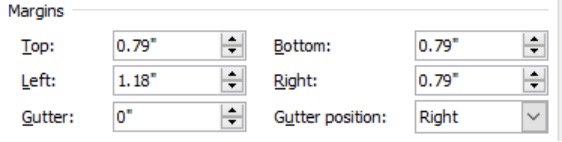
In the Kurdish and Arabic languages:
The size of the papers is A4, and the Margins are as follows:
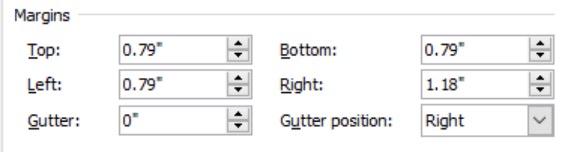
The entire article research information must be in one file format (i.e. Microsoft Word) and may not be in separate parts.
8. Type of writing fonts:
Research title: It must be written in three languages (Kurdish, Arabic, and English), and placed with the abstract page.
Abstract of the research: It must be written in three languages (Kurdish, Arabic, and English).
Keywords: They must be four words, and must be written in three languages (Kurdish, Arabic, and English), and in the same font types and sizes as the abstract, as follows:
In English language: font type (Times New Roman), size 12, bold for the title, and the same font size (12) for writing the content in the body and foot notes.
In Kurdish language: Writing on the Unicode keyboard and the font type (Bahij Myriad) should be 14 bold for the title, and the same font size should be 14 for writing content in the body and 12 for footnotes.
In Arabic language: writing on the Unicode keyboard and the font type (Bahij Myriad Arabic) should be 14 boldfor the title, and the same font should be sized (14) for writing content in the body and (12) for footnotes.
Leave a space (Tab) at the beginning of each paragraph.
In citation sources and references and writing footnotes: the researcher relies on footnote style, similar to the Chicago Notes and bibliography style, and in an independent sequence for each page separately, according to the Author guideline.
In transmitting texts quoted from the Holy Qur’an, the researcher must rely on writing the verses in the form of the Qur’an, correcting the form and indicating the verse number and the name of the surah.
The researcher must rely on the approved principles and references in extracting the noble Prophetic hadiths, (Pease be upon him) and their method of ratification explained in an Author guideline set by the Journal.
The research must be in proper language, free of linguistic and typographical errors, and the responsibility for this falls on the researcher.
Text paragraphs with single line spacing.
9. Pictures and tables:
All drawings, figures and tables will be placed within the text related to them instead of being collected at the end of the file.
All tables and images used in the research may not be more than (11) cm wide.
All images must be of JPG type and may not be in parts, and permitted scanned images must be clear and of good quality.
The font size within tables may not be larger than (12) nor smaller than (10).
Poetic verses in the research must be placed in a table, and each line should be placed in a cell.
The researcher should avoid using (Text Box) and (Word Art) when writing the research.
10. Evaluation and publication costs: The researcher bears the costs and expenses of evaluating the research, linguistic correction, by specialized experts, and publishing it in accordance with the approved administrative and financial directives based on the applicable laws, regulations, and instructions.