
Implicature and Speech Act Analysis in Erbil City Courtroom Discourse
##semicolon##
https://doi.org/10.21271/zjhs.29.SpB.51##semicolon##
Implicature, Speech Act, Legal Discourse.پوختە
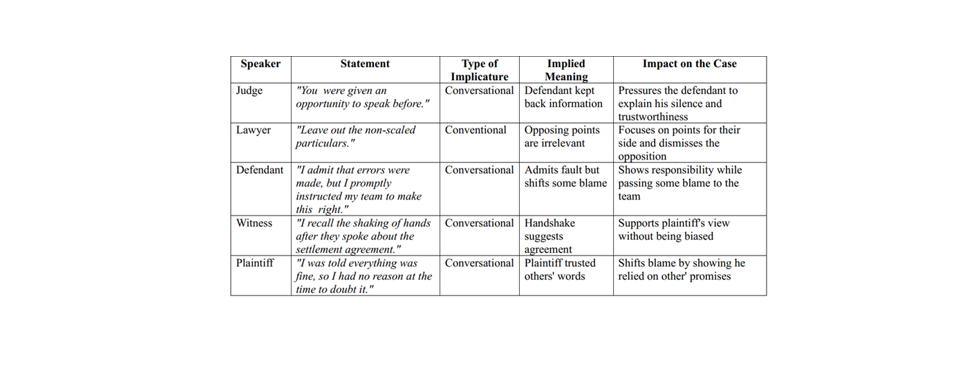
This study investigates the use of implicature and speech acts in Erbil City courtroom. Implicature is the implied meaning in addition to literal meaning of expressions, while speech acts are communicative actions such as asserting, commanding, or promising. This study aims at investigating how both the judicial and non-judicial participants in the courtroom are able to manipulate these pragmatic tools, thereby influencing legal communication. The study employs a mixed method design. Based on verbal casual observation of real litigation in courtrooms involving judges, lawyers, plaintiffs, defendants and witnesses. The paper builds upon Grice (1975)'s implicature theory and Searle 's typology of speech acts. Data were obtained from eight court observations in Erbil. The significance lies in enhancing forensic linguistics by revealing how pragmatic awareness can improve fairness, clarity, and effectiveness in legal settings. The study concludes that there is a significant dominance of conversational implicature over conventional implicature and expressive speech acts were the most prevalent. Defendants and witnesses rely heavily on implicatures to hedge their bets or to prevaricate, and apportion responsibility by the back door; and that the judges and lawyers make extensive use of directive and assertive speech acts to take charge and assert authority.
سەرچاوەکان
- Bhatia, V.K., (1993). Analyzing Genre: Language Use in Professional Settings. London: Longman.
- Coulthard, M. & Johnson, A., (2007). An Introduction to Forensic Linguistics: Language in Evidence. London: Routledge.
- Fromkin, V., Rodman, R., & Hyams, N. (2003). An introduction to language. (7th ed.). Thomson Learning.
- Gibbons, J., (2003). Forensic Linguistics: An Introduction to Language in the Justice System. Oxford: Blackwell.
- Grice, H.P., (1975). Logic and Conversation. In: Cole, P. & Morgan, J.L. (eds.), Syntax and Semantics. Vol. 3. New York: Academic Press, pp. 41-58.
- Levinson, S.C., (1983). Pragmatics. Cambridge: Cambridge University Press.
- Searle, J.R., (1969). Speech Acts: An Essay in the Philosophy of Language. Cambridge: Cambridge University Press.
- Shuy, R., (2010). The Language of Defamation Cases. Oxford: Oxford University Press.
- Trosborg, A., (1995). Interlanguage Pragmatics: Requests, Complaints, and Apologies. Berlin: Mouton de Gruyter.
- Yule, G., (1996). Pragmatics. Oxford: Oxford University Press.
- Yule, G. (2006). The study of language (4th ed.). Cambridge University Press.
##submission.downloads##
بڵاو کرایەوە
چۆنییەتی بەکارهێنانی سەرچاوە
ژمارە
بەش
##submission.license##
##submission.copyrightStatement##
##submission.license.cc.by4.footer##